
- RSS FeedSubscribe
- « Previous PostA La Carte (1/5)
- Next Post »A La Carte (12/6)
A Word about Free Will
- 01/05/09
- 83
Today I want to step into dangerous territory and discuss free will. This is a massive topic with implications that stretch to almost every part of the Christian faith. I want to look at just one small part of it. I want to deal with a statement I’ve heard and read time and again. I came across this most recently when reading C.S. Lewis’ Mere Christianity. “Free will,” he says, “though it makes evil possible, is also the only thing that makes possible any love or goodness or joy worth having.” If God had not given us free will, such people say, we could not truly have loved him. Our love would be the love of robots, of automatons, love that would be neither genuine nor sincere. It would be a meaningless, forced love which in reality would be no love at all. This is what we are told. I want to suggest today that the Bible does not tell us one way or another. This may be a valid inference, but it is one that is not explicit in Scripture and, hence, one we should be hesitant to declare with great confidence.
I am writing today knowing that I could be wrong and inviting you to show me if that is, indeed, the case.
My line of reasoning will go like this. If this statement is true, it casts doubt on the manner and sincerity of the Christian’s love of God in heaven. Therefore, if this statement is untrue of the heavenly man, it may also be untrue of the earthly man.
It was Augustine of Hippo who first described the four states of man. They are most easily understood when put into the form of a table like this one:
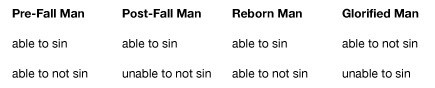
Adam and Eve were in what Thomas Boston calls a state of “primitive integrity,” able to choose whether they would sin or not sin. They were able to sin but were also able to not sin. The choice lay before them and we know which path they chose. Adam’s decision cast man into a state of “entire depravity” in which people can no longer make such a choice. Man is now able to sin and unable to not sin. There is not a person on earth who can go a lifetime without sinning; neither is there one who would wish to. Our very natures have become sinful. However, those who are born again, who are regenerated by the Spirit of God, are in a state of “begun recovery” (again, according to Boston) and every moment of every day face a choice. They are able to sin but are also able not to sin. Experience and observation shows that Christians sometimes make one choice and sometimes make another. Their new natures give them the ability to choose to not sin, but the old man constantly fights back, pushing to choose what is sinful. But all the while Christians look forward to the day of “consummate happiness” in heaven when they will be able to not sin and unable to sin. God will grant them the ability to not sin and will remove any vestige of desire to sin. This is one of the great promises of heaven, that “He will wipe away every tear from their eyes, and death shall be no more, neither shall there be mourning, nor crying, nor pain anymore, for the former things have passed away (Revelation 21:4).”
It is this final part of the grid that causes me to wonder if our love truly had to be entirely free for it to be genuine. After all, as Christians we look with great anticipation to the day when our sin will be taken away and we will no longer even be able to sin. At this time will our love for God be more genuine or less genuine? Will we love God more or less than we love him now? When we read Scripture and, with great anticipation look to the passages that describe heaven, we can only conclude that our love for God today is only a shadow of the love we will have for him in that day. And yet it will be a love that is restricted by our sinless natures—a love that will not allow us to ever sin or even consider sin.
As I understand it, Augustine would agree with me here. He would say that the ability to sin is not essential to free will. After all, God is free but without the ability to sin. The angels are free but without any ability to sin. And, as we’ve established, we will be free in heaven, but not free to sin.
All of this to say that I simply do not find that we need to believe that the only love worth having is a love that can choose not to love.
But feel free to tell me if and how I’m wrong here…


I am a follower of Jesus Christ, a husband to Aileen and a father to three young children. I worship and serve as a pastor at 

Releasing on April 1, The Next
Comments (83)
Hey Tim,
While I agree with your conclusion that genuine love does not necessitate the ability to do otherwise, I’d probably take a bit of a different tack in answering the objection.
The perfection of love is in God and the perfect love-relationship is intra-trinitarian. The Father loves the Son and the Son loves the Father and they both love the Spirit who exists as the perfection of love and unity between them. God cannot do otherwise than to love himself… does that make his love less than genuine? Clearly not.
The question that I think may be tougher to answer (although I think your line of reasoning probably tackles this one better) is whether the ability to do otherwise is part of what it means to be human. But again, I think you answered that indirectly by pointing out that we will not have the ability to sin in glory.
Very insightful Tim! I’ve never seen Augustine’s diagram of Man before. I might add a couple of notes for mutual benefit…
1. We could perhaps turn around this objection that only freely-choosing humans can have a “real” relationship of love with God and argue the opposite, that we cannot have such a relationship unless God has overcome our rebellious wills and given us a new heart that loves him.
2. John Frame, in his excellent book “The Doctrine of God”, reflects on this issue. He says,
[quote]What if it turns out that we are robots, after all-clay fashioned into marvelous robots, rather than being left as mere clay? Should we complain to God about that? Or should we rather feel honored that our bodies and minds are fashioned so completely to fulfill our assigned roles in God’s great drama? Some creatures are born as rabbits, some as cockroaches, and some as bacteria. By comparison, would it not be a privilege to be born as an intelligent robot? Indeed, what remarkable robots we would be-capable of love and intimacy with God, and assigned to rule over all the creatures. Is it not a wonderful blessing of grace that, when we sinned in Adam, God did not simply discard us, as a potter might very well do with his clay, and as a robot operator might well do with his malfunctioning machine, but sent his only Son to die for us? Risen with him to new life, believers enjoy unimaginably wonderful fellowship with him forever. As we meditate upon these dignities and blessings, the image of the robot becomes less and less appropriate, not because God’s control over us appears less complete, but because one doesn’t treat robots with such love and honor.[/quote]
Frame, John M. (2002). The Doctrine of God: A Theology of Lordship. Phillipsburg, NJ: P & R Publishing. Pp 146 - 147.
Is there scriptural support for the notion that in heaven we’ll be unable to sin? I can’t think of any. Perhaps it will be that we’ll be able to not sin and unwilling to sin — we will, afterall, be in the presence of our redeemer and will have seen first hand the final consequence of sin.
I’m not sure we’re really “able to not sin” now.
Angels can’t sin? How, then, do we explain the rebellion of Satan and his angels?
“But Heaven”, the free-willer responds, “consists of a state in which we freely surrender all sin, even our moral capacity to sin, so as to be in the most intimate love possible with God.”
Not that I necessarily believe that. It is only a thought I have thought before.
Not that I am capable in any way of arguing with Augustine…but is there a logic flaw? Or does the simplification of his “four states of man” into a table give the appearance of a logic flaw?
Is an Atheist “able to not sin”? (For example: They are tempted to tell a lie, or steal something, but then “decide” not to. Thereby, not committing a sin.)
Then by the table definition, are they “reborn”?
I was taught a while ago that there is often more value in the question than in the answer. The conversations between free-will or no free-will often seem moot. As Christians, we are provided a variety of revelations about ourselves:
1) He is the potter and we are the clay2) Herein is love, not that we loved God, but that he loved us…3) The natural man receiveth not the things of the spirit of God: for they are foolishness unto him: neither can he know them for they are spiritually discerned
In these verses, I see know real mention of our free-will coming into play. But that doesn’t necessarily mean it isn’t there. We are clearly told that we are the ones who sin against God and that he does not tempt us to sin or cause us to sin.
So, is it really our free-will that chooses to love God? Or is God, out of his love for us, able to override our nature and give us the ability to finally love him?
If our nature is truly depraved as a result of the fall, then we are incapable of choosing him. We’re incapable of doing a good thing. We’re incapable of understanding him. We’re incapable of following him. We’re incapable of loving him.
So our will may indeed be free, but only to act according to our nature. It’s not free to overcome our nature, which is depraved. It requires regeneration from above to supplant our nature with a new one that can now freely love God. But guess what? Even with our new nature, we’re still capable of sin, thanklessness, lack of prayer and so forth.
Finally, Phil 2:12-13 reminds us to workout our salvation with fear and trembling for it is God who works in us both to will and to do of his good pleasure.
That’s a fairly sobering thought. But I think these things should make us all the more thankful that he takes the time with us.
I agree with ChrisB. I have often wondered where the understanding that in heaven we will be UNABLE to sin came from. I certainly agree that there will be no more pain, no more suffering, no more death, and since the wages of sin is death, there will be no more sin.
But where does it say that we will not be ABLE to sin?
The same questions comes up for me when we think about Jesus. As a man was he unable to sin? When the devil tempted him, was he not able to bow before him and rebel against the Father?
I often wonder if it is not that he was unable, but unwilling. His will was perfect and so he only wanted to do things that pleased the Father, thus willing/choosing not to sin.
I suppose the question is, how far down does rebellion go?
Like that table from Augustine. And I also don’t buy Lewis’ argument about the robots for similar reasons as JP quoted Frame on. I think people who don’t want to be robots shouldn’t want to be Christians since we’re aspiring to be transformed into Christ who is actively transforming us to his will, which is being able to love perfectly.
I’m just a little interested in your line on Sin. You seem to connect sin to being something that is primarily about choice whether this was Pre-Fall or Reborn man.
From what I understand evil and sin is rooted in disbelief of God. It flows out of our heart. So in the circumstance of Adam and Eve their sin was disbelieving God and thinking that they had the supremacy to choose between good and evil. Thus humanity has been doomed to sin ever since because we are of the belief we can discern good from evil according to our own perceptions. Essentially we can’t do it alone, God must reveal himself to us so that we can see good as good and evil as evil. God Himself in the person of Jesus is the root of the truth that cuts good from evil. Thus without seeing Christ for who he is we are doomed to the confusion between good and evil, essentially the pursuit of “good” away from God.
Now if sin is so much about choice then why does the Serpent, Adam and Eve get punished. It should only be the “choosers” where as it’s all of them for disbelief. Often you’ll hear of “free-will” proponents making the argument that choice is part of our Imago Dei, our high level of creation. Yet how come the Serpent gets punished? I just don’t believe free-will (the ability to make decisions separate from God) is a part of our Imago Dei for that.
I think God authors things to happen for His good and that of those who love Him, even though we ourselves may actively will for evil in that same circumstance, yet this is not outside of God’s will.
“Is there scriptural support for the notion that in heaven we’ll be unable to sin?”My understanding and interpretation is in Revelation 21:4 it says”for the former things have passed away.” and in 21:1 we have a new Heaven and a new Earth. In 21:27 referring to the new Jerusalem it says “But nothing unclean will ever enter it, nor anyone who does what is detestable or false, but only those who are written in the Lamb’s book of life.”So looking at these verses in the context of the book of Revelation. I think when we are called up (1 Thessalonians 4:17-18) our bodies will be changed (1 Corinthians 15:51-53) into something new, where the sin nature is completely gone. I believe these scriptures support being unable to sin in Heaven.
I am seeking some clarification on the matrix. Did you put this together yourself or did you borrow it from somewhere? It seem to me the first category speaks to man’s propensity to sin whereas the second category speaks to man’s ability to resist sin. If that is so, should not the categories in the last case (i.e. glorified man) be reversed? It seems “able to not sin” speaks of one’s resistance to sin and “unable to sin” speaks to the propensity to sin. In my mind that fits the pattern better but perhaps I’m missing something.
On a related note: If I’m remembering correctly from a course I took 3 or 4 years ago, Anselm considers freedom as distinct from the ability to sin; freedom is the ability to maintain righteousness/a righteous will because doing so is right and good (not for other motives).
After consulting the Stanford Encyclopedia of Philosophy (http://plato.stanford.edu/entries/anselm/#FreSinRed), seems like I’m pretty close.
Not that Anselm is Truth. But, he presents a point of view that doesn’t think the ability to sin is a fundamental aspect of freedom. Which connects to the idea you point out, Tim, that God is most certainly free, and He cannot sin (which would mean contradicting His nature).
Hey Tim,Well said. If interested browse to my essay Augustine and Freedom: Some Tentative Philosophical Reflections where I have written similarly on your entry here.
Ryan said,
Is an Atheist “able to not sin”? (For example: They are tempted to tell a lie, or steal something, but then “decide” not to. Thereby, not committing a sin.)Then by the table definition, are they “reborn”?
But Scripture tells us that “whatever does not proceed from faith is sin.” (Romans 14:23)
Therefore the atheist with his lack of faith in God, sins in every way. Having no faith in Christ, he does nothing from faith, therefore everything he does is sin, even if it appears to be a good thing. He is unable to not sin. Until his heart is regenerate, at which time he is given faith and the ability to walk by faith, which is not to sin.
Scott Warren, you say “our bodies will be changed (1 Corinthians 15:51-53) into something new, where the sin nature is completely gone.” I see that our bodies will be changed, but where does it say that the sin nature will be completely gone?
I understand that the Bible states that there will be no sin in heaven, and that we will be perfect. But does perfection mean not having the ability to sin, or does perfection mean not having the DESIRE to sin?
This may be somewhat pedantic, but I do think that it speaks to our present day. If we are simply living our Christian lives, hoping for the day when we will no longer be able to sin, then we are not living the lives God is calling us to live today. We are not to wait for sometime in the future when we can no longer sin, we are to put to death our sinful nature and raise to life the new nature given to us in Christ.
Now.
Today.
I agree with your logic and I think it is scripturally sound and an important point to be made. however I think we often get pulled off coarse by the arminians when we allow them to make our free love for God into the main issue. though it is an important issue and one worth discussing in detail its not the MAIN issue. if we make it the main issue we end up painting God as this love sick puppy that desperately needs our freely chosen love, the idea is repulsive. the main issue is God’s glory, and He certainly can display His greatest glory through robots and automatons if He so chooses. Its just not as nice to the pride of the pots.
Ryan,What motivation would the atheist have for telling the truth? By definition he has no fear of God or desire to honor Him. Therefore the atheist tells the truth only for selfish motivations. Why would he not tell a lie if that better suited his purposes? Doing the “right” thing for sinful reasons is still sin. The atheist is unable to do otherwise.
Ryan:
To your comment. “Is an Atheist “able to not sin”? (For example: They are tempted to tell a lie, or steal something, but then “decide” not to. Thereby, not committing a sin.)”
Unbelief is a sin in itself so an atheist can do nothing but sin constantly. Atheists never even try to obey the first or second commandments.
We must remember that all sin is the same so just because an unbeliever is not murdering or stealing or lieing doesn’t mean that he is not in constant sin. In fact he is. No glory is ever given to God and the truth is supressed every second of every day. Unbelief in Christ as Savior is ultimately the sin that will damn someone to Hell forever. Without the Grace of God being poured into the heart of an unbeliever they will never even think about loving God with all their heart mind and soul. An unbeliever is dead in trespasses and sins making submission to Christ and obeying HIm impossible. God must intervene with spiritual resurrection (regeneration) or there is absolutely no hope.I feel that Augustine hit the nail on the head with his chart
Hey Tim,Loved the historical recap of your work, etc. (and Thabiti’s brick through the window comment!).
You’ve mentioned Thomas Boston today — have you plugged his work THE FOURFOLD STATE yet? it is one of my favorite books; a real spiritual gem.
Thank you for your thoughts, Tim and your comment, Pastor Chad. At the end of the day, this life is about bringing glory to God as is the eternal life. Dying to our sin now and perfectly no longer desiring sin later is quite logical and Biblical. I’ll let God explain to me later exactly the relationship between our will and his sovereignty. But for now the knowledge that he is sovereign suffices plenty.
Brance and Richard,
Thanks for the feedback on my question.
While I believe that nobody (both Christians and Atheists) can do good without the grace of God (Romans 3:12, Ecclesiastes 7:20), I could see somebody looking at that table and saying “but I don’t do all the evil I think of, so I am able to not sin”.
This same type of logic was used by Daniel Goleman in his book Social Intelligence to argue that people were basically good. I scribbled “monkey math” in the margin of that book.
Thanks for the Romans 14:23 scripture reference.
Pastor Chad, scripture does not state in exact words and I do not know that we will not be able to sin. It does state that the wolf and lamb will feed together and the lion will eat straw. (Isaiah 65:25) and in Isaiah 11:8-9 the child will reach into the snakes den and no one will hurt or destroy for all shall have full knowledge of the LORD. (my paraphrase) Is the lamb safe from the wolf because it no longer desires to eat it. or is it because God removed it’s natural desire. I don’t know. I do not desire to sin, yet i still get angry, I still feel envy. Jesus told us in the beatitudes to think of sin is to sin in God’s eyes.no man can is righteous and if they claim to be they are lying to themselves. If we still have an unchanged sin nature man will sin in thought, if not in deed. Adam and Eve were in a perfect paradise without the knowledge of good and evil, yet they sinned.Am I hoping for a day when I can no longer sin. No, I try to live as Christ would want me to everyday. As I lay down at night, I reflect on my day and realize I fall miserably short. I confess to God and try harder, yet man will inevitably fail.
While there may be no explicit scriptural reference to the inability to sin in the New Heavens & New Earth, surely the Apostle Peter hints at such: “Nevertheless we, according to his promise, look for new heavens and a new earth, wherein dwelleth righteousness” (2Pet. 3:13, emphasis added).
Given the contextual matters of both judgment on “ungodly men” (2Pet. 3:7) through the elements “melt[ing] with fervent heat…the works that are therein shall be burned up” (2Pet. 3:10) as well as specific exhortation to believers to consider what “manner of persons ought ye to be in all holy conversation and godliness” (2Pet. 3:11), it does not seem likely that our land of “many mansions” would specifically harbor even the possibility of unrighteousness dwelling there.
Add to the above John’s description of God’s coming city which needs no natural light since God’s Lamb illumines it (Rev. 21:23), nor temple since the Lord and His Lamb are its temple (Rev. 21:22). No wonder he then concludes:”And there shall in no wise enter into it any thing that defileth, neither whatsoever worketh abomination, or maketh a lie: but they which are written in the Lamb’s book of life” (Rev. 21:27, emphasis added).
Such texts—as well as others mentioned here (or could easily be marshaled)—leave little doubt, at least for me, Old Augustine was not incorrect to conclude the inability of Heaven’s dwellers to contemplate, as did Lucifer, a hopeless coup d’tat.
As for Augustine’s little chart Tim posted, our good friend R.C. Sproul makes much use of this in his writings.
With that, I am…Peter
@Pastor Chad, who said, “we are to put to death our sinful nature and raise to life the new nature given to us in Christ.”
Perhaps I’m misunderstanding your point. Are you saying that our new nature lies dormant and it is our responsibility to raise it to life?
As to Augustine; I think I disagree with his “Reborn Man” thesis that he is “Able to NOT sin”. I always think of Peter’s denial of the Lord. It’s an interesting Paradox. The Lord foretold that Peter would deny him. So, even with this knowledge, was Peter “Free” to choose differently?
The Lord hid the Tree of Life from Adam and Eve so that they would not eat of it and live in an everlasting state of “Able to Sin”. Once glorified, I believe we will eat of the tree, drink from the everlasting fountain and live in an everlasting state of “Not Able to Sin.”
A thought I had is that perhaps there is a connection between what Paul considers “flesh” and the fact that in heaven we will have new bodies? I dont have time to flesh it out, but I’m sure you might be able to run with that.
A couple of points in defense of free will: firstly we’re in heaven both as a result of our choice and God’s choice - the response of faith (which is the gift of God), so we gain the consequences of that choice just as we would in hell. Secondly, if Christ is the bridegroom and the church is the bride, perhaps we will be united with him and so in some deeper way share in the heavenly nature which will mean we will be like Christ - able to sin but utterly unwilling to do so, unlike our present state.
Nice post Mr. Challies.This (needing freewill to love) is one of those ideas that I have heard myself and without thinking about it re-spewed it onto other people.
Tim,The angels can’t sin? What about Satan, he certainly has sinned.
I have to disagree, although my argument may seem a little disjointed. Love has to be by choice and without free will there is no choice. Also, it is our nature is to hate captivity. Compulsory love is not love at all, sorry but I’ll have to use a parable to explain; does the child who can do no wrong (in his parent’s eyes) grow to love his parents more or less than the child who is punished when he does wrong? In the end, the spoiled child despises his parents because he can never show his love for them. If we were unable to sin then we would see ourselves as equal to God it is only through our weakness that we see God’s strength.
The Heaven of continuous worship described in Revelation does sound like compulsory worship but there has to be more to this than we can understand as humans. No matter how much I enjoy worship, I certainly don’t feel like worshipping all the time but perhaps Heavenly worship is so much better that I will want to worship continually in Heaven.
As for debating Augustine, I wish to take nothing away from the man but he is a man, not God, and I don’t agree with everything he said.
In any event this debate is of secondary importance to the Gospel.
We are sinners and will go to hell because we can not pay the debt for our sin; Jesus died on the cross to pay the debt for us; He rose on the third day; all those who believe will be forgiven and go to Heaven.
God bless,-jimhttp://ke4juh.wordpress.com/
To add something to this, I heard Piper say in reference to free will “We don’t need free will, we need wills made free” (my paraphrase from something I heard quite some time ago). It hinted at the fact that fallen (unregenerated) man does not want to “not sin” and thus his will is bound to sin. Regenerated man wants to “not sin”. -> we are free in that we want to do what’s right, not necessarily that we can do what’s right.
Tim,
Regarding the first stage of man, Adam was “able to sin” and “able not to sin”, however, he was not truly free. This is what bugs me about the 1689 Confession’s (and WCF) statement about the “liberty of mutable will”… (Thankfully the next chapter says God “directed it all to his glory.”) Edwards’ The Freedom of the Will (and Concerning the Divine Decrees, etc.) helped me move beyond the notion that Adam was truly “free”. Edwards says that knowledge after-the-fact (if it is not a hallucination), makes an event necessary, that it actually happened. So it is with God: his foreknowledge makes an event just as necessary as if it were after-known by us. So if there is a necessity that it could not happen any other way, in what sense was the will truly free to do any other than what was foreknown? The Lamb was slain before the foundation of the world (or in other translations, before the foundation of the world, the names of the elect were written in the book of the Lamb who was slain). Therefore, the sovereignty of God governed Adam’s mutable will just as much as his sovereignty governed those who were gathered together against Jesus (Acts 4), and just as much as his sovereignty governs everything today. If Adam was truly free, then Jesus was a Plan B rescue mission. But no, the covenant of Grace was Plan A all along. When Lewis wrote Mere Christianity, he was doing it as an apologetic work to reason with unbelievers (e.g. it could be that his free will thing was merely milk and not meat to him, but I could be wrong). So Christians who use the “robots can’t love” argument are playing with mudpies when they could take the offer of a holiday at the beach.
I love C.S. Lewis, but Edwards would have none of that free will talk.
Ryan- Is an Atheist “able to not sin”? (For example: They are tempted to tell a lie, or steal something, but then “decide” not to. Thereby, not committing a sin.)
Then by the table definition, are they “reborn”?
Romans 14:23 - For whatever does not proceed from faith is sin.
Romans 3:12 - All have turned aside; together they have become worthless; no one does good, not even one.
Everything that unregenerate man does is marred by sin. Even when his external behaviour seems good, the motivation behind that behaviour is not the glory of God. It is selfishness (i.e. - I feel good when I do this). Just the other day, I was thinking about the inability of man to do anything pleasing to God, and then on the radio the old song “We Are the World” came on. On the surface, the song was done for a very good cause. But the lyrics struck me as incredibly self-serving (e.g. - “We’re saving our own lives”, “We are the ones who make a brighter day”, etc.). Even in doing ‘good’, man is ultimately selfish and self-serving.
I started writing a response to Ryan and then had to leave for a bit. I just finished it up and posted it, and now going back to the thread, I see others have offered a similar answer to myself. Sorry to be redundant.
NOT TO PUBLISH
Hi Tim, my comment #30 only makes sense if my first post is up. Would you either want to post that one as well, or else feel free to delete #30.
Blessings,Matt
Tim,I really appreciate a man who is willing to tackle “dangerous teritory” and I believe they should handle it with love, grace, and understanding. Thanks for handling it well. I hope to see more on this subject even though it has been debated for centuries.I think one of the issues here for many is that they can see there ability to choose different things in every day life and apply that to the issue of spiritual free will. Although we have free will to choose a Pepsi over a Coke we certainly do not have the ability to chose righteousness over sin prior to conversion. Something to ponder though is that we are told in several places throughout the NT that we must confess with our mouth and believe in our hearts. Is that not free will? No! That is what is called human responsibility. When a sovereign God calls a fallen sinner he/she must respond or be condemned. This also sounds like free will but is it really? Did the fallen sinner force God to offer the call?We get all tangled up in this and forget the real question regaurding free will. How could we ever be saved if it was not for God revealing His salvation to us? We couldn’t !
One word: Compatibalism.The problem is not that some believe in free will and others don’t, it’s that some define free will out of a human-centric (sinful) mindset. Every intelligent calvinist would affirm that we do have free will, but not libertarian free will. This is indeed how we are able to live in Glory as “free will” agents without the ability to sin. God will construct the New Kingdom in such a way that we will be unable to sin simply for lack of the option and desire. “Man will do what man most desires.” That is free will in a nutshell.
@ Tim Irvin
Paul says it quite often, actually, but the passage I was thinking of was Colossians 3 where he tells the believers to ‘put to death whatever belongs to your earthly nature’.
The reference to the resurrection of the new self is not a reference to something latent within us, but to the fact that we (through baptism) have been united in Christ’s death and resurrection; a once for all reality that Paul tells us to work to realise (Romans 6).
May I suggest to all that reading Augustine would be a tremendous help as well. Consider:
“God … works in us, without our cooperation, the power to will, but once we begin to will, and do so in a way that brings us to act, then it is that He cooperates with us. But if He does not work in us the power to will or does not cooperate in our act of willing, we are powerless to perform good works of a salutory nature.”from Augustine’s “Grace and Free Will,” 14, 27; trans. Robert P. Russell, in The Fathers of the Church, vol. 59, ed. Roy Joscph Deferrari, 280.
In response to Ryan, comment 5 above, I would quote wcf 16:7 - Works done by unregenerate men, although for the matter of them they may be things which God commands; and of good use both to themselves and others: yet, because they proceed not from an heart purified by faith; nor are done in a right manner, according to the Word;nor to a right end, the glory of God, they are therefore sinful and cannot please God, or make a man meet to receive grace from God: and yet, their neglect of them is more sinful and displeasing unto God.
After reading a dozen or two post, I must say that arguing love at the level of ‘choice’ is shallow (lack of a better word). Augustine understood something so much deeper:
“Freedom [or love] cannot be reduced to a sense of choice: it is a freedom to act fully. Such freedom must involve the transcendence of a sense of choice. For a sense of choice is a symptom of the disintergration of the will: the final union of knowledge and feeling would involve a man in the object of his choice in a way that any other alternative would be inconceivable” (Augustine of Hippo, Peter Brown, p. 376)
He continues from Augustine commentary of John, “Give me a man in love: he knows what I mean. Give me one who yearns; give me one who is hungry; give me one for away in this desert, who is thirsty and sighs for the spring of the Eternal country. Give me that sort of man: he knows what I mean. But if I speak to a cold man, he just does not know what I am talking about…” (Ibid, p. 377)
I remember when I met my wife-to-be, I sought her with a passionate love. I pray I will forever lose that… and never make love a choice.
You’ve managed to express my own view much more concisely than I’ve ever been able to. Very well said. I also appreciate the comments above which included excerpts from Frame’s Doctrine of God and Edwards’ Freedom of the Will - both of which were very instructive for me when I dove headlong into this topic a couple of years back.
When I first began looking into this matter in those days, Lewis’ philosophy was exactly the one I held to. I didn’t even have a mental category for anything different, and struggled and struggled to think outside of that box, not sure it was possible. Interestingly enough, it was my teenage daughter who shocked me into realizing there is another way to see it. One day as I studied she asked me what I was doing. I told her I was puzzling over “free-will”. I gave her a brief overview of the problem that was giving me such a headache. When I was finished, she said very simply, “Mom, there’s no such thing as free will. If God knows the end from the beginning, then everything that is going to happen has to happen - it’s fixed. There was a bit more to the conversation, like how her ability to grasp this came from playing virtual reality games like the Sims. (Yes, I understand the world is not a computer game, but it helped me understand her point.)
Clearly the matter is not quite as simple as she stated it to be; but once I was able to see outside the box I was freed mentally to understand some alternate philosophies. This paved the way for me to understand Edwards’ view in Freedom of the Will, (which Aaron brings up in comment #29). I no longer accept free will philosophy in the form in which it is generally held. Certainly man has desires and volition. He owns them and is responsible for them. Certainly God does not incite man to sin. Certainly man fell and now lives in a state of perpetual sinfulness. Certainly God accomplishes all His purposes using nature, and the desires and volition of sinful man in such a way that men carry out their own desires while somehow, usually unwittingly, serving God’s ultimate purposes as well . These are truths that are clear from Scripture. How God accomplishes such a thing is a mystery, but He clearly accomplishes it.
Tim, you wrote:”I want to suggest today that the Bible does not tell us one way or another. This may be a valid inference, but it is one that is not explicit in Scripture and, hence, one we should be hesitant to declare with great confidence. I am writing today knowing that I could be wrong and inviting you to show me if that is, indeed, the case.”I do think you are wrong if you are not clearly stating that Lewis is completely off-base here, which he is. Scripture abundantly shows that our faith and love are products of God’s grace, but once possessing this love, as Peter says, “Though you have not seen him, you love him. Though you do not now see him, you believe in him and rejoice with joy that is inexpressible and filled with glory.” Is this a fake, robotic love?Once God gives us spiritual life and the ability to see His beauty, the response of love and faith is certainly genuine. To say that it must come from natural sinful man is to exalt what pitiful capability for love we have rather to exalt the very life and love of God as implanted in the souls of His children.I do appreciate your open and honest presentation of this topic of free will. Though a contraversial one, it is very important to our view of salvation and just what Christ has done for us.
Question Tim: Where in the Bible does it say that Angels cannot sin? Satan was an Angel and did sin so clearly they have the potential. I think a more precise statement would be something like ”Angels have the ability to sin but by God’s providence they will not sin even though they have the ability to do so on their own”.
I liked this post. Interesting thoughts. Going against my Arminian background, this stands in marked contrast to what I had been taught….but I guess I would tend to agree.
I wasn’t able to read all the comments so maybe this has already come up, but can we be sure based on the Bible that we will be unable to sin in heaven? Or are we just inferring it like some have inferred that we are given free will in order to show that we love God.
P.S. I do know about the verse in Revelation 21:4 that mentions that Jesus will wipe away our tears and their will be no more morning, etc. But it doesn’t specifically mention sin.
I would like to offer up one question to everyone. Why would God send his Son to die a horrible death on a cross if all he intended to do is choose who would love him and who would not? What purpose does Jesus serve whatsoever if there is no free will? Okay that’s kinda like 2 questions… but anyway. Okay three questions… why would God go through this exercise of letting us live on his earth creation at all if not to give us the chance to choose him? Isn’t it all meaningless otherwise? (q4)Okay I’m quitting before it gets to 20 questions…
Thanks for conjuring up the box model of Augustine’s concept of the 4 states of man and the respective relationship sin has to them.
I agree with the Pre-Fall man, the Post-Fall man, and the Glorified man.
With the Reborn man, however, the “able to not sin,” I believe, needs to be differentiated from the “able to not sin” of the Pre-Fall man for at least 3 reasons:1. Physical & Spiritual Nature of man. Pre-Fall man was born without sin in both his physical and his spiritual nature. Reborn man is reborn without sin spiritually (thus the spiritual rebirth) but not physically (e.g we’re stlll in our unglorified physical bodies).2. Romans 7:20. For those who interpret this verse as Paul’s unconverted period of life, then the Reborn man is truly “able to not sin.” But for those (like me) who interpret this verse as Paul’s confession in his reborn life, it is clear that Paul confesses that sin still actively lives in him and causes him to sin.3. Pelagian “Perfectionism.” The Pre-Fall man’s worship of God, lifestyle habits, thoughts, desires, etc. were truly free from sin. Reborn man’s worship of God, lifestyle habits, thoughts, desires, etc. are still far short of being in any degree near the perfect stage of “sinlessness” as Pelagius/Finley subscribes.
I think it is best to say for the Reborn man that he is both “unable to not sin” AND “able to not sin.” I also think that while the model above is truly helpful, it needs to be expanded to distinguish the two natures of man (body and spirit; physical and spiritual; flesh and soul).
I like your thoughts here. I see all over scripture that God is the author of all things. Therefore He is also the author of love. I am always puzzled that the believer who so readily accepts that God has created all things, recoils at the notion that He would also create the love that we love Him with. Maybe this issue does not seem complex to me. Why is it offensive that God gives us the love that we love Him with? That does not make us robots, it makes us beings who are fulfilling our purpose. It seems prideful and heretic to think that we could create a love for God within ourselves that He is not a part of.
Tim,
I’ve heard the heaven/St. Augustine question a number of times and am still trying to figure out the best way to think about it. I do agree that the “love requires free will in order to exist” argument is not specifically found in Scripture. But neither is Augustine’s idea that we are “unable” instead of “unwilling” to sin in heaven. Scripture like 2 Peter 3:13, Rev. 21:4, 27, I Thess. 4:17-18, I Cor. 15:51-53 make it clear that there will be no sin or evil in heaven, but they do not answer the philosophical distinction between whether we are “unwilling to sin” or “unable to sin.”
Pastor Chad asked - “But does perfection mean not having the ability to sin, or does perfection mean not having the DESIRE to sin?”
Isn’t it impossible to be tempted to sin if you do not have the ability to sin? Jesus was tempted like we are (Heb. 4:15). I think that implies the ability to sin and being unwilling, not having the desire to sin like Pastor Chad asked. This is why I don’t see the logic behind the idea that we do not have free will in heaven.
If, by free will, you make the choice to accept or reject God, isn’t than a permanent decision? If there is such a thing as a permanent decision, or a choice that has permanent consequences (faith in Christ means you are now in the process of being sanctified - a permanent consequence).
The example of the angels is interesting because I’ve always wondered if some of the good angels can still fall? I don’t think so. Why? Because when Satan rebelled, each angel made a permanent choice (through free will) to obey or disobey God. The fact that they made the free choice doesn’t mean they don’t have free will anymore. It just means the choice has been made. It’s final.
I wonder if the same thing goes for heaven & hell - is it possible to make a final, ultimate free choice with lasting consequences? Placing your faith in Christ sure seems like a permanent decision. But does the fact that you’ve made a permanent free decision mean you don’t have free will? Not necessarily.
Also, even though I like St. Augustine, there are times when I’d have to part ways with him and go with St. Thomas Aquinas instead (and vice versa).
Rick it seems u assume that life and creation is about us…but indeed and thankfully its about God…. why did he do it this way…b/c it pleased Him psm 115 1 Not to us, O LORD, not to us, but to your name give glory,for the sake of your steadfast love and your faithfulness!
2Why should the nations say,”Where is their God?”3 Our God is in the heavens;he does all that he pleases.Why did Jesus die on the cross for the sins of the many?….for His joy and Gods glory!!!!!heb12:2looking to Jesus, the founder and perfecter of our faith, who for the joy that was set before him endured the cross, despising the shame, and is seated at the right hand of the throne of God.
Its all about Jesus and Him glorified!…if u have problems with us not haveing a hand in salvation read romans and stand in awe of Gods great plan 2 bring Him self the most Glory!
J.P.??? Is John Piper posting on Challies???
Ricky - Jesus life, death, and resurrection most likely serves a greater purpose in the Reformed view. If all Jesus accomplished was to ‘make man savable’ by providing a plan, then it is entirely possible that nobody would accept His atoning work, and He could very well have died in vain. In fact, if man is truly dead in sin, this is exactly what would have happened.
If, on the other hand, Jesus died in the place of specific, individual sinners and secured their salvation perfectly, then He truly did accomplish all His purpose (Isaiah 46:10; Ephesians 1:5).
In point of fact, the doctrine of substitutionary atonement only really makes sense if Christ perfectly secured the salvation of a particular people.