
- RSS FeedSubscribe
- « Previous PostA La Carte (7/24)
- Next Post »A La Carte (7/25)
Reading Classics - The Religious Affections (I)
- 07/24/08
- 28
Today we come to the second week of reading through The Religious Affections. You can click here to read more about this effort.
This weeks’ reading really marked my first significant attempt at plowing through a substantial part of Edwards’ work. While I began with some trepidation, I have to say that it wasn’t as bad as I may have feared. Sure the language was a bit obscure and sure Edwards often uses several sentences when he could probably get away with just one, but overall I didn’t find that it was too difficult. Tough, yes; impossible, no.
Summary
Our assigned reading for this week was nothing less than the entirety of Part 1. While the reading was long, I think it made sense to read it as a unit rather than dividing it into two smaller portions. This makes sense logically as well as in terms of timing since it will take a very long time to read this book if we do only 15 pages at a time. In this first part, Edwards writes about the nature of the Affections and their importance in religion.
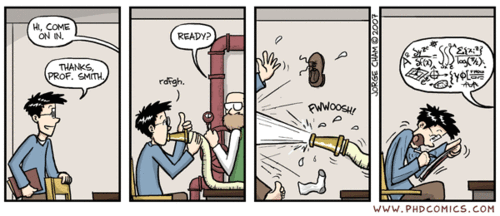
Having said that, a reader who is participating in this reading challenge sent along this comic. I definitely feel some of this:
Edwards first seeks to define true religion, saying, “true religion, in great part, consists in holy affections.” He defines the affections in this way: “The affections are no other than the more vigorous and sensible exercises of the inclination and will of the soul.” He bases this definition on the understand that the human soul has two faculties, one of which he terms understanding. This is the faculty that allows the human soul to discern, view and judge. The second faculty he terms inclination or will or heart. It is this one that allows the soul not to just perceive and view things, but to incline or disincline it. Holy affections are those that are distinguished by “vigorous exercise of the inclination and will towards divine objects.”
The bulk of the chapter is given to ten biblical proofs that true religion lies much in the affections. It concludes with three inferences or applications from this doctrine.
Discussion
This was a long and dense chapter but one of uneven importance, meaning that there were some portions that were more important than others. I’m grateful for this since otherwise I don’t know that I could have absorbed very much! I am going to provide thoughts on just a few areas that jumped out at me.
After providing his ten biblical proofs that true religion requires true affection, Edwards summarizes by saying, “It is evident that religion consists so much in affection, as that without holy affection there is no true religion; and no light in the understanding is good which does not produce holy affection in the heart: no habit or principle in the heart is good which has no such exercise; and no external fruit is good which does not proceed from such exercises.” All of this to say that an affectionless Christian is no Christian at all. While the presence of affection does not necessarily prove a person to be a Christian, the complete absence proves that he cannot be one. Just last night my son asked how he can know that he is a Christian and here Edwards gives us a mark to look for. Is your heart stirred by these affections? If it is, that may point you to the reality that you are saved; if it is not, it will point you to the sad reality that you are unsaved. Affections are too close to the heart of the faith to be completely absent. At one point Edwards says, “I am bold to assert that there never was any considerable change wrought in the mind or conversation of any person, by anything of a religious nature that ever he read, heard or saw, that had not his affections moved.”
Edwards’ second inference about the affections is a logical one. If true religion lies in the affections, we must pursue those things that tend to move our affections. Here he points to prayer, preaching and praise. True Christians will necessarily wish to pursue such means of grace to stir our hearts and to grow in our affections. The application is obvious: do you find that your affections are tied to such means of grace? Is listening to a sermon a delight or a chore? Is prayer a duty or a delight?
The chapter’s final exhortation is one worth pondering. “So has God disposed things, in the affair of our redemption, and in his glorious dispensations, revealed to us in the gospel, as though everything were purposely contrived in such a manner as to have the greatest possible tendency to reach our hearts in the most tender part, and move our affections most sensibly and strongly. How great cause have we therefore to be humbled to dust that we are no more affected!” And really, what excuse do we have for being so little affected by the great things revealed to us? What a hard-hearted people we are…
Next Time
Our reading for next week will take us from the beginning of Part 2 up to the end of the seventh (VII) point. So stop when you hit point VIII and see “Nothing can certainly be determined concerning the nature of the affections by this, that comforts and joys seem to follow awakenings and convictions of conscience, in a certain order.” In my book (the Banner of Truth edition) this will take us from page 54 until page 78.
Your Turn
I am eager to know what you gained from this part of the book. Feel free to post comments below or to write about this on your own blog (and then post a comment linking us to your thoughts). Do not feel that you can only say anything if you are going to say something that will wow us all. Just add a comment with some of the things you gained from the this week’s reading.

I am a follower of Jesus Christ, a husband to Aileen and a father to three young children. I worship and serve as a pastor at
Releasing on April 1, The Next
Comments (28)
I liked that he took time to define his use of the word affections. I’ll probably never think of that word the same way after reading this book. It is (at least in my mind) a word that means something very different in today’s culture or, at the very least, is commonly used for a different purpose. But I have found my thoughts coming back to thinking with an “affected” frame of mind all week. My pastor recently spoke on being consumed with Christ. Living with zeal. That concept goes hand in hand with what Edwards is saying. There are affections that need to be evident in the life of the believer. These affections in fact mark the believer and make him distinct. It has been a great challenge to me even after this first week to examine my life to see how many of the affections he lists are characteristics of my life.
Excellent book choice Tim. And thanks again for the challenge.
This section accomplished what it desired in laying out what it is Edwards is talking about with these affections, and why they are crucial to the Biblical life. It also struck me when Edwards talked about what was going on in his day, how people had become so focused on the affections and approving of all demonstrations of affections…to then denouncing forms of affections. The backlash swings the pendulum to and fro. This can certainly be said of a myriad of issues in our day, and I am definitely guilty of being too eager to throw the baby out with the bathwater. I’m definitely looking forward to learning from Edwards and fellow readers how we can step back during these times, take a breath, and discern what is going on, and separate the wheat from the chaff.
I find it difficult to comment on Edwards other than just quoting him. After listening and reading part 1, I am humbled that I lack so much in my zeal and affection for Christ.
‘But is there anything which Christians can find in heaven orearth, so worthy to be the objects of their admiration and love, their earnest and longing desires, their hope, and their rejoicing, and their fervent zeal, as those things that are held forth to us in the gospel of Jesus Christ?……How great cause have we therefore to be humbled to the dust, that we are no more affected!’
Great summary/remarks Tim!Here are my thoughts after reading the Part 1 myself:John Piper, Preaching, True Religion, and Desiring God
And, after reading your post, I realised I missed some.
I found it interesting where Edwards started his treatise. He is looking for true religion and he starts out by pointing us to 1st Peter 1:8. 1st Peter was written to persecuted Christians under the madman Nero. Nero was feeding Christians to the lions and strapping them to poles and lighting their bodies on fire to serve as lamp posts! This was a most horrific time. Yet….incredibly yet…..Peter was hearing stories of beautiful faith in Christ which no doubt lead him to pen these verses and seek to encourage them.
So, it would seem, Edwards is proclaiming that during these trials true faith is crystal clear. Under such circumstances, people with either curse God or cling to his mercy. Trials also serve to purify our faith.
Apart from severe trials, true faith is much more difficult to recognize and thus sets Edwards course for the rest of the text.
I am determined to let the findings of Jonathan Edwards view of Christ deeply into my cells. Therefore I have also set upon a quest to understand the context of this writing. To accomplish this, I have also concurrently started reading Marsden’s award winning biography entitled “Jonathan Edwards - A Life”. This is so far a wonderful text and is helping me to understand Edwards from many different perspectives.
I also downloaded the free audio version that Tim mentioned a few weeks ago. It is interesting to listen to the words as I also read them. It brings more of my senses to the experience and digs the text deeper it seems.
In review, I found so much in this first part that I couldn’t possibly contain myself to one post in my blog. Therefore, I am breaking this first section into pieces.
My introductory material is here:http://www.boomerinthepew.com/2008/07/drinking-from-a.htmland my first post on the first section is found here:http://www.boomerinthepew.com/2008/07/jonathan-edward.html
Tim, thank you so much for pointing us to this text. As we learned in the preface, Edwards was deeply troubled that false religion constantly reared its ugly head to attack the revivals of God. He was also deeply concerned that many might be deceived by “false religion”.
How appropriate for our day when we see, so called healers of God, feeling lead to kick grandmothers in the face with army boots under the spirits leading.
How appropriate for our day when we see that our nations largest congregation is “worshiping” to a false teaching of “God wants you rich”.
I pray that together we all might sharpen each other swords, and that most of all, God might quicken us with eyes that can see.
I am reveling in this text! How about you?
I’m ashamed at some of the things I *do* show zeal for: a winning touchdown, a home run that wins the game for my team, etc. Edwards reminds us that these worldy things pale in comparison to the excellence of Christ.
I just hope I will examine myself soberly as I read this book and not get too “beat up” because I don’t exhibit all of the affections on a regular basis.
Tim, I am so appreciative for the coupon you posted from christianaudio.com. I downloaded the book to my ipod and I JUST LOVE IT!
I can’t even begin to communicate how much easier it is to understand and follow the book with Simon Vance reading it! !He has an awesome British accent and his diction is superb.It actually sounds like Edwards could be reading his own book.Vance seems really to understand the book and this just comes through.
I guess the coupon must not be available anymore? My pastor had wanted to download it also.
I only wish you could bookmark (more than one bookmark) the ipod.
Thanks again.
One thing Edwards does at the start of many of his major works, (at least ‘The end for which God created the world’, ‘freedom of the will’ and this) is he defines his terms and what he means by this or that term. I think its needed today in this postmodern world. As an added bonus, in the into to ‘The end for which God created the world’or ‘freedom of the will’ Edwards says why he defines his words…I’ll go find it later tonight.
When I read this book last time, (and since listened to it a couple times), is the affections seem to be the compass needle. Your emotions make point in this or that direction depending on the day, as if you are traveling you may have to deviate from going in the direction your compass needle points, but in general you head the direction you need to go. I’ve always asked myself, is my compass needle pointing towards Christ? When all is said and done, when the dust settles, when your first born dies, when you win the lottery, whatever happens, are your affections inclined towards Christ?
It’s refreshing the second time reading it, I’m noticing so much more. He puts thought into his words.
-Mike
“There are false affections, and there are true. A man’s having much affection, does not prove that he has any true religion: but if he has no affection it proves that he has no true religion.”
I think what I am reading here is that first we have to be careful that we are not deceived by the display of “much affection” that tends to point to “true religion”, both in ourselves and others. Because the presence of what appears to be “true affection” is not always evidence of “true religion”. Am I reading that correctly? Or when he says “much affection” is he talking about affections that would never point to “true religion”, like affections for the things of this world?
Secondly, he does make clear that we can be sure there is no “true religion” where there is total lack of affection. Sounds like he is basically saying our affections will be the evidence of our faith. I think today we often say something similar, but we may use the term fruit or works.
I enjoyed this section. It was difficult, maybe not as much as I expected, but I found myself re-reading several passages.
I am reading the Kindle edition. For others doing the same the next week’s material appears to end at location 1100. Thought I would save others the time of looking for it.
Victoria, and whoever else is listening…Part 2 starts @ 1:44:07You’ll have to add the time together of whatever parts its on, since I combined my mp3 downloads into one large mp3 file (using the unix cat command), and converted it to m4a, renamed the extension to m4b, and thus its in my audiobooks section in itunes/ipod.
Indeed he reads it very well…a little to fast if I’m reading it also since I want to underline and write notes!
Wow Mike, making your own AUDIO files from the originals:) Since we are talking about manipulating the audio files, I took another reading of Edwards’ sermons on www.christianaudio.com - which was not properly divided - and imported it into Cool Edit Pro, now Adobe Audition it is called. From there I took the file and divided it into the proper parts. ALSO one can slow down the reading with this same program. You might be able to also use the free program AUDACITY,
http://audacity.sourceforge.net/
but I haven’t tested it on MP3’s. SOMEONE MIGHT OBJECT that this violates the copyright to manipulate the sound files - I have a solution. I also narrated this whole work and I don’t have a copyright on it.That narration is here….
http://www.sermonaudio.com/sermoninfo.asp?SID=11304223733
And it is still free even if the Christian Audio version is not.
How do affections compare to emotions according to Edwards? Affections seem to be similar to the will but not identical.
Is a “holy affection” the same as a “holy desire?”
How do affections compare to emotions according to Edwards? Affections seem to be similar to the will but not identical.
To expand on that question, how do “affections” compare to “passions” and those then compare to “emotions”?
In Edwards’ definition of terms here, I understand affections to be those things that arise from the heart where the mind is involved & in control. Religious affections are then what arise from the truth of God being pressed into the soul by the Spirit. Passions are more like the “animal spirits”, or those things that arise from natural senses, perhaps something like sensationalism & generally involve a lack of rational / controlled thought. I’m probably not doing a very good job of distinguishing so I’d be interested to hear other attempts. But this does seem to be a very important point. We tend to lump affections & passions into one word and call it “emotions” and I think lose a vital distinction in doing so. For example, if good music is being played and great harmony is made and a person “feels” something, should that be attributed to true religious affections or simply natural passions? In other words, what is the cause or motive of the “feeling”?
It’s been almost 3 years since I read Religious Affections, and I at the time had only been saved several months. Doctorine and theology was absolutely new to me, so first off I probably wouldn’t recomend this particular book to new Christians, however thats not to say new Christians shouldn’t read it. Many years of sinful living habits have dulled my brain. So being that I have a less than average mentality, most people should be able to grasp much of what Edwards is trying to get through.
Aaron S.I think from what I understood you are on the right track. I’ve come to think our emotions tend to be governed mostly by outside stimulus, but our affections seem to be processed from within. It would seem that God has made us so that both our emotions and our affections fuel our passions. Depending where and what our affections are bent towards, ie. sin or holiness, determines our passions. But I really would need to reread the book, and take the time to process what Edwards is saying. At best, at this point I can only speak from the limited understanding of scripture I have and personal experience filtered through the word.
Tim, I think it’s great that you are doing this reading together, I kind of wish my church would start something like this. Maybe I should bring it to my elders. I love Edwards, actually, I started reading his complete works a year ago, but then got sidetracked by a few new books that came out, (Truth War, God is the Gospel, amoung others) and never did get back to it. After I get done the ones I’m on,(Tale of Two Sons, What We Confess1,2,3) I will get back at it. Thankyou for igniting a passion for reading in me.
BtW, could all of you who read this please keep my family and I in your prayers, at least a little. We are going on a house boat vacation together and though I’ve witnessed to my family before, many of them are unsaved. This may be an excellent opportunity, I right this with a heavy heart. Thankyou, and may God bless you and keep you.
Just when I thought I was going to be keeping right up with the group, my teenage son was hospitalized. By God’s grace I’ll catch up in time for next week. It has been a blessing so far.
Hello friends!
Just so we don’t get too bogged down in the terminology, Edwards is simply helping us answer the question “do I love God, or do I not? If you call that love, “disposition” “inclination” or “holy affection” it is one and the same and something that it is not possible for the carnal mind to do. Romans 8:7.
There are signs that people trust to that they suppose prove that they love God, such as an abundance of religious activity, which neither proves nor disproves it.
There are other signs that are proof that we love God for sure, If you love me you will keep My commandments. - signs 13, and 14 of the book.
If you have some doubts, this poem from John Newton is as good as it gets….
Tis a point I long to know,Oft it causes anxious thought;Do I love the Lord, or no?Am I his, or am I not?
2. If I love, why am I thus?Why this dull and lifeless frame?Hardly, sure, can they be worse,Who have never heard his name!
3. Could my heart so hard remain,Prayer a task and burden prove;Every trifle give me pain,If I knew a Saviour’s love?
4. When I turn my eyes within,All is dark, and vain, and wild;Filled with unbelief and sin,Can I deem myself a child?
5. If I pray, or hear, or read,Sin is mixed with all I do;You that love the Lord indeed,Tell me, Is it thus with you?
6. Yet I mourn my stubborn will,Find my sin, a grief, and thrall;Should I grieve for what I feel,If I did not love at all?
7. Could I joy his saints to meet,Choose the ways I once abhorred,Find, at times, the promise sweet,If I did not love the Lord?
8. Lord decide the doubtful case!Thou who art thy people’s sun;Shine upon thy work of grace,If it be indeed begun.
9. Let me love thee more and more,If I love at all, I pray;If I have not loved before,Help me to begin today.
I almost forgot to get in on this. I’ve been on vacation and this is now my study leave. But here I am, a bit late, but still caught up… so far.
I read through Religious Affections about 15-16 years ago with another group of pastors. We tackled it in sections (probably broke Section 2 in half, at least). This is great review and it will challenge my memory in seeing the marginal notes I made those many years ago.
One of the things mentioned in some of the above comments is our (my) difficulty in grasping the full notion of the term “affection.” It’s not a term we use today; and when we do, it’s not one that Edwards would understand. Once I grasp this, the rest becomes a bit easier.
Someone above commented on being ashamed on what they show zeal for. I think this might come close to what J.E. is speaking of in affections, but he also seems to put forth the idea that if there are no accompanying actions - praise, service, loving acts, etc. - then the affections weren’t genuine or real, nor were they of a truly religious nature. I can’t leap with joy over making birdie on the golf course, but what action flows from that joy? And even more importantly, what action flows from that joy that glorifies God, serves my brother in Christ and causes me to grow deeper in my love & knowledge of Christ? The joy is real, no doubt. But is it a religious affection? Hardly.
When we get to section two, about the signs that may or may not be what religious affections are all about, we’ll see this even more. I would, however, add this warning, especially if this is your first time reading this work: section three is coming! Section two will strip away every single ounce of fleshly pride and confidence you have in standing before God in Christ. Anything you think makes you worthy in His eyes will be completely removed by the time you end section two. Section Three, however, will bless you to no end. So, to all here: read on, my brothers and sisters, read on!
I personally keep coming to one of Edwards’ earlier points, “That religion which God requires, and will accept, does not consist in weak, dull, and lifeless wishes, raising us but a little above a state of indifference: God, in His word, greatly insists upon it, that we be in good earnest…” (page 27 Banner of Truth)
Too many times I’m satisfied with weak, dull and lifeless wishes that indeed only raise me a little above a state of indifference. When things are this way on any given day, I can know that I need to pray more earnestly and ask the Lord to deliver me out of that state, a state in which I used to be complacent. George Mueller said,
“It has recently pleased the Lord to teach me a truth…that the first great and primary business to which I ought to attend every day was, to have my soul happy in the Lord.
For I might seek to set the truth before the unconverted, I might seek to benefit believers, I might seek to relieve the distressed, I might in other ways seek to behave myself as it becomes a child of God in this world; and yet, not being happy in the Lord, and not being nourished and strengthened in my inner man day by day, all this might not be attended to in a right spirit.”
Thanks for the John Newton poem, Thomas Sullivan. That one gets printed out and placed where I will see it everyday.
Also, to Laurie and Curtis, my prayers and I’m sure those of other readers are with you.
Hi everyone,
As we fight and run so as to obtain, as sons and daughters of the Most High God, the possessor of heaven and earth, we need to have hearts that are “easily moved with religious and pious affection… hearts that are tender, and easily affected and moved in spiritual and divine things, as little children have in other things.”As I read, prayed and examined myself, these words and many more were right on point!I am greatly encouraged to pray for mature but soft, child-like hearts so that we may be absolutely “humbled [by the Gospel] to the dust that we are no more affected!”
Thanks for all the encouraging comments guys and the Newton poem is definitely a keeper.
KAN
I have blogged on part I here: http://staffaction.blogspot.com/2008/07/religious-affections-part-i.html
Tim, thanks for leading this process, it’s very enjoyable. To all: you can view my thoughts and comments at the blog address below, but here is a brief summary of the direction of my observations:
1 - The connection of “holy affections” to the “affective” realm in the Christian teaching-learning process.
2 - 1 Peter 1:8 as foundational.
3 - 1 Peter 1:8 and the fruits of the Spirit.
4 - The best experiences of the affection as a taste of heaven.
5 - The distinction between right affections and uncontrolled passions.
http://3rdjohn8.blogspot.com/
“I’ll find it later tonight”…life gets the best of me sometimes. Better late than never. Intro to the Freedom of the Will…
“SECTION IConcerning the nature of the willIT may possibly be thought, that there is no great need of going about to define or describe the will. This word being generally as well understood as any other words we can use to explain it And so perhaps it would be, had not philosophers, metaphysicians and polemic divines brought the matter into obscurity by the things they have said of it. But since it is so, I think it may be of some use, and will tend to the greater clearness in the following discourse, to say a few things concerning it.”
And Thomas Sullivan,If you’re the one who narrated many works of Edwards and Owen on sermon audio, I must say thanks. I’ve listened to everything on that site by those two (and more, and re-listened to them), and my hat is off to you. The stuff is definitely a blessing.
What I’ve done with the audio is usually kept by me and listened to me, and I just provide links to free stuff if I can. I usually put a note in itunes on the audio file what time certain parts are at. I may have to divide some of the christian audio files so it makes more sense (like Luther in his own words, random Edwards sermons, reformed confessions) which have multiple works in one recording split oddly.
-Mike
Enjoying the reading, but finding the language a bit challenging. I have put my thoughts (and quotes) at http://couragetotremble.wordpress.com/2008/07/27/the-religious-affections-part-1/It struck me that so much of what we are reading is relevant for us today.
Thanks Mike for your encouragement regarding the narrations. I hope to get all of the Edwards’ sermons narrated in both of the volumes of the Banner of Truth editions.
This quote by Edwards is so vivid in the intro…
After religion has revived in the church of God, and enemies appear,people that are engaged to defend its cause are commonly most exposed,where they are least sensible of danger. While they are wholly intent uponthe opposition that appears openly before them, in order to make headagainst that, and while they neglect carefully to look around,the devilcomes behind them, and gives a fatal stab unseen; and he has opportunityto give a more home stroke, and to wound the deeper, because he strikesat his leisure, being obstructed by no resistance or guard.
I was particularly interested in the section where Edwards describes a hard heart. The pendulum in always swinging from one extreme to the other, and in my own experience, affections are to be the last on the list of vitals. That is why I paid close attention to the part of the hard heart. In trying to come to a balance it seems that fearing God is the key. Also he makes the statement that I have never analyzed before now. It was one of those statements I took for granted and did not think about. Edwards says, that Christ ‘s “power of the exercises of his holy love, that they were stronger than death” (II-7). Christ demonstrated this literally. Are my holy affections stronger than death, if not then am I giving into the passions of the world that only lead to death? This was a profound question and observation that I had never seen before. Also, I wrote this in the margin where he is talking about true holy affections, “it is ironic that our greatest times of joy and love come from God showing us who we really are and who He really is, and how He truly accepts us in spite of both things.” JE is proving to be a wonderful challenge. Thank you Tim for exposing us to this marvelous book. Lynn lynnsmusings.blogspot.com
I agree with Tim in that this was a bit overwhelming for me when I began it. I have to say that I was delighted I chose to read it when I had reached the end of the first five pages. JE is an interesting writer in the way that he uses his words. I think that he probably could have accomplished the same writing in less sentences, but was this the way that people wrote in that time? Were they so concerned that they not be mistaken that they made things crystal clear?
As far as the word “Affection”, I think that most of us would use this word in regards to a favorite aunt or uncle. Maybe we would have used it to describe our relationship with a beloved pet. I don’t think I would have put such a passionate turn on the word “Affection”. Definately a new way of looking at just one word.
Catherine: Your words reminded me of something that Archibald Alexander wrote in his book, Thoughts on Religious Experience” in 1844, “His {Edwards} Treatise on the Religious Affections is too abstract and tedious for common readers; but it is an excellent work, although I think his fourteen signs of truly gracious affections might be reduced to half the number on his own plan.”
If Alexander warned the this book was difficult to apply - and he himself wrote one of the most helpful books - the title I have just given, it is going to take some work for us.
I have an advantage with the language since I have read the book numerous times, but still parts of it are easier to read than to know how to compare ourselves to.
Way behind due to a cross-country move, but my comments are here. Great reading all the comments above, too - it’s so good to get the perspective of many different people on this work.