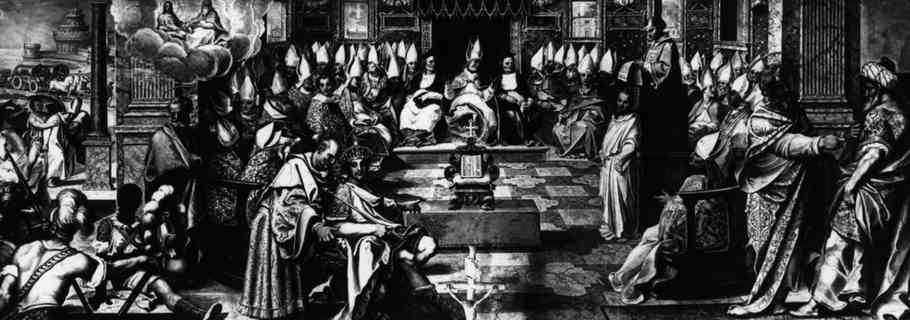
Today I am beginning a new series of articles on the seven ecumenical councils of the early church. These councils commenced with the First Council of Nicaea in 325 and concluded with the Second Council of Nicaea in 787. Between these two events were five more, each of which attempted to understand and establish a unified Christian theology.
In this series we will take a look at each of the seven councils. For each one we will consider the setting and purpose, the major characters, the nature of the conflict, and then the results and lasting significance.
We begin today with the First Council of Nicaea.
Setting & Purpose
The First Council of Nicaea was convened in 325 by the Roman Emperor Constantine. Constantine had hoped to unite his empire under the banner of Christianity, but now saw such unity threatened by a grave theological dispute. Hosius of Cordoba recommended a council as the means to address the brewing controversy and Constantine responded by calling church leaders to Nicaea in Bithynia (modern-day Iznik, Turkey). Somewhere between 250 and 318 bishops from across the Roman empire attended, and the council began its formal deliberations on May 20.
The major issue the council was charged with addressing was the nature of Christ’s divinity, and in particular, the relationship between the Father and the Son. As a secondary matter the council was to debate the celebration of Easter.
Major Characters
The two most important figures at the council were Athanasius, a young deacon who came as a companion to Bishop Alexander of Alexandria, and Arius, a controversial presbyter and priest from Alexandria. Constantine was present as an overseer, but did not vote.
The Conflict
The conflict at the heart of the First Council of Nicaea involved the nature of God the Son in relation to God the Father. On one side of the conflict were those who held that Jesus Christ was created by the Father and on the other side were those who held that Jesus Christ was begotten by the Father.
Arius was the lead proponent of the created position. He held that God the Son was God’s first creation and that through him everything else was made (Colossians 1:15). This made the Son the only direct creation of the Father and thus unique among all creation as the first and greatest created being. He believed that the Father’s divinity was greater than the Son’s, and cited John 14:28 in support of his position: “You heard me say to you, ‘I am going away, and I will come to you.’ If you loved me, you would have rejoiced, because I am going to the Father, for the Father is greater than I.” Arius said, “If the Father begat the Son, he that was begotten had a beginning of existence: and from this it is evident, that there was a time when the Son was not.”
Alexander of Alexandria and his protege Athanasius held that Christ was begotten, not created, and was, therefore, fully equal to the Father. The council agreed with this view and understood that Arianism undermined the unity of the Godhead, making the Father greater than the Son and contradicting such scriptures as John 10:30 and John 1:1. Over the course of the council, the great majority of the delegates came to agree with Athanasius that the Son had an eternal derivation from the Father but was nonetheless co-eternal and equally divine. Athanasius explained, “Jesus that I know as my Redeemer cannot be less than God.”
The Result
The debate lasted from May 20 until June 19, at which point the council produced an initial form of the Nicaean Creed which explicitly affirmed the begotten position and condemned Arianism. All but two of the attendees voted in its favor and those two, along with Arius, were excommunicated and banished to Illyria. All of Arius’ writings were ordered confiscated and burned.
Here is the original version of the creed (which was adjusted at the Second Ecumenical Council in Constantinople in 381).
We believe in one God, the Father Almighty, Maker of all things visible and invisible. And in one Lord Jesus Christ, the Son of God, begotten of the Father [the only-begotten; that is, of the essence of the Father, God of God, Light of Light, very God of very God, begotten, not made, being of one substance with the Father; by whom all things were made both in heaven and on earth]; who for us men, and for our salvation, came down and was incarnate and was made man; He suffered, and the third day he rose again, ascended into heaven; from thence he shall come to judge the quick and the dead. And in the Holy Ghost. But those who say: ‘There was a time when he was not;’ and ‘He was not before he was made;’ and ‘He was made out of nothing,’ or ‘He is of another substance’ or ‘essence,’ or ‘The Son of God is created,’ or ‘changeable,’ or ‘alterable,’ they are condemned by the holy catholic and apostolic Church.
The council also agreed on a date to celebrate Easter. In a circular letter Constantine issued after the council, he explained: “At the council we also considered the issue of our holiest day, Easter, and it was determined by common consent that everyone, everywhere should celebrate it on one and the same day.”
Lasting Significance
The First Council of Nicaea is most significant in settling an essential issue related to the divinity and humanity of Jesus Christ. Jesus Christ was decreed to be eternal and divine, equal with the Father, and infinitely greater than a created being. However, the Council is also significant as the first attempt to achieve a consensus among all Christians through a debate between representatives from the opposing sides. It set a precedent for holding councils to decide other doctrinal and practical church matters, and for turning these decisions into creeds and canon law.
It would be 56 years before the next council, First Council of Constantinople.





