
This is part four of our series studying the differences between Calvinism and Arminianism. Please note that this is only a brief overview of a vast topic. A thorough discussion of this topic can (and often has) filled many books. At the conclusion of the series I will provide a list of helpful resources should you wish to pursue this study further.
Today we turn our attention to a comparison of the two views. I present this as a “quick and dirty” summary of the opposing views. Remember that not all Calvinists hold to all of the points I have listed below. Similarly, not all Arminians believe all of the points below.
Free Will
- The fall has seriously affected humans but has not left them completely spiritually helpless.
- Man is not enslaved to his nature
- Man has the ability to choose for or against God. Man can choose either good or evil as his will dictates.
- The Spirit assists man as he develops faith.
- Faith is man’s act and a gift to God
Total Depravity
- The fall has left man completely unable to respond to God in any way. Man is spiritually dead.
- Man is enslaved to his nature
- Man has free will within the bounds of his nature. Since man is in a fallen state, he can never choose for God unless the Spirit has first regenerated him.
- The Spirit regenerates man and then gives him the faith Christ secured.
- Faith is God’s act and a gift to man
Conditional Election
- God chose certain people before the foundation of the world based on seeing that in the future they would respond to His call.
- Election is conditional on God seeing who would choose Him.
- The final cause of salvation is man choosing God.
Unconditional Election
- God chose certain people before the foundation of the world for His own reasons and not based on seeing who would respond to His call.
- Election is unconditional. God simply chose some and not others.
- The final cause of salvation is God choosing man.
Unlimited Atonement
- Christ’s death achieved the potential for man to be saved.
- Christ died for every person who ever lived, but only saves those who believe.
- Christ’s death secured the potential for salvation and did not secure faith (which is man’s work)
Limited Atonement
- Christ’s death effectually saved the elect.
- Christ’s death was only for the elect and not for the entire human race.
- Christ’s death secured salvation and faith
Obstructable Grace
- God never forces salvation upon anyone.
- The Spirit woos people but they are free to accept or reject Him.
- Faith allows the Spirit to do His work in man
Irresistible Grace
- God gives the gift of salvation to His elect and they have no choice but to respond.
- The Spirit regenerates people who are then given faith and must repent.
- The Spirit does His work based on who God has predestined to eternal life
Falling From Grace
- Because salvation is ultimately dependent on man, he can reject his salvation.
Perseverance of the Saints
- Because salvation is ultimately dependent on God, man can never lose salvation
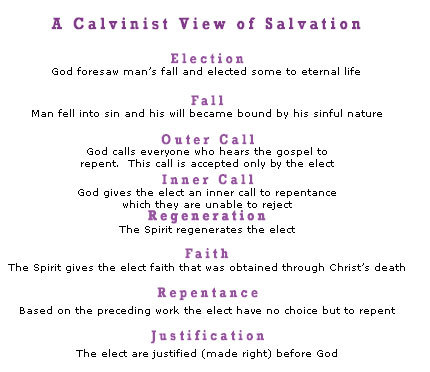
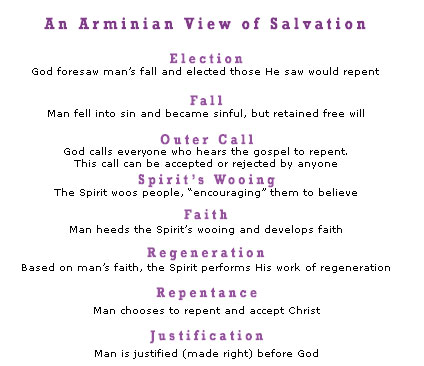
As you see, the process of a person becoming saved is vastly different in each of the views. I have created a chart for each of the views to try to simplify the differences between them.
Next time we will wrap up the discussion with some conclusions and I will provide an explanation for the view to which I adhere.





