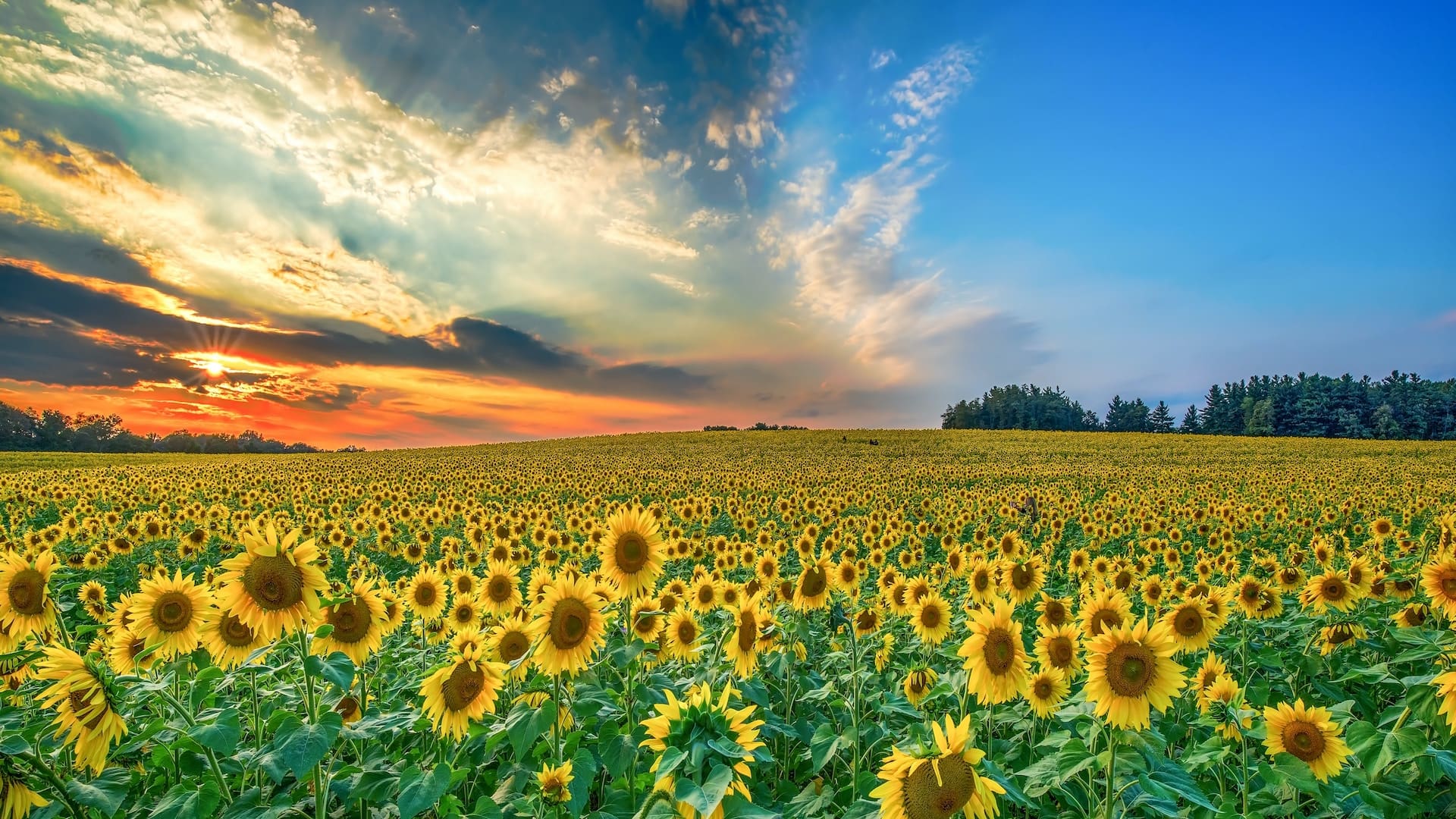
Sunflower fields trampled, pumpkin patches trod under, apple orchards pillaged and wrecked. It has become a phenomenon of the Instagram era that fields ripe for harvest are also fields perfect for selfies. When the flowers are at their brightest, the pumpkins at their biggest, the apples at their reddest, word gets out, and crowds descend. One nearby farm had to close after an estimated 7,000 cars attempted to park in the streets around it. “By noon, the hordes were coming from all directions. People were parking as much as a kilometre away. The crowds started ignoring the overwhelmed farm staff, strolling into the fields without paying. Police told the Bogles that parents were crossing four lanes of traffic with strollers, people were getting in fender benders—one driver had his door ripped off by a passing car.” Their website now makes it clear: “There will be NO 2021 SUNFLOWER PHOTOGRAPHY OPPORTUNITIES.”
It used to be that a sunflower plant at full bloom represented a commodity that was valuable as a source of food. Pumpkin patches and apple orchards, too. Their primary value was not related to their beauty but their utility. However, in the age of Instagram, the fact that these plants provide food has become secondary to the fact that they look pretty. They are no longer a commodity, but a prop. And so people swarm to the site to get a photo of their face in the foreground and the sunflowers in the background. It’s a little parable for our times, that.
The Bible has much to say about fruit and fruitfulness. “Bear fruit,” says Jesus, and “each tree is known by its own fruit.” And again, “I am the vine; you are the branches. Whoever abides in me and I in him, he it is that bears much fruit.” The Apostle Paul spoke of it in many of his epistles and perhaps most memorably in Galatians where he said “the fruit of the Spirit is love, joy, peace, patience, kindness, goodness, faithfulness, gentleness, self-control.”
We learn that fruit represents the external evidence of a person’s life and character. Just as an apple tree produces apples and an orange tree produces oranges, lost people produce one kind of fruit and forgiven people produce another. Or, to change the analogy slightly, a healthy tree produces healthy fruit while an unhealthy tree produces rotten fruit. God’s expectation is that those who have been transformed by his gospel will begin to bear fruit in keeping with their lives of repentance. As the Spirit takes up residence within and begins his work of renewal, a person will begin to produce love where there used to be hate, joy where there used to be bitterness, peace where there used to be rivalry, and so on. God transforms us from the inside out, and the external evidence of this transformation is fruit.
There are a number of ways in which a tree and a Christian bearing fruit are similar, but perhaps most notably this: Though fruit is beautiful, it is not meant to be looked at or admired, but given to others. An apple tree heavy with perfect fruit is a wonder to behold. But it does a starving person no good if he cannot reach out and take its fruit and be nourished by it. A sunflower is one of the most beautiful of all flowers, especially when in a field surrounded by millions of others. But they do our hungry bodies no good if we cannot pluck the seeds and eat them. And in much the same way, the Spirit does not cause us to bear fruit so we can look spiritually beautiful while keeping all the good of it to ourselves. He causes us to bear fruit so we have something to give to others, some way to bless them, some way to nourish them as they walk the weary road of life.
Thus, the Spirit gives us patience, so we can express that patience toward others when they wrong us or so we can bear with them in love when their Christian progress slows to a crawl. The Spirit makes us kind, so we can express kindness to others when they are downcast or downtrodden. The Spirit works self-control within us so we are no longer distracted by whatever else might have had power over us, but can instead discipline ourselves toward godliness and toward expressing love for others. Fruit is not a decoration, not a prop, but a means to the great end of doing good to others and, thus, glorifying God.
We may be accustomed to inventorying our fruit to see whether we feel its evidence within or whether we are aware of making some kind of spiritual progress. Well and good. But it is better still to look at whether that fruit is feeding and nourishing others. Is patience something you feel internally, or something that expresses itself in relationship with others so they benefit from it? Do you have the joy (joy joy joy) down in your heart, or is it manifesting itself through your mouth and through your hands and thus proving a blessing to those around you? Do you merely have gentle thoughts, or do you have gentle lips and gentle hands? Look inside, to be certain, but also look outside to ensure the fruit of your relationship with the Lord is a gift not only to you, but to all you know, all you love. For like fruit on a tree, fruit on a life is meant to be a gift that nourishes those who are hungry for a blessing.





