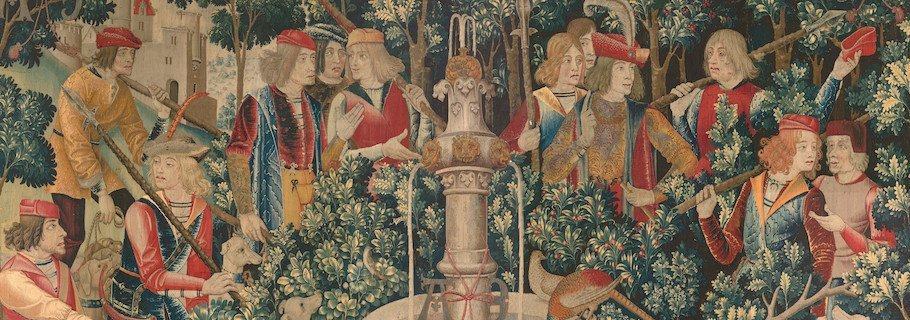
Have you ever compared the front and back of a tapestry? The front of a tapestry is art. In the hands of a skilled weaver it displays incredible artistry and fine detail. The world’s best art museums collect the world’s best tapestries and display them there as examples of a rare but beautiful form of art.
The back of a tapestry is a mess. A tapestry is made by weaving together different-colored threads, and the images and designs are created by the interplay between the different colors and textures. What is clear on the front is opaque on the back. The back shows something of the image, but it looks more like a child’s attempt than a master’s: it lacks nuance and clarity and detail. Where the front is smooth, the back is covered in knots and loose ends.
We are meant to see and admire the front of the tapestry, not the back, and this has often served as an illustration of the truths of Romans 8:28: That God promises to use every single event in our lives to bring about good. Though I have often heard Joni Eareckson Tada use the illustration, I believe it originated with Corrie Ten Boom and her poem “The Master Weaver’s Plan.” “Oft’ times He weaveth sorrow; / And I in foolish pride / Forget He sees the upper / And I the underside.” It serves as an effective illustration for the truth that for now we get to see only the underside of all God is weaving together in this world, while clinging to the promise that someday we will see the upper side and marvel at what he has been doing.
But it illustrates something else equally well. I have been thinking a lot lately about good deeds—not the good deeds people do to try to earn the favor of God, but the good deeds people do when they already know that Christ has earned them the favor of God. Titus 2 calls us to be people that are zealous for good works; in Matthew 5 Jesus tells us to let our light shine before others by doing good works; Ephesians 2 tells us that God’s very purpose in saving us was enabling us to glorify him by the good works we do for others. As Christians we are to be known for our good works—those things done for the glory of God and the good of other people.
And so we go through life doing these good works, and far more often than not, these are small and seemingly inconsequential deeds. We rarely talk a person out of recklessly taking his own life; we rarely write a check that utterly transforms a life or ministry; we rarely save a drowning child or defuse a ticking time bomb. Instead we interact with people for moments at a time and attempt to say something—anything—that may be encouraging; we write small checks and place them in the offering basket; we have brief conversations with children, and we share just a shred of the Good News with that taxi driver.
Most of our good deeds go unnoticed and unmarked by others. I suspect that even we ourselves fail to notice or remember the majority of the good deeds we do. But not God. God sees them all, knows them all, remembers them all, and uses them all.
Just as some day we will see the beautiful tapestry God has been weaving through our suffering, through the events we never would have chosen, in the same way we will see the tapestry this Master Weaver has been creating through those good deeds. We will see how a kind word resonated in a person’s heart even days and weeks later; we will see how that small amount of money was used to accomplish something amazing; we will see how that little shred of the gospel was the pebble in the shoe of the person who had hardened himself against God.
Some day God will show us his tapestry, we will see how God has woven each of these little deeds together to his own glory, and we will rejoice.
Here is Corrie Ten Boom’s poem:
My life is but a weaving
Between my God and me.I cannot choose the colors
He weaveth steadily.Oft’ times He weaveth sorrow;
And I in foolish pride
Forget He sees the upper
And I the underside.Not ’til the loom is silent
And the shuttles cease to fly
Will God unroll the canvas
And reveal the reason why.The dark threads are as needful
In the weaver’s skillful hand
As the threads of gold and silver
In the pattern He has plannedHe knows, He loves, He cares;
Nothing this truth can dim.
He gives the very best to those
Who leave the choice to Him.





