
You cannot follow the news these days, and especially technological news, without reading about the perils of sitting. Yes, sitting. In a recent TED talk Nilofer Merchant explained “People spend 9.3 hours per day on their derrieres, eclipsing even the 7.7 hours they spend sleeping. Their sedentary lifestyles contribute 10 percent of the risk of breast and colon cancer, 6 percent of the risk of heart disease, and 7 percent of the risk of type 2 diabetes.”
“Sitting is so incredibly prevalent that we don’t even question how much we’re doing it ,” Merchant told the TED audience. “And because everyone else is doing it, it doesn’t even occur to us that it’s not OK.”
“In that way, sitting has become the smoking of our generation.”
Merchant is far from alone in declaring the dangers of our sedentary office lifestyles. All over the news we find people warning us that all our sitting is killing us.
One of the common solutions is using a standing desk in place of, or in addition to, a normal sitting desk. I am a restless person who is always tapping my foot, shaking my leg or otherwise being annoying. I was just beginning to look into purchasing a standing desk when I was offered an UpDesk if I would consider sharing a review.
The UpDesk is a new product and a unique one in that it goes up and down, allowing it to be both a standing and sitting desk. One version uses a crank while another is electronic. I have been using it for about a month now and have been considering three different things: the value of a standing desk, the value of a desk that can be used for both sitting and standing, and UpDesk’s implementation of each of these.
A Standing Desk. I have enjoyed using a standing desk. It takes some adjustment to do standing what I am accustomed to doing sitting. I found typing, reading, and studying simple enough, but struggled with handwriting. Standing is particularly helpful in the afternoon when my energy is beginning to lag a little bit. Though it seems counter-intuitive, I actually gain energy and focus by standing up instead of sitting.
A Standing & Sitting Desk. While I have enjoyed using a standing desk, I do not want to stand all the time. This is especially true early in the morning and late at night. Standing through a complete 8 or 10 hour workday would be too draining. The ability to have a standing or sitting desk and to be able to transition back-and-forth is brilliant. Most people wind up having two different desks but it is far better, I think, to have one that will do both.
UpDesk’s Implementation. I quite like the UpDesk. It is solidly built and very sturdy, especially compared to the Ikea-quality furniture I typically use. It required some assembly, but nothing more complicated than attaching the legs to the desktop with a few screws. The lift mechanism works quickly and smoothly and allows the desk to transition from sitting to standing in just a few seconds. The contoured front is convenient for both standing and sitting and the plastic edging keeps it from getting nicked.
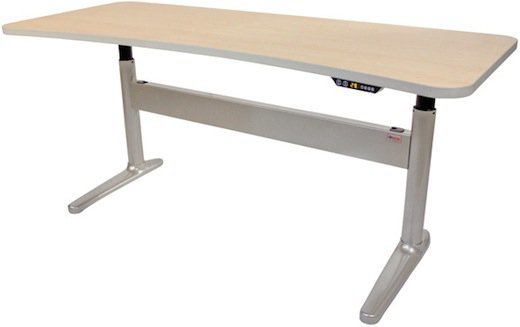
Having said all of that, in certain ways the UpDesk has the feel of a version 1.0 product that will inevitably grow stronger as it matures. The most prominent weaknesses are cable management and the stabilizing bar. There are several cables underneath the desk (one to each of the two legs, one to a power socket and one to the up/down controls) and there is no simple way to manage the cables, all of which are far longer than they need to be. I plan to find and install a conduit of sorts to tidy it up and keep my legs from getting tangled. There is also a bar that runs the length of the desk exactly where my knees want to be when I pull my chair right up to the front of the desk. This is very good for my posture, but not as good for comfort, and especially so when I try to slouch down a little bit.
Now that I have used a standing desk I can say that I am a fan of them. I see and feel the value of standing for at least a portion of my work day. I definitely feel better at the end of the day when I have stood for a good part of it. While the UpDesk is a work in progress, it is useful in its current form and I will definitely continue to use it.