For millennia, human beings have looked to the night skies and grappled with their own insignificance. It is difficult to feel big and important when looking at thousands and millions of stars stretching far beyond our gaze and far beyond our comprehension. King David’s experience is one most of us have shared.
When I look at your heavens, the work of your fingers,
the moon and the stars, which you have set in place,
what is man that you are mindful of him,
and the son of man that you care for him?
(Psalm 8:3-4 ESV)
The Bible tells us that the splendor and magnitude of the universe is meant to force us to acknowledge the existence of a Creator and to force us to acknowledge his infinite power. We, too, are meant to echo David: “The heavens declare the glory of God, and the sky above proclaims his handiwork” (Psalm 19:1).
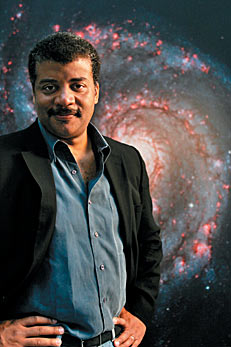 Famous astrophysicist Dr. Neil DeGrasse Tyson has dedicated much of his life to looking to the skies, but has found a way to feel big. He was once asked by a reader of TIME magazine, “What is the most astounding fact you can share with us about the Universe?” Here is his answer:
The most astounding fact is the knowledge that the atoms that comprise life on earth, the atoms that make up the human body, are traceable to the crucibles that cooked light elements into heavy elements in their core under extreme temperatures and pressures. These stars, when unstable in their later years, collapse and explode, scattering their enriched guts across the galaxy. Guts made of carbon, nitrogen, oxygen, and all the fundamental ingredients of life itself. These ingredients become part of gas clouds that condense and collapse, form the next generation of solar systems—stars with orbiting planets. And those planets now have the ingredients for life itself. So when I look up at the night sky I know that, yes, we are part of this universe. We are in the universe. But perhaps, more important, that the universe is in us. When I reflect on the fact, I look up—many people feel small, because they are small and the universe is big. But I feel big because my atoms come from those stars. There is a level of connectivity. That’s really what you want in life. You want to feel connected, want to feel relevant, want to feel like a participant in the goings on and the activities and events around you. That’s precisely what we are just by being alive.
He is right in some ways. We all want to feel connected, we all want to feel relevant, we all want to feel like participants in what is going on around us. Ultimately, we all want assurance that we matter precisely because we have an innate understanding of our insignificance.
He is a brilliant fool, a man who uses his intellectual gifts to express folly.
Tyson says our significance comes when we understand that we are made of the same stuff as the stars–we are one with the universe and part of the big picture of the universe because our bodies are composed of the building-blocks of the universe. That may seem compelling and it may seem encouraging, but if this is the most astounding fact he can come up with, he is a fool. He is a brilliant fool, a man who uses his intellectual gifts to express folly.
The Bible has far better news.
We are very, very small, and we are very, very significant.
The Bible assures us of two facts that are in no way contradictory: We are very, very small, and we are very, very significant. We are small in comparison to the infinite and eternal God who created us, but we have the utmost significance because we are created in his image. We are microscopic when compared to God, but an integral part of his plan for this universe. We are mere dust, but the Son of God saw fit to clothe himself in this dust. The most astounding fact is not that we are made of the same stuff as the stars, but that God chose to be made of the same stuff as us.
Image credit: Shutterstock