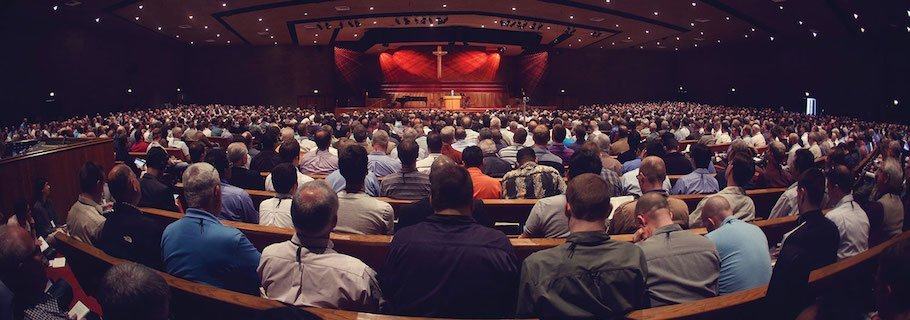
Why should you care about the Inerrancy Summit? There are, after all, hundreds of conferences every year, and it can be difficult to distinguish between them. Well, if for no other reason, you should care about this summit because there are almost 5,000 people here this week, most of them church leaders, representing 70 different countries. This is a major event that will influence many people, including current and future leaders. Not only that, but the conference brings together many of today’s most notable Christian leaders to teach, discuss, and affirm one of the most important theological issues: the inerrancy and authority of God’s Word.
John MacArthur opened the conference yesterday morning by addressing the question of why he called for this summit. He recounted attending the 1978 conference sponsored the International Council on Biblical Inerrancy, and how he listened as the theologians there formed the Chicago Statement on Biblical Inerrancy. (He also recounted his flight home in which he sat next to Robert Schuller, of all people.)
The heart of his opening address was a list of four reasons he called for this summit.
First, the Scripture is attacked and we are called to defend it. Any reader of the Bible understands that Satan will always threaten to undermine the Word of God. What continues to surprise us is that these threats more often come from within the visible church than outside of it. Yet before God there is no greater offense than to cause people to question the veracity, inerrancy, or authority of Scripture. He went on to do a brief historical survey in which he pointed out the major challenges to the authority of the Bible through sacramentalism, rationalism, liberalism, cultism, experientialism, pragmatism, and several other damaging philosophies. His point was this: Whenever the church abandons its commitment to the authority and inerrancy of Scripture, the results are catastrophic. With eternity at stake, it is no surprise the Bible reserves its harshest condemnations for those who take away from God’s Words or who add to it.
Second, Scripture is authoritative and we are called to declare it. He went to 2 Timothy 3:16 and then several other texts to show how Scripture consistently claims to speak with the authority and voice of God. God’s Word is consistently pure and authentic, and not a word of it will ever be nullified or taken away.
Third, Scripture is accurate and we are to demonstrate it. While we can prove the authority of the Bible from within the Bible, we can also look outside of it to general revelation. MacArthur showed how the Bible accurately describes the universe and Creation and that it offers the only logical and compelling explanation as to why the world is the way it is. The Bible is always found to be accurate when it intersects with modern science. Everywhere you look in the Bible you will find consistency since, after all, this Author knows the way things really are in his world.
Fourth, the Scripture is active through the power of the Spirit and we are called to deploy it. The Bible is the means by which people are saved. The power is not in the presentation of the preacher, but inherent in the text. The Bible is sharp and powerful—more powerful than anything else. So we are saved by the Word, but also sanctified, edified, comforted, and instructed by it. There are lots of books that can change your thinking, but only one that can change your nature and your eternal destiny. The simple fact is that when we preach the Word we deploy the instrument the Holy Spirit uses to do his supernatural work.
MacArthur’s final call was to the pastors attending, telling them “You cannot be an expositor of Scripture if you have a weak view of the Bible.”
So why does this conference matter? Because I trust and hope that it will raise a new banner for the absolute importance of the doctrine of inerrancy. We are a long way from 1978, and this event will bring the issue to front-center for a whole new generation of leaders.
While the livestream experienced significant difficulty yesterday, you should have more success following it today. If you would like a session by session liveblog, you can find it here at the site for The Master’s Seminary. Today you will hear from:
- 1:00 PM EST – Miguel Nuñez
- 2:45 PM EST – Carl Trueman
- 7:30 PM EST – Ian Hamilton
- 10:30 PM EST – Mark Dever





