We have many ways to express our love for others. We have many words and phrases to express affection for those we hold dearest. Some of them are clear and obvious: I love you. I treasure you. You complete me. But other expressions are less obvious because they are idiomatic. One of these expressions that is unusual yet in common usage is “apple of my eye.” This is an expression that has deep roots in English because, like so many of our phrases, it is drawn out of the King James Version of the Bible.
The Expression
The apple of my eye is an expression we use to speak of a favorite person. In a recent news story a grieving grandmother says of her tragically-killed granddaughter, “she was the apple of my eye.” A small-town newspaper interviews a town administrator who says, “My daughter Claire is in third grade and she’s the apple of my eye.” Musician Ben Folds lightheartedly expands the meaning to speak of a favorite group of instrumentalists: “It was like one of those sort of ’50s stories with the couple who meet each other in high school and they don’t ever date anybody else, I guess. ‘She was the apple of my eye.’” In every case, the expression narrows the field of humanity to one favored individual.
The Origin
This phrase was first an idiom in Hebrew which means something like “the little man of the eye.” It is translated as “apple of my eye” a number of times in the King James Version and always to speak of God’s particular love for his people: “He found him in a desert land, and in the waste howling wilderness; he led him about, he instructed him, he kept him as the apple of his eye” (Deuteronomy 32:10). “Keep me as the apple of the eye, hide me under the shadow of thy wings” (Psalm 17:8). “Keep my commandments, and live; and my law as the apple of thine eye” (Proverbs 7:2). “For thus saith the LORD of hosts; After the glory hath he sent me unto the nations which spoiled you: for he that toucheth you toucheth the apple of his eye” (Zechariah 2:8).
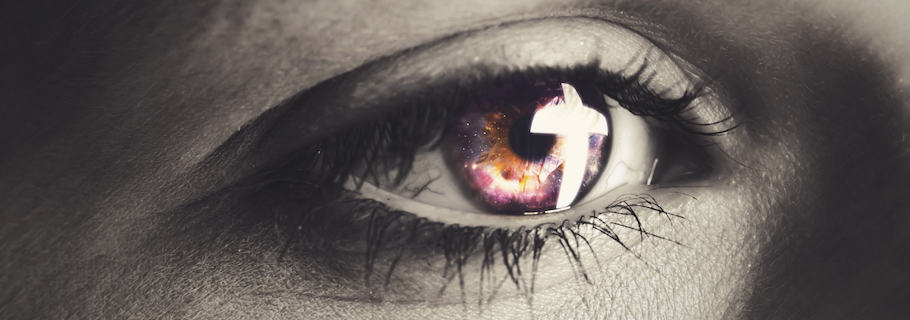
This refers, of course, to the pupil, and “little man” may be used because of the reflection of ourselves we see in another person’s pupil. In English it is the “apple” simply because the pupil resembles an apple. This language appears to have roots all the way back in ninth century Old English. It also appears in Shakespeare’s A Midsummer Night’s Dream: “Flower of this purple dye, / Hit with Cupid’s archery, / Sink in apple of his eye”.
The Application
Why would this expression for God’s tender care refer to the eye, and especially to the pupil? Because there is no place on the body we protect as automatically and as fully as we do the pupil. At the least sign of danger we flinch, we close our eyelids. What is more precious to us than our eyes and our eyesight? When God refers to his people as the apple of his eye, he is communicating that nothing is more precious, nothing will so easily and automatically come under his care. Here is how John MacArthur once explained it:
God says when you touch Israel, you touch the apple of My eye. God is saying you touch Israel and you’re poking your finger in My eye and that irritates Me…the most sensitive part of the exposed human anatomy, of course. And so He is saying you touch Israel, you poke your finger in My eye. You touch the church, you irritate Me, it’s My church, I gave My life for that church, Acts 20:28, He purchased it with His own blood. He is its architect. He is its builder. He is its foundation for other foundation can no man lay that in that is laid which is Christ Jesus. He is the living cornerstone. He says in John 10 I am the good shepherd and I know My sheep and have known of Mine. I know them and they know My voice. And He says no man is able to pluck them out of My hand.
While we are right to use the expression to speak of those we love, we ought to remember that our love is only ever a dull reflection of the much greater love with which God has loved us.
Would you like to sing about such sweet truth? Then why not sing along to “O the Deep, Deep Love of Jesus.” “O the deep, deep love of Jesus, / Vast, unmeasured, boundless, free! / Rolling as a mighty ocean / In its fullness over me!”
Or “Here Is Love” by Steve and Vicki Cook. “Here is love wide as the ocean / Loving kindness as a flood / When the Prince of Life, our ransom / Shed for us His precious blood.”