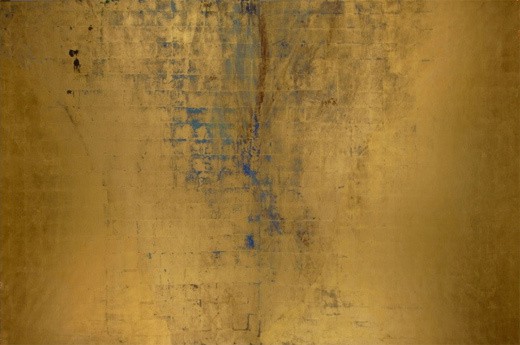
A little while ago I conducted a brief interview with Makoto Fujimura (makotofujimura.com). Fujimura is a New York-based artist who deals with a kind of art with which I have little familiarity. I first heard of him through an article written by Phil Ryken in which he describes visiting an exhibition featuring Fujimura’s work. I was intrigued by the examples of his art I saw through the internet and asked if he’d be willing to answer a few questions. He was kind enough to comply.
When did you first discover your love for art? Did you receive any formal artistic education? Who are your greatest influences in your art?
I grew up in a creative home (I was born in Boston, and grew up bi-culturally between Japan and US), my father being a research scientist, and my mother being a creative educator. Art was always part of my life, but it was not until I was in high school that I realized I had to protect my creative time, or it will be taken from me. I studied art in college (as part of a double major at Bucknell Universtiy), and received Japanese Governmental scholarship and ended up for six and a half years at a prestigious Nihonga program at Tokyo National University.
What kind of art do you primarily create?
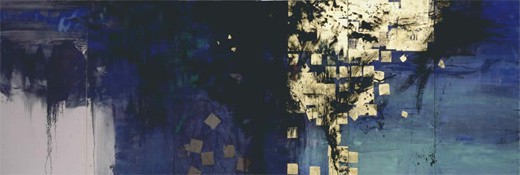
My art is based on medieval technique and method of Japanese art now known as Nihonga. If you come to my exhibits in NYC, you will not only see paintings, but also video installations. I also do collaborations with musicians, and recently I became the first artist ever to paint live on stage at the Carnegie Hall. But I see my art as part of my life, my writings, my effort to help our church plant activities in NYC. To me, “art” is not just the product of what I produce, but the process of revealing the core of my humanity.
Tell us about how you came to know the Lord.
My new book River Grace (will be available via www.iamny.org) accounts for my journey to come to faith in Japan while as a graduate student. My wife had a lot to do with it. It was triggered by the experience of creating beauty but that same beauty exposed my emptiness within.
Eric Liddell, the great Scottish Olympian and missionary once said, “I believe God made me for a purpose, but he also made me fast. And when I run I feel His pleasure.” Even in something as simple as running he felt the pleasure of God. Can you identify with that as you create works of art?
Absolutely. It’s the most intimate, worshipful experience to be alone in the studio and paint. I also resonate with Liddell, as I, too, feel that passionate call to share the love of Christ with others and be used to build the City of God.
Have you ever thought about what art will be like in the new heavens and new earth? Do you suppose you’ll be able to continue to create art for God’s glory for all eternity?
All the time…Art taps into the glory of the transcendent, and earthy, realities of the new heavens and new earth. Good art (whether created by Christians or non-Christians) should produce a longing for that reality.
Which of the works you’ve made so far are your favorites? Why?
I have a few paintings that I see as seminal works, such as Sacrificial Grace series in ‘98, exhibited at Dillon Gallery in NYC. I also did a series of works based on Dante’s The Divine Comedy, as a response to 9/11 (I am a “Ground Zero” resident), and my most recent called Golden Flames painting is one of the most important works for me.
How do you seek to bring glory to God through your art?
By being faithful and resourceful to investment in refinement of the gifts given to me, to use my creativity to contribute to community around me. I believe that art is inherently is of and from God (remember that our God is THE Creator), though we twist the gift of creativity given to us. So if you are involved in creativity, you dwell near the heart of God. Of course that does not mean we have personal relationship with the Creator and thereby being able, via the Holy Spirit, to enjoy God’s presence that is revealed via our creativity.
What are your hopes and dreams for your art? As you look to the future and allow yourself to dream a little bit, what would you like to see happen with your art?
I do want to be the best artist that I can be, to represent God’s grace in the world in my life as well as in the world. My effort to advocate for artists have grown into the International Arts Movement, a not-for profit arts organization that has a headquarter in New York City and chapters in Japan and elsewhere. We believe that God desires to re-humanize the world via the arts and creative expression, and we want to create a home for folks wrestling with deep issues of art, faith and humanity. Re-humanizing the world is a big, ambitious goal, and yet a goal that God calls all of us to participate in.
You may wish to learn more about Makoto Fujimura at makotofujimura.com.