This sponsored post was prepared by The Good Book Company, publisher of 90 Days in Genesis, Exodus, Psalms, & Galatians, with Calvin, Luther, Bullinger and Cranmer.
It seems like every publisher, organisation and church has been waving the reformation flag in some way as we celebrate 500 years of the protestant revolution.
No doubt there are many church members who have been helped to discover an aspect of our evangelical heritage that was invisible to them. But I wonder if there isn’t a different category of Christian that needs a different kind of help. Like any slice of history and heritage, we can easily get the wrong impression about what was really going on. Here are four common ones … you may have others.
1. It’s all about a man with a hammer
Not Thor—Martin Luther. The story of his 95 theses and the door of Wittenberg cathedral is widely seen as the starting point for the reformation. But like many revolutionary sparks, it is much less important than the volatile combustible material that it sets fire to. Widespread discontent with an authoritarian, corrupt and greedy church, combined with a hunger for education and personal knowledge was the tinder. Martin Luther was one focus of the revolution, but many others were significant parts of the picture Once the fire was started, there was no putting it out.
2. It was a clash between thinkers, theologians and powerful politicians
History recounts the dealings between kings and popes and churchmen, and the councils and disputations they spoke at. But lost from view is the bigger thing that was happening. Ordinary men and women were discovering powerful, life-transforming truths as they read the scriptures for the first time. It is not just that there were no priests in the New Testament. Nor that purgatory and indulgences are nowhere to be found in the Bible. It was the intense and liberating idea that God forgives a person direct by grace, and that everyone has access to God through Jesus without the need for an intermediary, best a church or a priest.
The great reformers we remember were scholars, and to some extent politicians or soldiers. But they shared a passion for communicating the doctrines of grace to ordinary people—the tinkers, farmers, merchants, mothers and milkmaids who comprise the substance of the reformation. We love the books of the leaders, but we do them disservice when we keep them as textbooks for seminary students, or for pastors. Their writings, once liberated from archaic translations, speak clearly and powerfully about the gospel of grace today to ordinary people.
3. We think that “being reformed” is about having a certain kind of style
It’s really not. “Reformed” has long been associated with a deep seriousness that expresses itself in more conservative forms of social interaction. Men in dark suits. Formal ways of doing church. Loooooooong sermons. But none of these things are core to what the reformation was all about.
At its heart, being protestant is about faith and grace and scripture and the glory of God alone — but there are a million different ways to express these values within church structure and a church-family culture. Noisy or quiet. Formal or informal. Classical or contemporary. Calvin promoted the “regulative principle” (i.e. that anything not mentioned in Scripture is not obligatory in church), and yet so many of his descendants adopt a more Lutheran approach—who believed that anything that was traditional in church should be maintained unless it was directly taught against by Scripture. Being reformed in the Calvin tradition should cultivate a rich and diverse freedom of expression in church life.
4. It’s over
It most definitely is not. The reformation is not something that happened back then. It is something that needs to continue today—even in reformed churches. The reformation was always incomplete, even in the places and the times when it took it’s strongest grip on a country or people group. What led to the need for a reformation was a vibrant early church that eventually lost its way. We are all in danger of that at all times. We need to keep being critical of our culture and own doctrine; to hold our thinking and practice and priorities up to the scriptures to see where we are falling short, and adjust accordingly. Semper reformanda—always reforming—must remain our watchword.
To celebrate the 500th Anniversary of the Reformation, why not let Calvin, Luther, Bullinger and Cranmer sit alongside you as you open up your Bible day by day with 90 Days in Genesis, Exodus, the Psalms & Galatians. The writings of these Reformers have been edited, and in parts translated, by Dr Lee Gatiss. Each day includes helpful questions and prompts to apply the reformers’ insights to your life and bring the reformation to life in your own devotional walk with God.
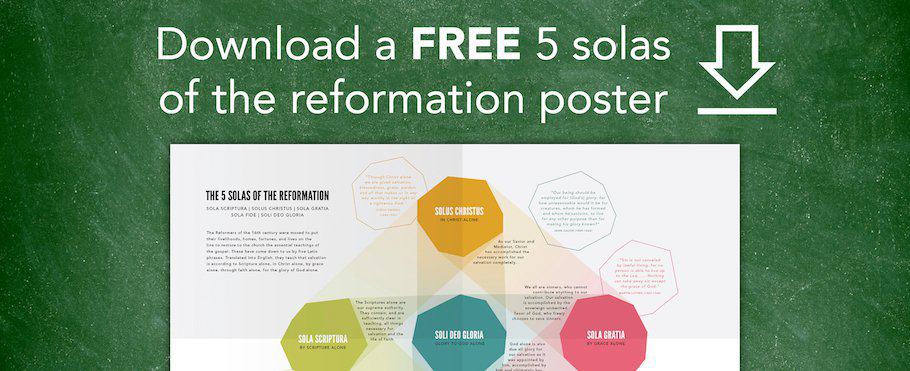
Download a free 5 Solas of The Reformation poster
The Reformers of the 16th century were moved to put their livelihoods, homes, fortunes, and lives on the line to restore to the church the essential teachings of the gospel. These have come down to us by five Latin phrases. Translated into English, they teach that salvation is according to Scripture alone, in Christ alone, by grace alone, through faith alone, for the glory of God alone.