

This sponsored post was prepared by John M. Frame.
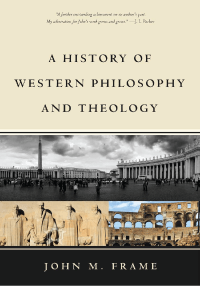 The history of philosophy (and of theology, which closely parallels it) is pretty exciting when you look at it through the lens of God’s Word. It challenges Christians today to resist the fashionable trends of secular thought, to resist temptations to compromise the truth for the sake of academic respectability. Living by faith in Jesus is important, not only in worship and moral living, but also in our intellectual decisions. That is my reason for writing my History of Western Philosophy and Theology, which I hope will encourage Christians to a bolder witness to thinking people of our day.
Many writers today extol the value of storytelling, so my new book will tell a story about philosophy, of all things. This story takes seven radical turns that I call convulsions. Convulsions happen because philosophy is central to our lives. Philosophies express our heart commitments and apply those commitments to all areas of life. When our philosophy is disturbed, everything else is affected. That makes for a dramatic story.
Here are the convulsions:
- Creation. When God brought out of nothing the world in all its splendor, the event was overwhelming and dazzling. And it was philosophical. When God made Adam, he gave him a philosophy that said that God was Lord and that mankind was made to think God’s thoughts after him.
- The fall. But then a new convulsion turned this dazzling reality upside down. After the fall, Adam and Eve forsook God’s thoughts to think their own way—“autonomously.” They no longer accepted God’s thoughts as their law, and the whole creation fell under a curse, unwilling to accept easily the dominion of mankind. But God reached out to Adam and Eve in love and promised redemption. Sometimes they and their children lived by the promise, sometimes not, sometimes by a mixture of truth and lies. Their offspring gathered some of the best thoughts of mankind under the label wisdom. We have some of this wisdom in the Bible—in Job, Proverbs, Ecclesiastes, and the Song of Solomon.
- Greek philosophy. In Greece people who claimed to love wisdom, and therefore called themselves philosophers, set aside the wisdom of the wise men and the religious traditions and sought to understand the world by their own autonomous reason. Plato, Aristotle, and others wrote ingenious arguments, trying to locate ultimate truth in the abstract forms of human experience. But they failed to impose an autonomous rational scheme on a universe that they insisted was irrational chaos.
- Jesus and the gospel. The preaching and teaching of early Christians had the potential to wrench the intellectual initiative from the Greek philosophers. But instead early Christian philosophers sought to gain intellectual respectability through compromises with Greek philosophers. This continued even into the medieval period when Christian philosophy dominated the West.
- The Protestant Reformation. Luther, Calvin, and many others challenged Christian philosophers to turn away decisively from autonomous reasoning. But before the Reformers could make progress in philosophy, there was still another convulsion.
- “Modern” philosophy. This thinking was marked by an autonomous secularism more radical than that of the Greek philosophers. In Europe, under the leadership of Descartes and others, it focused on human reason. In the English-speaking world, Locke and others proclaimed the authority of sense experience. This secularism continues to dominate academic philosophy down to our own day.
- The final judgment. Imagine what will happen to earthly philosophy when Jesus comes again. In our own time, we see trends that anticipate much more consistently Christian ways of understanding the world, inviting us again to think God’s thoughts after him. This trend has the makings of a seventh historical convulsion, and of a new birth in philosophic insight.
The story of philosophy should challenge both Christians and non-Christians to hear God’s Word as they develop their worldviews, for God’s Word teaches us how to think his thoughts. It also shows the importance of asking God for courage in what I call the “spiritual warfare in the life of the mind.” That warfare is not easy, as more and more cultural forces line up to marginalize the biblical view of the world. But God has promised us victory. In time, everyone will bow the knee as God brings every thought captive to the obedience of Christ.
Preorder A History of Western Philosophy and Theology at Amazon.com or go to Westminster Books to be notified when it is available.
John M. Frame (AB, Princeton University; BD, Westminster Theological Seminary; MA and MPhil, Yale University; DD, Belhaven College) is the J. D. Trimble Professor of Systematic Theology and Philosophy at Reformed Theological Seminary in Orlando and the author of many books, including the four-volume Theology of Lordship series.