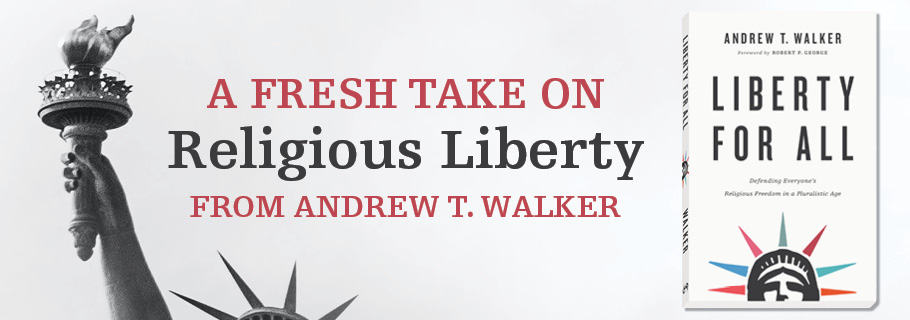
This week the blog is sponsored by Brazos Press and is adapted from Andrew T. Walker’s new book Liberty for All: Defending Everyone’s Religious Freedom in a Pluralistic Age.
It is common to hear religious liberty advanced under the banner of the “free market of ideas.” While we should exercise caution in reducing evangelism to ideas associated with mere choice and consumption, there is an important truth here: if the gospel is true, the gospel does not need government preference.
Why?
Because in the scope of history, truth wins. That is not to say that truth is always victorious, but that in the fullness of time truth will overcome error just as goodness will triumph over evil. Truth needs nothing other than itself for persuasion.
Thus, for a Christian, religious liberty expresses confidence in the gospel. The gospel needs no accomplices. It is independent from artificial supports that would attempt to bolster its credibility. The gospel needs not the bejeweled trappings of salesmanship or a sword-drawn threat. Those with ears to hear will hear (Matt. 11:15). Humanity is not under compulsion to accept the blessings of Christ. The rich young ruler’s rejection of Christ was not met with earthly punishment (Luke 18:18–30).
Paul did not fear a free market of ideas but used such a context to spread the gospel. Indeed, the apostolic witness of the New Testament asserts the priority of the conscience against the claims and protestations of government authorities in order to proclaim the gospel (Acts 5:29). Paul never backed away from the strange claim that God raised Jesus from the dead. He used persuasion, argument, and an appeal to the conscience to advance the gospel.
The gospel advances in only convicted, not coerced, consciences.
For Paul, a pluralistic setting was not an obstacle to making an exclusivist claim concerning soteriology. Paul explicitly invoked Jesus and the resurrection to his hearers, doing so by exploiting their assumptions and directing them to see how Christ fulfilled their own metaphysical views. Rather than watering down the exclusive claims to service the needs of an enlightened audience, Paul reinforced the starkness of the gospel by summoning all to its dawning.
That is instructive for missiology because it demonstrates that religious liberty operates according to sincerity of conviction and that Christianity’s messengers need not downplay the strength of their message for it to be received.
Religious liberty speaks to the confidence the church has in its gospel—that because the gospel is true, it requires neither force nor privilege. The gospel calls for the church to be prophetically separate from the institutions of society that would subjugate it for exploitative ends.
A church can possess all the requisite freedoms it desires and still not preach a true gospel. A doctrine of religious liberty frees the church to be the church that God is calling it to be in society for the sake of the world.
Liberty for All: Defending Everyone’s Religious Freedom in a Pluralistic Age is available now wherever good books are sold.