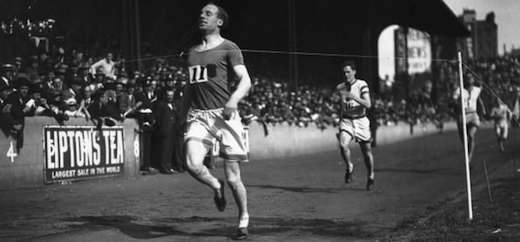
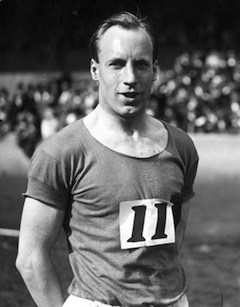
 Yesterday I shared the first part of a brief biography of Eric Liddell. Today I would like to complete it. In the first part we got as far as Eric Liddell returning to Scotland after winning two Olympic medals.
And here he is, just 23 years old, a sports hero who still had at least another Olympics or two in him. He could have played professional rugby, he could have kept running. The world was before him. But he shut it all down and gave it all up, heading to China so he could preach the gospel. And here is a second lesson I see in his life. He was willing to give up everything for the sake of the gospel. Would you be willing to give up fame and money and popularity and everything else in order to heed the call of God? Let’s not make light of this and pretend like it was an easy thing. He was giving up everything most of us dream of. And it seems like it wasn’t difficult for him at all. He knew what God was calling him to do and he had no regrets, no second thoughts. Could you do that?
1925 marked the beginning of Eric Liddell’s second career, the one he cared about far more than the first. He had loved running, but now he was to be a teacher, and best of all, a teacher who could share the gospel with his students. He became a science teacher at Tientsin Anglo-Chinese College. This was a college that catered to the sons of many wealthy Chinese politicians and businessmen. The college’s founder thought this would be a way of reaching the next generation of rulers with the gospel.
Eric’s parents were serving in that very area, so for the first time in many years, Eric got to live with his family—his parents, his younger sister and his younger brother. Rob had married in the meantime and was heading to a different part of China to work as a doctor and missionary. It wouldn’t be long before Eric also started pursuing a wife.
There was just one problem.
The girl he was in love with was ten years younger than he was. Florence MacKenzie was her name, a child of a missionary from Canada. Her dad, Hugh MacKenzie, had been sent to China by the United Church. Now Eric started to notice Florence, or Flo as she was called. He started to make sure he was home when Flo came to the Liddell home for a piano lesson and he started to drop by the MacKenzie home fairly often, just to hang out. He was successful enough in all of this, or awkward enough, more likely, that no one guessed that he was interested in Florence. It was three or four years before he started to become bold, figuring then that Florence was old enough to pursue a relationship. He finally did ask her to marry him and when he did, she was so surprised that she made him repeat the question. She had no idea he was in love with her. But she was thrilled and said yes. There was just one problem—she wanted to be a nurse and her father insisted that she finish her training before she could marry him. And that would take four years. From 1930 to 1934 she studied right here in Toronto. Eric and Florence saw each other a couple of times in these years, but only for short visits. But finally the years were over, she was a nurse, and she returned to China. They were married on March 27, 1934. Eric was 32 and thrilled to finally be married.
At this point Liddell had only ten years to live, though they didn’t know it at the time. He and Florence settled well into married life and God eventually blessed them with three children, all girls. By this time he had decided to leave teaching and to dive into more straightforward missionary work. While there were missionaries serving the cities, there were not very many in the countryside, serving the small towns and hamlets. He decided that God was calling him to this kind of ministry. He took up work in the area of Siaochang, a tough place to be since there was still little peace in China. Communism was starting to grow and a kind of civil war broke out between the Communists and the anti-Communist Nationalists. Much of Eric’s work involved traveling long distances to visit small churches and encourage the pastors. He would also organize conferences for those preachers and would do evangelistic work on his own. And all the while he crisscrossed the country, passing one army and then another one, with wars raging all around.
In 1937 it got far worse. Japan attacked China, invading the country and committing horrible atrocities against its people. Eric found himself in the midst of this fighting and was called upon to try to rescue Chinese citizens who had been wounded. In such times he showed great bravery, one time traveling 40 miles to save a man who had been badly wounded but not quite killed and bring him all the way back to the hospital.
By early 1941 the situation was so unstable that Eric sent his family back to Canada. The World was at war and it would be just a few months more before Japan waded into it as well. China was becoming a very dangerous place to be, but Eric felt that he needed to stay there, to minister to the people he loved. He had been born in China and he would die in China. When Japan attacked the United States in December, Eric, like all foreigners, was placed under house arrest, not able to travel around and not able to have any real freedom. He was an enemy in the country he loved. In 1943 he and all the other London Missionary workers were sent to an internment camp in Weihsien, about 600 miles away. And here they would remain until the end of the war. The quarters were rough and cramped, with four men sharing a tiny room 9 feet by 12 feet. The missionaries tried to carry on life as usual, teaching, preaching and otherwise carrying on a semblance of normal life. All the while they were able to send only short 25-word letters to home and these would often take 6 months or more to travel to Canada.
Eric was a popular person in this camp. He took it upon himself to preach the gospel and to work with young people. He discipled many young people, especially teenagers. He preached, the taught, he helped organize events that would help overcome the boredom of being captives in a small compound. The kids came to call him Uncle Eric and they loved him as if he was a true uncle.
By the closing days of 1944, though, a change came over Eric. He began to experience terrible headaches and even began to lose his temper on occasion, something no one had ever witnessed before. Doctors at the compound suspected he might have a brain tumor. There was no medical treatment available there, so they just had to wait and see.
By February he suffered a small stroke, confirming what the doctors thought—he must have that tumor. On February 21, while talking to a friend, he suddenly collapsed and slipped into a coma. That night, at 9:20 PM, he died. His last words were, “It is surrender.”
And those were appropriate words, because his life was all about surrender. Here’s the third lesson from his life: the importance of total surrender. Liddell spoke often of surrender; it was one of those terms he loved to use and loved to apply to all of his life. He knew that God had called him in a radical way; he knew that God demanded all of his life. He wanted to surrender all he was and all he had. He wanted to be used by God in whatever way God could use him. At that prison camp a friend asked him, “Did you ever pray to win a race?” No, he said, he didn’t ever pray to win a race. But he sure would pray before he preached the gospel. He prayed far more for those short speeches than for those great races. He would surrender himself. Win or lose, he wanted God to be glorified. He felt that God would not be glorified in racing on Sunday and he completely surrendered himself to that. And that is how people remember him today, as the man whose Christian principles outweighed everything else.
You know, if ever there was a man for who these words are appropriate, it was Eric Liddell. “I have fought the good fight, I have finished the race, I have kept the faith. Henceforth there is laid up for me the crown of righteousness, which the Lord, the righteous judge, will award to me on that Day, and not only to me but also to all who have loved his appearing.” Eric Liddell knew all about the victor’s crown, he knew all about the gold medals and the cheering crowds. But he got what he wanted most of all; he got that crown of righteousness. He finished race and he kept the faith. His most famous run lasted 47.6 seconds, a world record, but his legacy continues not because of that race and that victory, but because of the one he didn’t run. His legacy is built on his faithfulness to God.
Chariots of Fire
As I was preparing this short biography I watched the film Chariots of Fire. I think it’s likely that the more you know about Liddell, the less you’ll enjoy the movie. Or maybe I’m just a bit of a jerk. But since most people know Eric through the movie, let me correct it in just a few places.
- He was not as bad a runner as the movie indicates. They almost lampoon his running style. Video of Eric shows that he really did not have terrible form. He did have the odd habit of throwing back his head at pivotal moments, but he did not thrash his arms as badly as the film shows.
- In the film his sister is shown to be a real shrew, but in reality she was quite supportive. She was also in China for most of Eric’s life, so was not such a constant presence.
- Eric did not discover on the way to the Olympics that he was going to have to run on Sunday. He actually found out months in advance and had lots of time to prepare himself. Of course this also means that he had a lot more time to face critique.
- Just for fun, watch the final race and you’ll see that the piece of paper he is handed is sometimes in his hand and other times not. He starts with it and ends with it, but in the middle it’s clearly not there!
- The movie attempts to contrast Liddell and Abrahams, but in doing so it shows both men as far less than they really were.
- Oh, and it shows them with medals. At the 1924 Olympics the medals were actually mailed to the winners months later; there were no medal ceremonies back then.
I guess the long and short is that it’s a good movie, but it’s still a movie. It’s meant to tell a good story, not necessarily a true story.
Want to learn more about Liddell? Here are a couple of recommendations:
- Pure Gold by David McCasland. A good, general biography.
- Running the Race by John Keddie. A good biography that focuses a bit more on his sports accomplishments.