I don’t think we should go back to using hymnals. But I do think there’s value in considering what we lost when, over the course of a relatively short period of time, we gave up hymnals for PowerPoint projection. Not all of us, mind you, but most of us. It’s worth considering because it helpfully shows what we stand to lose when we switch from one media to another, and especially when we do so quickly and without due consideration.
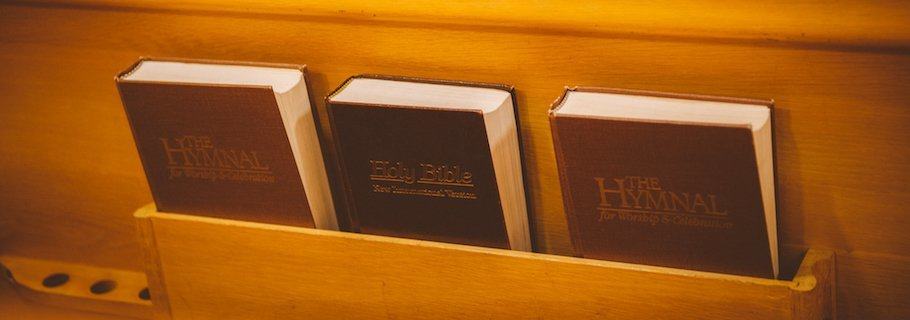
If we were to go back in time twenty or thirty years, we would find that most churches had hymnals. They had hymnals because it was the best way of providing each member of the congregation with a copy of the songs. You’d hear it in every church: “Take out your hymnal and turn to hymn 154…” And then hymnals went the way of the dodo and we began to look instead to words projected on a screen. Here is some of what we lost along the way.
We lost an established body of songs. Hymnals communicated that a church had an established collection of songs. This, in turn, communicated that its songs were vetted carefully and added to its repertoire only after careful consideration. After all, great songs are not written every day and their worth is proven only over time. Therefore, new hymns would be chosen carefully and added to new editions of the hymnal only occasionally. Churches would update their hymnals, and, therefore, their established body of songs, only once every ten or fifteen years.
We lost a deep knowledge of our songs. When we removed the hymnal, we gained the ability to add new songs to our repertoire whenever we encounter one we deem worthy. And we do—we add new songs all the time. As we add new songs with greater regularity, we sing old songs with less frequency. This reduces our familiarity with our songs so that today we have far fewer of them fixed in our minds and hearts. Few congregations could sing even the greatest hymns without that PowerPoint screen.
We lost the ability to do harmonies. Hymnody grew up at a time when instrumentation took a back seat to the voice. Hymns were most often written so they could be sung a cappella or with minimal instrumentation. For that reason, hymnals almost invariably included the music for both melody and harmonies and congregations learned to sing the parts. The loss of the hymnal and the associated rise of the worship band has reduced our ability to harmonize and, in that way, to sing to the fullest of our abilities.
It often seems like all we want from the congregation is their enthusiasm.
We lost the ability to sing skillfully. As congregations have lost their knowledge of their songs, they have lost the ability to sing them well. We tend to compensate for our poorly-sung songs by cranking up the volume of the musical accompaniment. The loss of the voice has given rise to the gain of the amplifier. This leads to our music being dominated by a few instrumentalists and perhaps a pair of miced-up vocalists while the larger congregation plays only a meager role. In fact, it often seems like all we want from the congregation is their enthusiasm.
We lost the ability to have the songs in our homes. Hymnals usually lived at the church, resting from Monday to Saturday in the little pockets on the back of the pews. But people also bought their own and took them home so the family could have that established body of songs there as well. Families would often sing together as part of their family worship. It is easy to imagine a family singing “It Is Well With My Soul” after eating dinner together, but almost impossible to imagine them singing, “Oceans.”
It is probably too late to go back to the hymnal. I am not at all convinced we ought to. But it is still worth considering what we lost along the way and how congregational singing has been utterly transformed by what may appear to have been a simple and practical switch in the media. That little change from book to screen changed nearly everything.