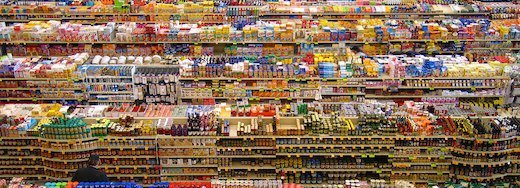
Simplicity is a trending topic in our culture and our day; there is good reason for this. We are drowning in stuff and drowning in options. Somewhere along the way, many of us find it all overwhelming and overbearing. Somewhere along the way, all of these choices are making us miserable.
In the past couple of weeks I have been in the market for a new car. Having just accepted a full-time position as Associate Pastor at Grace Fellowship Church, I found that in order for me to do ministry well, and in order for Aileen to be able to keep things running around the home, a second car would be very, very useful. I went out shopping and within hours my head was spinning. My main requirements were reliability and fuel efficiency while also keeping a close eye on price. This led me to the compact market–cars like the Honda Civic, Ford Fiesta (or Focus), Hyundai Elantra, Volkswagen Jetta and on and on and on. Within a fifteen minute radius of my home there are probably 30 or 40 different cars that would fit the bill. But not only that, there are 5 or 6 models of each of those cars–DX, LX, EX, entry model, mid-range, high-end. The choices were bewildering. Oh, but there’s more. Even once you choose your model there are colors to go through, typically 6 or 8 per car. And then there are the accessories to choose from–from better tires to rear spoilers to $50 cup holders and upgraded stereos. And those $2000 navigation systems that don’t do anything a $100 TomTom can’t do.
I eventually settled on a Honda Civic, pretty much ending where I had begun. But even then the choices were not finished. No sooner had I said, “Sold!” than they started telling me what a horrible decision I had made and how badly I was going to need 1 of the 8 extended warranty plans they make available. Suddenly my Honda Civic, historically the most reliable compact car on the market, had become a Lada. In what may not have been my finest moment, I reached over and closed the brochure the guy was leading me through and said, “You sold me this car on its reliability. There is no way I’m going to sit here and listen to you tell me what a piece of junk I’ve bought. So we’re just going to put this away and I don’t want to hear another word about the extended warranty unless you’re going to give it to me for free.”
I picked up the car on Monday and love it. But I can’t help but feel a nagging in the back of my mind. What about all those things I chose not too choose? Did I make the right decision? Should I have gone with the model up? The model down? Should I have added in some of those options and accessories? Am I going to regret not getting the satellite radio? Do I really want to have a GPS stuck on my windshield instead of installed into the dashboard? I made my decisions and I now have to live with them, but that doesn’t mean that I am not going to find myself wondering if I did what was best.
The fact is that we live in a world of almost infinite choice. It wasn’t always this way, of course. Even just a few generations ago people made do with far less to choose from. But today we demand and expect that we will be able to choose from among hundreds of options. This is true when it comes to cars or mobile phones or even just choosing a cereal for breakfast.
I guess the thing is that by now society has given us just about all we need to live comfortable lives, but companies have found that they can increase profit margins by leveraging us into buying things based on marginal options. These options are not necessary or even that important. Instead, they are the optional features that few of us will ever use but all of us think we might, just perhaps, need. So we buy the camera with the extra megapixels (in case we ever want to make a print the size of a house) or the extra address book storage capacity (in case we ever have that many friends to keep track of). One author writes “The market for most practical products is saturated. Manufacturers used to respond to this problem by competing primarily on price, but beyond a certain point that gets too painful. So they began instead to offer more options–creating whole new wants and then supplying things to meet them.” They give us more to choose from, which gives us all the rationale we need to spend more money.
A little while ago an article in the Times discussed this very thing. Though our consumeristic mindset may beg to differ, choice, is not the key to happiness.
Everywhere you turn there is a mind-boggling parade of clothes, gadgets, financial products, holidays and entertainment. Tantalised by all these buying options, we stockpile our shopping baskets, homes and lives with ever more consumer goods that we probably don’t need or even appreciate. And this isn’t good for our happiness.
“The huge number of choices that assault us every day makes many of us feel inadequate and in some cases even clinically depressed,” says Professor Barry Schwartz, a psychologist from Swarthmore College in Pennsylvania and the author of The Paradox of Choice. “There is vastly too much choice in the modern world and we are paying an enormous price for it. It makes us feel helpless, mentally paralysed and profoundly dissatisfied.”
And who can claim that they haven’t felt dissatisfied after choosing from among so many options? Not too long ago Aileen needed a new cell phone as her old phone had stopped working. There were so many options to choose from that we really had no idea how to distinguish one from the others. Eventually we just went with what the company recommended to us, undoubtedly the phone for which they make the greatest profit margins. “Professor Schwartz believes that the dogma of all Western societies – that maximising freedom and choice increases welfare-is deeply flawed. ‘It wouldn’t surprise me if eventually you’ll be able to buy a mobile phone with integral nasal-hair trimmer and creme brulee torch,’ he speculates sardonically.”
I could really use a new torch, and all the better if it integrated with my phone, my nail clippers and my Honda Civic.
“So much choice makes decision-making increasingly complex,” says David Shanks, a psychology professor and the co-author of Straight Choices, a new book that examines how to make the best decisions when faced with a perplexing array of options. We feel bad that every time we do make a choice, it seems we are missing out on other opportunities. This makes us feel inadequate and dissatisfied with what we have chosen. Often, we feel bamboozled and just shove a familiar or prominently displayed brand into our basket. Then we feel useless because we can’t cook gourmet dinners like Jamie Oliver and don’t know what to do with any of these exotic new ingredients. So we end up buying and eating the same meals time and again.
This excess also numbs us to the heady pleasure felt by previous generations when they bought something new in an era when budgets were leaner and consumer goods in shorter supply. All we can think about now is what we still want to buy, rather than appreciating what we have.
Or perhaps instead we’re thinking about what we could have had. This new car I have is excellent. But maybe I should have bought the next one up–the one with the 17″ tires and the built-in nav. Or maybe I should have saved a few bucks by buying the one that is one-step down. Or…it never ends. The evidence suggests, says Professor Leppe, that we thrive when we have less choice. “Excess choice is paralysis rather than liberation.” “‘It challenges a lot of our beliefs, but it could just be that choice within constraints will make us feel a lot better,’ says Professor Schwartz. ‘We need to live in the moment, appreciate what we have and not think about all the other things that we could choose instead.’”
Even better, we need to live with an eye to the future. We can pile up all the stuff we want here on earth, but we can’t take it with us. But we could still live our lives miserable, always wondering what could have been. The endless choice we face may be the mark of our culture’s prosperity but the evidence is proving that it just makes us miserable. It seems to me that endless choice makes for endless discontent.