
Today I want to step into dangerous territory and discuss free will. This is a massive topic with implications that stretch to almost every part of the Christian faith. I want to look at just one small part of it. I want to deal with a statement I’ve heard and read time and again. I came across this most recently when reading C.S. Lewis’ Mere Christianity. “Free will,” he says, “though it makes evil possible, is also the only thing that makes possible any love or goodness or joy worth having.” If God had not given us free will, such people say, we could not truly have loved him. Our love would be the love of robots, of automatons, love that would be neither genuine nor sincere. It would be a meaningless, forced love which in reality would be no love at all. This is what we are told. I want to suggest today that the Bible does not tell us one way or another. This may be a valid inference, but it is one that is not explicit in Scripture and, hence, one we should be hesitant to declare with great confidence.
I am writing today knowing that I could be wrong and inviting you to show me if that is, indeed, the case.
My line of reasoning will go like this. If this statement is true, it casts doubt on the manner and sincerity of the Christian’s love of God in heaven. Therefore, if this statement is untrue of the heavenly man, it may also be untrue of the earthly man.
It was Augustine of Hippo who first described the four states of man. They are most easily understood when put into the form of a table like this one:
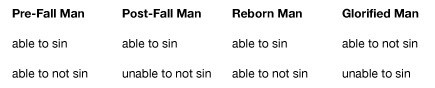
Adam and Eve were in what Thomas Boston calls a state of “primitive integrity,” able to choose whether they would sin or not sin. They were able to sin but were also able to not sin. The choice lay before them and we know which path they chose. Adam’s decision cast man into a state of “entire depravity” in which people can no longer make such a choice. Man is now able to sin and unable to not sin. There is not a person on earth who can go a lifetime without sinning; neither is there one who would wish to. Our very natures have become sinful. However, those who are born again, who are regenerated by the Spirit of God, are in a state of “begun recovery” (again, according to Boston) and every moment of every day face a choice. They are able to sin but are also able not to sin. Experience and observation shows that Christians sometimes make one choice and sometimes make another. Their new natures give them the ability to choose to not sin, but the old man constantly fights back, pushing to choose what is sinful. But all the while Christians look forward to the day of “consummate happiness” in heaven when they will be able to not sin and unable to sin. God will grant them the ability to not sin and will remove any vestige of desire to sin. This is one of the great promises of heaven, that “He will wipe away every tear from their eyes, and death shall be no more, neither shall there be mourning, nor crying, nor pain anymore, for the former things have passed away (Revelation 21:4).”
It is this final part of the grid that causes me to wonder if our love truly had to be entirely free for it to be genuine. After all, as Christians we look with great anticipation to the day when our sin will be taken away and we will no longer even be able to sin. At this time will our love for God be more genuine or less genuine? Will we love God more or less than we love him now? When we read Scripture and, with great anticipation look to the passages that describe heaven, we can only conclude that our love for God today is only a shadow of the love we will have for him in that day. And yet it will be a love that is restricted by our sinless natures–a love that will not allow us to ever sin or even consider sin.
As I understand it, Augustine would agree with me here. He would say that the ability to sin is not essential to free will. After all, God is free but without the ability to sin. The angels are free but without any ability to sin. And, as we’ve established, we will be free in heaven, but not free to sin.
All of this to say that I simply do not find that we need to believe that the only love worth having is a love that can choose not to love.
But feel free to tell me if and how I’m wrong here…





