Authors are being targeted today. I expect this targeting includes all authors, but I can attest that it certainly includes Christian authors. As far as I can tell, these are not particularly dangerous scams, but they are annoying nonetheless and potentially costly.
Here’s how they work. After you have published a book, you may begin to receive emails from people who say they have read and enjoyed it. They may claim they work in marketing and have identified ways in which your book could be marketed more successfully. Alternatively, they may claim they work in translation and would like to help create foreign editions. These emails tend to come from plausible email addresses and are usually written by people with realistic names, though “Zaydrin Orvex” (see below) may be stretching credibility since it sounds like it could have come from The Hitchhiker’s Guide to the Galaxy.
Another variation comes from people who also express appreciation for your book and then say they would like to include it in a forthcoming book club (often “Glasgow Book Club”). These emails also come from people whose names may trigger no alarms and from actual email addresses. If you look carefully, though, you may notice they are off by a character or two. I have received emails claiming to be from people and organizations I actually know and who are associated with my relatively narrow corner of the publishing field, which tells me that the targeting is relatively granular.
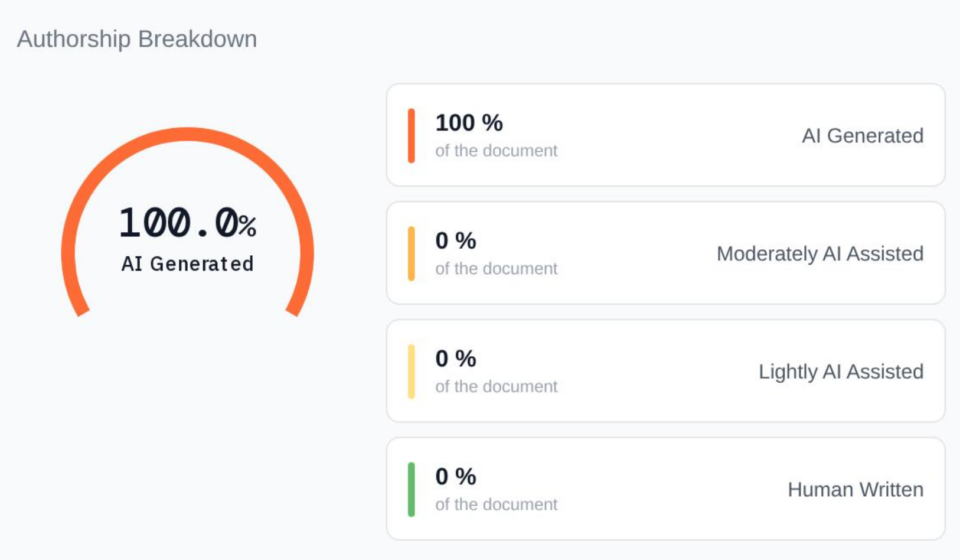
In any case, a careful reading of the email will show it has probably been generated by AI. So too will screening it with an AI-detection tool like Pangram. You will notice many tells:
- It may be addressed to a first name and last name rather than merely a first name, as would be more typical.
- It may be mostly boilerplate text that could pertain to any book, with only a few details changed to fit yours.
- It may be clear that any information about the book has been drawn exclusively from the book’s description at Amazon or the publisher’s site.
- It may repeat the book’s subtitle more than any human author would.
- It may just have that AI feel to it.
Yet for all of that, it may be close enough to be confusing or even convincing. Not only that, but enough real people are using AI to write emails today that AI use alone could be insufficient proof.
The Scam
What’s the scam? If you were to reply, you would soon be asked for money—money to market your book, translate it, or include it in a book club. The request is unlikely to be for vast sums, though it will be enough for you to feel it, especially since you will either get nothing in return or nothing of any quality. Whoever is behind the scam may take the money and run, or they may take the money and churn out some low-quality AI-generated marketing material or translation. It is unlikely that you will receive any significant value for your money.
My encouragement to authors is to be wary of unsolicited emails like these. If you receive one and are intrigued by the offer, find a way to verify it. Look up the name of the person who claims to have emailed you, look carefully at the email address to see if it is merely similar to that of a legitimate individual, and pass the email through Pangram. You could also consider copying and pasting the email and header data into your favorite AI and asking if it is spam, as those tools may offer helpful insights. Presuming you have worked with a publisher, be sure to ask your publisher if these offers are legitimate. Understand that it would be very rare for a book club to charge you to read a book, for a translation to be created apart from the publisher (who probably holds the contractual right to translations), or for an author to hire an outside marketer rather than use the publisher’s in-house team. In short, prepare yourself to receive these spam emails and prepare yourself to ignore them.
A Sample Email
Here is just one of many such emails I have received. Scroll down for the Pangram report.
Dear Tim Challies,
I didn’t sit down today intending to write to an author.
Then I came across God’s Great Big Global Church: Visit 10 Kids and Their Churches All Around the World.
What stood out to me wasn’t simply that the book introduces children to churches in different countries, but the way you help young readers see that their local church is part of something much larger, a global family of people worshiping God.
I was especially drawn to the decision to introduce children to ten different countries through the experiences of fictionalized children. Rather than simply presenting facts about different cultures, the book allows young readers to discover what everyday life, worship, church community, and faith can look like for children around the world.
The combination of engaging stories, cultural details, illustrations, Bible passages, and family discussion prompts gives the book an educational purpose while keeping the experience accessible for children ages four to eight. It also creates an opportunity for parents, churches, and Sunday School teachers to help children develop a broader understanding of Christian fellowship and the diversity of God’s people.
That’s why I’m reaching out.
I work with authors to help identify international markets where their books have strong potential and guide them through producing high quality translations that preserve the biblical message, child friendly language, cultural details, warmth, educational value, and faith centered purpose of the original work, not simply the literal words.
For God’s Great Big Global Church, thoughtful translation is especially important because the book brings together Christianity with real world cultural experiences from different countries. The descriptions of daily life, worship practices, Bible passages, conversations, and cultural references all need to remain accurate, natural, and meaningful for children and families reading in another language.
There are Christian families, churches, Sunday Schools, Christian schools, homeschool communities, children’s ministries, and parents around the world who are looking for resources that help children understand both their faith and the wider Christian community. A carefully translated edition could allow God’s Great Big Global Church to reach children who may never encounter it simply because it is currently available primarily to English language audiences.
If you’ve ever been curious about what expanding God’s Great Big Global Church: Visit 10 Kids and Their Churches All Around the World into other languages could realistically look like, I’d be happy to prepare a simple overview of the markets I’d recommend, why they make sense for this particular book, and what the translation process and potential outcome could involve.
I look forward to hearing from you.
Warm regards,
Zaydrin Orvex
Evaluating the Email
Here is the Pangram report.
Meanwhile, here is what ChatGPT had to say about it:
I would treat this as mass-produced, AI-personalized sales spam, though the text alone does not prove fraud.
The strongest signals:
- The opening is a reusable template: “I didn’t sit down today intending to write to an author. Then I came across BOOK TITLE.”
- The personalized material reads like an expanded publisher description. It mentions no genuinely distinctive passage, illustration, argument, or personal reaction that demonstrates the sender actually read the book.
- Several paragraphs repeatedly restate the same premise—children, churches, cultures, faith, translation—with little new information. That repetition is characteristic of AI-generated outreach.
- The transition “That’s why I’m reaching out” is a stock cold-email bridge.
- The offer is deliberately vague. There are no proposed languages, markets, comparable translated titles, sales estimates, translators, credentials, pricing, distribution partners, or publishing arrangements.
- “Potential outcome” avoids making any concrete commitment.
- A translation professional would normally recognize that translation rights may be controlled by the publisher, not simply approach the author as though translation were a straightforward author-purchased service.
- Using a Gmail address is not inherently suspicious, but combined with the absence of a company, website, job title, physical location, portfolio, or verifiable credentials, it is a significant warning sign.
- A web search found no meaningful professional footprint for “Zaydrin Orvex” and no indexed occurrence of the distinctive opening. That does not prove the identity is fabricated, but it offers no reason to trust it either.
My assessment:
- Mass-produced/AI-assisted solicitation: very likely
- Sender actually read the book: unlikely
- Legitimate, established translation professional: unsupported
- Outright scam: possible, but not established from this email alone
The likely business model is to provoke a reply and then sell translation, publishing, or “international marketing” services—possibly low-quality or largely AI-produced ones. The compliment-heavy introduction is there to create the impression of careful personal attention.
I would not reply unless you are genuinely curious. Do not send a manuscript, sign anything, or pay for a “market analysis.” If you do engage, ask for the sender’s legal business name, website, LinkedIn profile, translated books with ISBNs, author references, translators’ qualifications, exact target markets, distribution arrangements, and an explanation of how they handle rights with your publisher. A genuine professional should answer those questions concretely.
Another Email
Here is a second email which was much more plausible since it cleverly impersonated a person and organization.
Dear Tim Challies,
I am [actual name of someone I know], founder of [actual site for readers]. For years, our mission has been to help [actual correct details] with confidence and biblical discernment. We deeply appreciate books like yours that engage young minds while respecting their moral and spiritual development.
Your recent work, God’s Great Big Global Church: Visit 10 Kids and Their Churches All Around the World, caught our attention for its compelling storytelling and strong thematic integrity. We would love to feature your book on our platform to help our highly engaged community of Christian families discover your work.
To help your book reach the right readers, I would love to explore a partnership collaboration with you. We can design a tailored promotional campaign that includes an in-depth review on our website, a featured spot in our popular newsletter, and direct engagement with our audience through our social media channels.
By partnering with [organization], you will connect directly with thousands of intentional parents and educators who are actively searching for high-quality, trustworthy literature for their children.
Let me know if you would be open to discussing how we can work together to champion your book.
Warmly,
[Name]
Founder, [Organization]
[Plausible email address that includes the organization name, but with an “s” appended]
Once again, ChatGPT made short work of the email. It went to the legitimate site and found a rash of errors and inconsistencies before concluding, “My verdict: the organization and named person are legitimate; this email is not. It is highly likely to be an AI-written impersonation intended to lead into a paid promotional offer or scam. Do not reply to the Gmail account.”