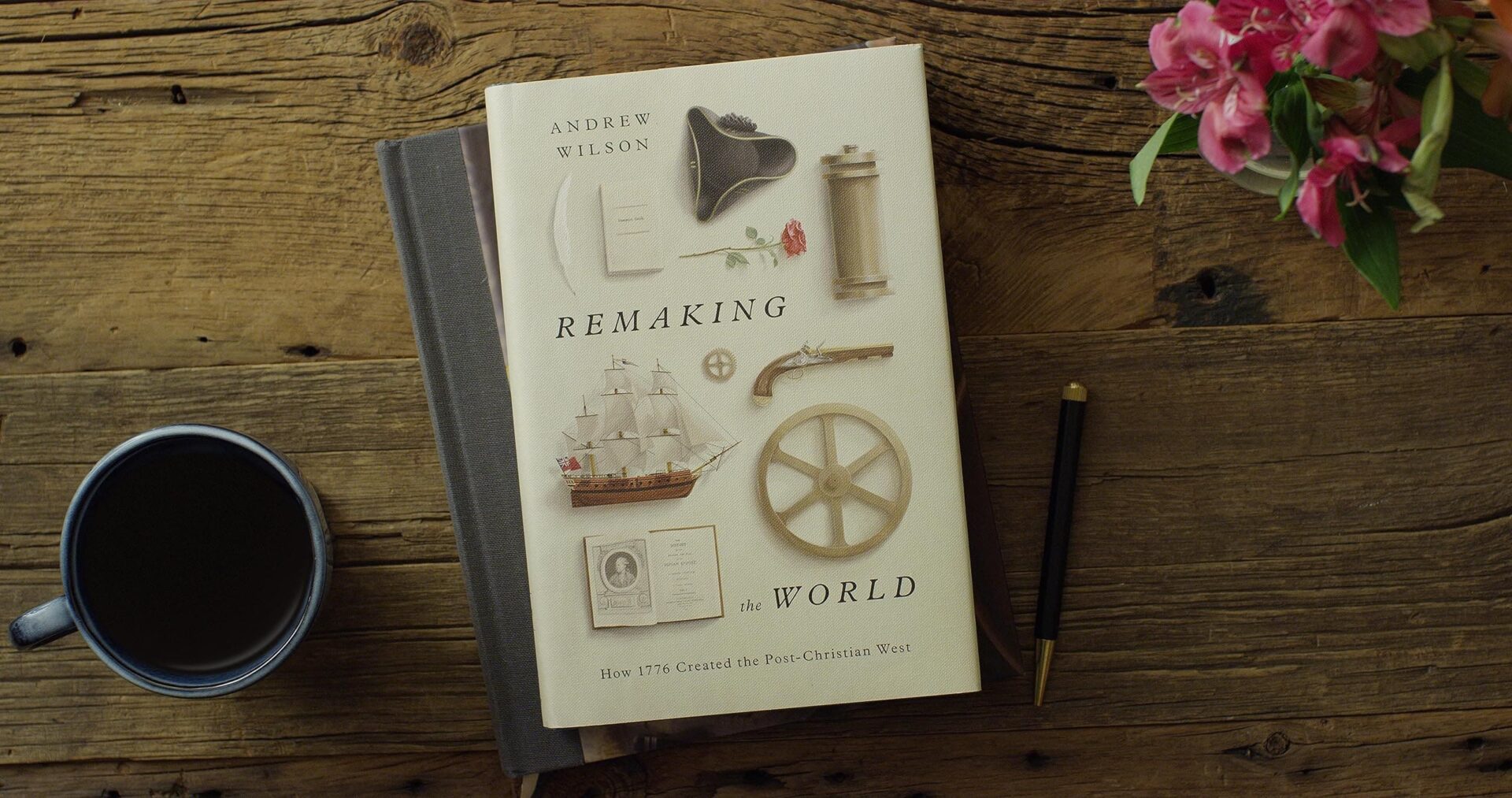
Every now and again I sit down to write a review for a book and realize I am really under-equipped to review it well. I might have read it, enjoyed it, and benefitted from it, but lack the knowledge or expertise to confidently analyze it. This is exactly the case with Andrew Wilson’s Remaking the World: How 1776 Created the Post-Christian West.
The book’s big idea is that the year “1776, more than any other year in the last millennium, is the year that made us who we are.” In this case, the “us” refers to those who live in what we might call the modern, industrialized West. Of course when we hear “1776” we probably think first of the American Revolution. And when we learn that the author is an Englishman we might think we know what he is going to say. But we would be misled, for his point is not to argue that everything went wrong when America threw off its loyalty to the crown. What he argues is that if we want to understand who we are, we need to understand that year, for “it was a year that witnessed seven transformations taking place—globalization, the Enlightenment, the Industrial Revolution, the Great Enrichment, the American Revolution, the rise of post-Christianity, and the dawn of Romanticism.” Together these transformations “remade the world and profoundly influenced the way we think about God, life, the universe, and everything.” Of course each of the transformations has roots that extended much deeper in history and none of them took place neatly between January and December of that year. Yet each of them has some distinct connection to 1776.
As for those of us who live in the modern, industrialized West, Wilson describes this society as one that, “relative to others past and present, is … WEIRDER: Western, Educated, Industrialized, Rich, Democratic, Ex-Christian, and Romantic.” In each of these seven descriptions, we are outliers compared to the great majority of people past or present who have lived in non-WEIRDER times and places. “The vast majority of people in human history have not shared our views of work, family, government, religion, sex, identity, or morality, no matter how universal or self-evident we may think they are.”
The book means to prove that our WEIRDER society can best be understood, or perhaps only be understood, in light of the year 1776. To do that Wilson first defends his use of WEIRDER as an apt description of you and me and the people around us. And I think few of us would seriously argue that our society is anything but Western, Educated, Industrialized, Rich, Democratic, Ex-Christian, and Romantic (provided we understand “romantic” in the sense he means it rather than assuming he means that we are obsessed with wooing and swooning in an amorous way).
Having defended his acronym, he spends one chapter on each of them, showing how that descriptor is appropriate and how it connects to 1776. He does this a little out-of-order in relation to the acronym, opting to approach them as W-D-E-E-I-R-R. And it’s right about here that I realize I am under-equipped to really provide rigorous analysis. I resonated with his descriptions and enjoyed his observations and appreciated his arguments. But in the end, I do not know enough about history, and especially Western history around 1776, to know if his arguments hold. That is a level of analysis that will need to wait for people whose historical credentials far exceed my own. And I will legitimately look forward to reading such reviews and analyses.
This would probably be an appropriate juncture to point out that the book was positively endorsed by Thomas Kidd and Mark Noll, both of whom are true historians. I will also point out that two of the book’s endorsements used the word “verve” to describe the author’s efforts—possibly a first in Christian publishing, but also a good descriptor since it really is an enjoyable and lively look at a subject that in the hands of the wrong author could easily be drab or boring.
With his analysis of each of the letters in the acronym behind him, Wilson closes with two chapters that ask and answer questions like these: “What challenges and opportunities emerge from Westernization or Romanticism or Industrialization, and what should we do about them? How should Christians act in an Ex-Christian culture? What does faithful Christianity look like in the shadow of 1776? And here, I believe, we can draw a great deal of wisdom from an obvious source: faithful Christianity in 1776. How did believers in this turbulent and transformative era respond to what was happening around them? And what can we learn?” These chapters provide a solid place to end and provide an opportunity for personal application.
I very much enjoyed reading Remaking the World. It is an enjoyable book, a well-paced book, and, dare I say it, one written with verve. It takes on an audacious thesis and, as far as I can tell (even while admitting I’m entirely unqualified to judge), one the author defends well. I think you’re likely to enjoy it just as much as I did.





