One of the great questions of life is the question of identity. Who am I? When faced with this question–a question we must all answer at one time or another–some respond with their vocation: I am a pastor or a police officer. Others respond with deep pain from the past: I am a victim of sexual assault or I am a drug addict. Others respond with their greatest success or most shameful failure. Yet none of these get right to the heart of the matter. These may be what we do or what we have done or what has been done to us, but none goes deep enough.
The Christian answer can and should and must be different. It is this, the matter of identity, that is at the heart of Mark Driscoll’s new book Who Do You Think You Are?. Driscoll says rightly that even as Christians “we’re continually forgetting who we are in Christ and filling that void by placing our identity in pretty much anything else.” The question “Who am I?” is “far-reaching, belief-revealing, life-shaping and identity-forming. How you answer determines your identity and your testimony. Tragically, few people–even few Bible-believing, Jesus-loving Christians–rightly answer that question.”
This is too true. Joel Osteen made a recent appearance on Oprah Winfrey’s show where he led a crowd in a long list of positive declarations, each of which began with “I am.” “I am strong. I am healthy. I am confident. I am secure. I am talented. I am creative. I am disciplined. I am focused. I am valuable. I am beautiful. I am blessed. I am excited about my future. I am victorious.” Osteen sees the importance of identity, but answers it without reference to the Bible. In stark contrast, Driscoll grounds his answer in the timeless truths of Scripture. “My goal is to take one massive need in your life, your need for identity, and connect it to one book of the Bible, Ephesians. Thankfully, the Holy Spirit penned Ephesians through Paul for just this purpose.”
Identity is a matter of life and death.
At the heart of it all is our identity as God’s image-bearers. We have been created in God’s image and this gives us inherent worth and dignity. We are created as worshippers, yet by falling into sin we worship all the wrong things, leading us to craft idolatrous identities for ourselves. Instead of being identified first and foremost in our relationship to God, we ignore the Creator and craft other identities. It is the gospel, the good news of what Christ has done, that transforms, or re-forms, our identity. Driscoll writes, “Only by knowing our false identity apart from Christ in relation to our true identity in him can we rightly deal with and overcome the issues in our lives.” Identity is a matter of life and death.
Working his way through the book of Ephesians, Driscoll provides a long list of answers to this question of Who Am I?: I am in Christ, I am a saint, I am blessed, I am appreciated, I am saved, I am reconciled, I am afflicted, I am heard, I am gifted, I am new, I am forgiven, I am adopted, I am loved, I am rewarded, I am victorious. Each one is firmly grounded in Scripture. Each one flows from the good news of the gospel.
I am quite certain that I have read each one of Driscoll’s books, and I am confident that this one displays the greatest level of pastoral care and sensitivity. Driscoll is writing as a pastor and often illustrates his points by relating the stories of people in his church, describing how they came to find a new identity in Jesus Christ. He writes humbly and with carefully-chosen words, rarely turning far from the biblical text. He dedicates this book to his daughter and it is a book most fathers would be very glad to have their daughters read.
One theological application demands special mention. In other places Driscoll has described himself as a “charismatic with a seat belt,” and here, in a chapter on spiritual gifting, he looks briefly to a long list of spiritual gifts. What he says about healing, miracles and speaking in tongues shows that this seat belt might fit rather loosely, so to speak. Many Christians, myself included, will be uncomfortable with some of what he teaches about the miraculous gifts. Having said that, he remains well within the mainstream of Reformed Charismatics, and in this way is not teaching anything novel.
It is noteworthy that Driscoll ends his book where Osteen ended his list of positive affirmations, with “I am victorious.” This is fitting. Osteen’s cry of victory is built upon self-improvement and self-help; it comes from self and through self and to the glory of self. Driscoll’s cry of victory is built upon the victory already won by Jesus Christ; it comes from God and through God and to the glory of God. Where Osteen’s brand of identity will always shift and always ultimately fail, an identity founded upon Jesus Christ will stand eternally. I trust that the Lord will use Who Do You Think You Are? to help many Christians understand and believe that their deepest identity is based on what Christ has already accomplished for them. This makes all the difference.
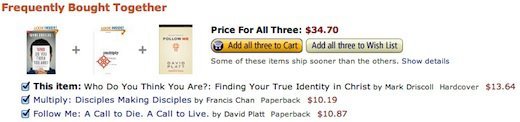
Several of the most popular Christian megachurch pastor/authors have released new books within a short period of time and I thought it might prove interesting to work my way through that list. To this point I have read Vertical Church by James MacDonald, Creature of the Word by Matt Chandler and Who Do You Think You Are?. In the next couple of weeks I will also look at Francis Chan’s Multiply and David Platt’s Follow Me. Interestingly, I am not the only one seeing the close connection between these books. I dropped by Amazon today and, on the page for Driscoll’s book, saw the following offer: