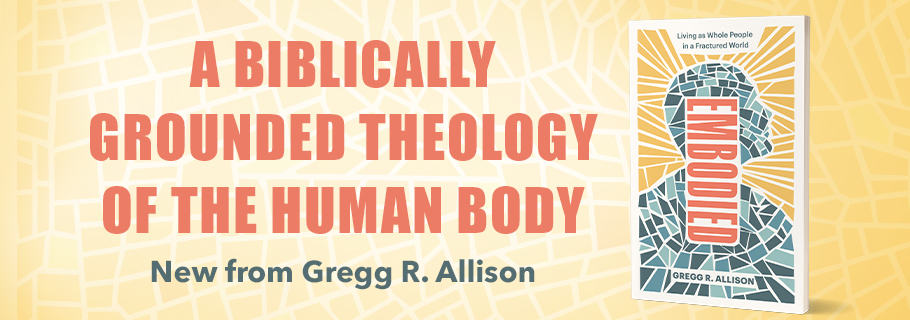
This week the blog is sponsored by Baker Books and is adapted from Gregg R. Allison’s new book Embodied: Living as Whole People in a Fractured World.
“I am my body.” Do you agree or disagree with this statement? I’m not asking about your assessment of the statement “I am only my body.” That can’t be true—so you’d better not agree!—because we exist as disembodied people in heaven between our death and resurrection. But my focus is on our earthly embodiment, so I frame the statement to highlight being embodied.
Put differently as a question: “Am I who I am principally in virtue of the fact that I have the body I have?” (Justin E. H. Smith, Embodiment: A History). I respond positively. What about you? Put as another statement: “Without this body I do not exist, and I am myself as my body” (the Russian philosopher Vladimir Iljine). I agree. What about you?
This position contradicts the popular contention set forth by George MacDonald that “You don’t have a soul. You are a soul. You have a body” (Annals of a Quiet Neighborhood). This view seems to reflect the influence of Gnostic thought, which privileges the immaterial aspect of human nature—the soul or spirit—over the material aspect—the body. Rejecting such influence, which is driven by philosophy rather than Scripture, I affirm to the contrary, “I am my body.”
If you agree, an implication to be drawn is to stop viewing your body as an instrument, an object to be used and stewarded. When my wife and I were on the staff of Cru, one of our regular topics in discipling Christians was stewardship, which the Merriam-Webster Dictionary defines as “the careful and responsible management of something entrusted to one’s care.” Ideas that were included under this subject were the stewardship of our time (schedule), our treasures (money), our talents (abilities and gifts), and our body. It was this last item that always seemed like it belonged in a different category than the other topics. For example, our money and possessions are disconnected from us, but our body isn’t outside of us. We have a different relationship to our body than we do to our abilities and gifts. We put our skills to work. We lend our insights to counsel others. But, as I propose, we are our bodies.
Still today I often hear people talk about body stewardship. It appears in statements like, “I exercise in order to keep my body functioning at peak performance” or “I eat only certain foods in order to fuel my body properly.” These expressions, while valid in one sense, can appear to regard our body as a mere instrument to leverage, a machine to tune up, a tool to keep sharp.
But is this the right way to view our body? It is certainly common to do so. But the fact that God designed and created us to be his embodied image-bearers weighs against this view. As Frederica Mathewes-Green offers, “The initial impression that we stand critically apart from our bodies was our first mistake. We are not merely passengers riding around in skin-tight racecars; we are our bodies. They embody us” (“The Subject Was Noses”).
“I am my body.”
Agree or disagree?
To consider this further, please consider reading Gregg R. Allison’s new book Embodied: Living as Whole People in a Fractured World