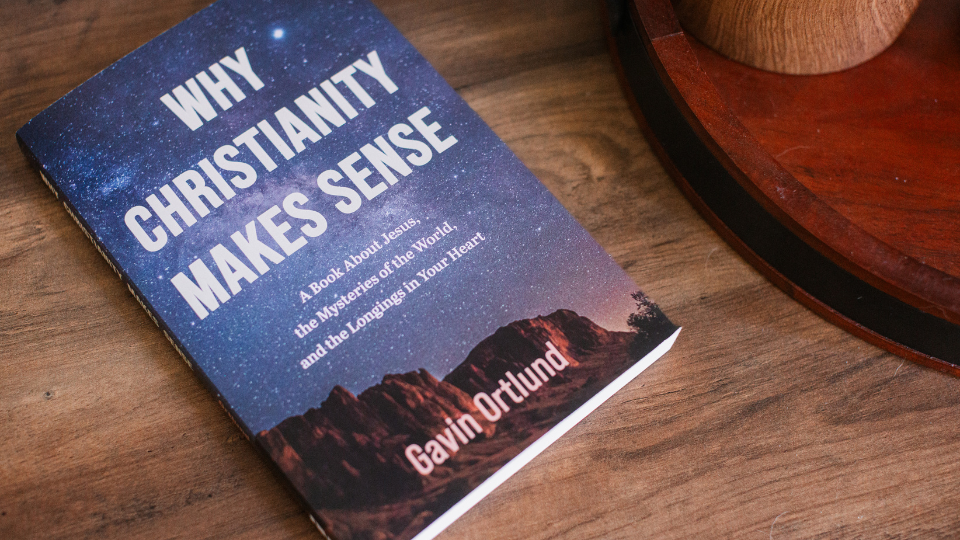
This week the blog is sponsored by Zondervan Reflective. This content is adapted from Why Christianity Makes Sense by Gavin Ortlund. Copyright © 2026 by Gavin Ortlund. Used by permission of Zondervan.
Deep in the human heart, there is an ache—an ache for transcendence, for love, for justice, for happiness. It might be the deepest reality in the human heart. Yet despite this, we tend not to think about it as much as we ought. Why is this?
Diversion and Distraction
The philosopher Blaise Pascal famously asserted that “the sole cause of man’s unhappiness is that he does not know how to stay quietly in his room.”1 What a statement! But what does Pascal mean, exactly?
Pascal is arguing that we use diversions to distract ourselves from ultimate questions. If we could practice genuine solitude, we would realize there is a deep restlessness inside us. We would have to come to terms with the fact that way deep down, in the remote places of our heart, something is missing. There is an emptiness, a yearning— an ache.
But so long as we cram our lives with busyness and clutter, we can avoid dealing with this situation. We can hold the deep questions of life at bay.
Can you relate to this tendency toward distraction? When was the last time you slowed down to really consider: Am I happy? Is life working?
Slowing down and taking stock of our actual situation invites us to envision the big questions. Here’s one:
Suppose there is no God of any kind, nor any supernatural reality of any kind. It’s just physical nature— there are no souls, no angels, no afterlife. What would this entail for the meaning of life?
Deep in the human heart, there is an ache—an ache for transcendence, for love, for justice, for happiness. It might be the deepest reality in the human heart. Yet despite this, we tend not to think about it as much as we ought. Why is this?
Gavin Ortland
Existentialist Philosophy
We are, of course, not the first to ponder the meaning of life, so we would be foolish not to consider how those who preceded us have struggled with this question. Perhaps the most renowned effort to locate meaning in a world without God is represented by atheistic existentialist philosophy. Existentialism powerfully captures the emotions of atheism— what it feels like to adjust to life without God.
We might sum up the core intuition of existentialism with the philosopher Jean- Paul Sartre’s slogan: Existence precedes essence.2 Essentially, this means that life has no model or blueprint (essence). We simply are (existence). Thus, we are free to construct our own meaning and purpose.
Put it like this: There is nothing that the world is supposed to be. It simply is.
(If this doesn’t feel terrifying yet, keep reading.) Sartre saw this state of affairs as the result of atheism. To explain why, Sartre appealed to the famous slogan of the Russian writer Fyodor Dostoevsky: “If God did not exist, everything would be permitted.”3 That is, without God there is no objective value of goodness that exists outside of us, to which our lives must correspond.
This might seem like a drastic conclusion, but think about it: If there is no Creator who has assigned the world a meaning, where else would this meaning come from? It’s hard to see where a plan for the world would come from without someone or something behind the world doing the planning.
For Sartre, there is no divine plan or human nature to conform to. Existence comes first— we’re hurled into the world, and now we have the burden of inventing our own meaning.
Does this prospect disturb you, as it disturbs me? Let it really wash over you: Your relationships, your goals, your suffering, everything you’ve been through— it doesn’t add up to any kind of coherent unity. There is no overarching plan or design. You must invent your own meaning as you go.
Much is at stake with this question of meaning. It touches something deep down at the core of our humanity. Probably the same place we feel the ache.
We should care about such questions. We should take Pascal’s advice and slow down. The ache inside is trying to tell us something. We should listen.