Today’s post is sponsored by P&R Publishing and written by P&R’s editorial director, Amanda Martin.
I learned a new word last year, as I often do when talking to my dad. Diatessaron. Five syllables of majestic-sounding Greek. He said it with relish, which is exactly how such a word ought to be said.
It was a word I immediately wanted to use, but my opportunities to do so are limited. This is because a diatessaron is a single-narrative arrangement of the four canonical gospels. There aren’t many of those lying around! And yet they have a long history: the first diatessaron was created in the late 100s.
My dad, a Presbyterian pastor, was telling me about diatessarons because I was working on one—although at the time I hadn’t realized it had such a delightful name. I was editing a new edition of theologian Loraine Boettner’s Harmony of the Gospels (now titled The Gospel of Jesus) and learning so much as I saw the work of Matthew, Mark, Luke, and John come together in a chronological narrative. Not only had I gotten a clearer sense of just how much Jesus traveled during his earthly ministry (he traveled a lot), but I was especially enjoying Mark’s eye for the dramatic detail.
How does a diatessaron work?
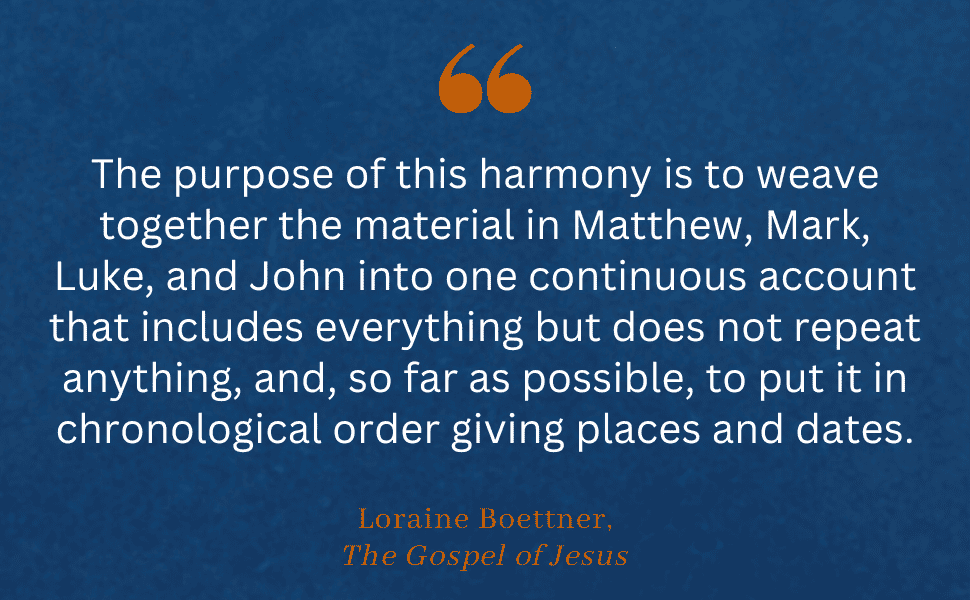
I’ll write about the one I know well. Boettner wove the material from the four gospels into one continuous account, including everything but repeating nothing, and added section headings, dates, and locations (where possible). He was a Bible teacher in Kentucky and wanted to create a useful Bible study aid for his class.
The genius of Boettner’s diatessaron is that it includes all Scripture references so that readers can remain mindful of the original text and its context. Any detail that is inserted from another gospel account appears with a reference on the margin of the page. Thus, when you’re reading the story of Jesus’s temptation in the wilderness, you know it’s Mark who dropped in the detail about the wild animals (Mark 1:13). When Jesus is transfigured before his disciples, you know it’s Mark who considered a launderer’s struggle to whiten clothes (Mark 9:3). When Jesus is besting the Pharisees in debate, you know it’s Mark who mentioned that the “large crowd was listening to him with delight” (Mark 12:37 CSB).
The same is true for each gospel writer. No one gets lost. As you read one coherent story, you see how the four gospels harmonize—even in tricky places such as the resurrection accounts.
Please take a moment to say diatessaron out loud. Di-a-tes-sa-ron. It’s a great word, right? Maybe it’s time to bring it back.
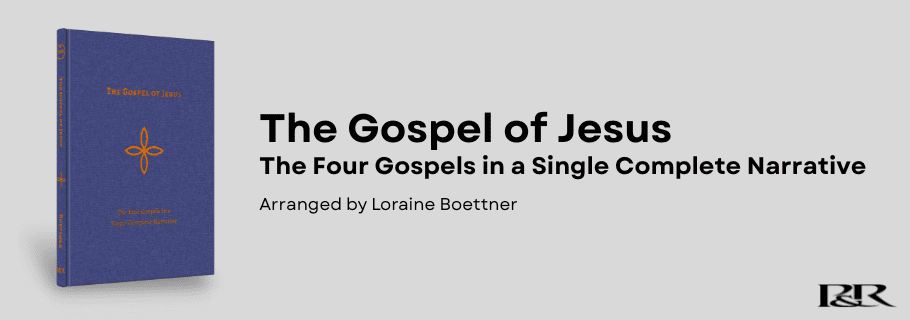
And if you’re curious and want to experience a diatessaron for yourself, check out The Gospel of Jesus, edited by Loraine Boettner—it’s reader-friendly, attractively bound, and developed to serve students of the Bible.