Yesterday I proposed Read the Classics Together–choosing a classic Christian book and reading it in tandem, returning here once a week or so for a bit of discussion. This method, I thought, could provide the accountability many of us need to make our way through some of the classics of the faith. Based on the comments for that post I guess you are in agreement. So let’s make it happen!
After receiving many suggestions I decided J.C. Ryle’s Holiness may just be the best place to start. While it’s not the title that is highest on my list, I think it is the most suitable starting point. The first edition is only seven chapters long, meaning that, if we read just one chapter per week, we can work our way through it in seven weeks (Make it eight with the introduction.). This makes more sense to me than beginning with something very long and intimidating (such as Calvin’s Institutes which would probably take at least a year!). We can test the idea and the methodology with a fairly short commitment and reassess before moving to another book.
Of course this is not to disparage Holiness. J.I. Packer says that though “much of Ryle reads dated, culturally and situationally, what he has to say on the interior aspects of personal holiness in Christianity is of perennial importance. Though Ryle’s rhetoric retains its Victorian tinge, his points, biblical and Puritan as they are, are uniformly relevant to Christian living here and now, and indeed speak as pungently to our own shallownesses and superficialities as they did to the counterparts of these lapses a century and a quarter ago.” This is regarded as a classic text on the subject of personal holiness. Packer promises “Real Christians will find it a gold mine, a feast, a spur and a heart warmer, food, drink, medicine and a course of vitamins, all in one. Reading it will, I trust, confirm to you the estimate of Ryle … as a great man and–more important!–fill your heart with the realism, wisdom, energy, lowliness, and joy of Christ. So may Ryle truly come into his own in all our lives.”
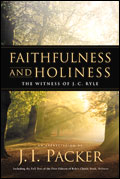 The edition I recommend and the one I’ll be reading from is called Faithfulness and Holiness and was published by Crossway in 2002. It includes the full text of the First Edition of Holiness along with an “Appreciation” by J.I. Packer. This will give some useful context for those who wish to understand more about the book and its author. It’s a nice hardcover volume with the first 85 pages being Packer’s contribution and the following 140 or so being Ryle’s book. In the Foreword, Packer explains why this First Edition, some 13 chapters shorter than the Second Edition, is the best choice:
While many of Ryle’s books, including the second edition of Holiness (1879, often reprinted), appear as a set of some twenty coordinate yet separate messages on a single multi-faceted theme, rather than as a series of stages in a single line of thought, these seven chapters were meant to be read as a set, restoring biblical breadth and depth to evangelical minds that had been swept away by fashionable holiness teaching that was actually extreme, shallow, biblically incorrect, and a hindrance to growth in grace. Ryle’s response was not to cross swords with its exponents, but to lay out afresh, biblically, systematically, and in practical terms, the true fundamentals of Christian sanctity, with constant appeal to Puritan and other pundits who had trodden this path before him. These seven chapters are the nearest thing to a treatise that Ryle ever composed, and they enable one to assess the range and balance of his mind, and the shrewdness of his judgment on spiritual things, better than any alternative selection of items would do.
I believe the editions vary only in that thirteen chapters are appended to the Second. As I understand it, the first seven are identical, so even if you have the Second Edition you should be able to follow along without any complication.
If you’d like to purchase the book you can do so at Westminster Books where it’s listed at $11.69. Amazon shoppers will find it here ($14.03). Alternatively, those wishing to read the book online can find it in a variety of formats at CCEL.
I propose we begin our study two weeks from today–August 30. I think that should allow time for people to arrange to obtain a copy of the book and to read the first chapter (“Introduction”). I will post a topic with a few initial thoughts and will invite readers to post their thoughts, reflections and questions on the first chapter. Obviously the greatest value will be in the reading while the discussion will serve to reinforce and clarify what we’ve learned.
Let me know in the comments if you’re going to be part of this (though if you aren’t the kind who comments that’s fine–feel free to remain silent but to read along anyways).





