
john calvin

Without the Gospel

What difference does the gospel make? What difference does it make in your life? These are good questions to ask, I think, and good answers to ponder. How does your belief in the gospel of Jesus Christ impact your life? In what way is your life, even your Christian life, distinctly different because of the gospel?

Here is a quote I found somewhere or another, that addresses these questions head-on. It comes from the pen of John Calvin.

Without the gospel everything is useless and vain; without the gospel we are not Christians; without the gospel all riches is poverty, all wisdom folly before God; strength is weakness, and all the justice of man is under the condemnation of God. But by the knowledge of the gospel we are made children of God, brothers of Jesus Christ, fellow townsmen with the saints, citizens of the Kingdom of Heaven, heirs of God with Jesus Christ, by whom the poor are made rich, the weak strong, the fools wise, the sinner justified, the desolate comforted, the doubting sure, and slaves free. It is the power of God for the salvation of all those who believe.

Book Review - Calvin

John Calvin by Bruce GordonIt is here at last. For years now I have been waiting for a great biography of Calvin—the kind of biography which I would recommend without hesitation for those who would want to learn about the life of the great Reformer. In a year that has seen the arrival of at least half a dozen biographies of Calvin, this one, I believe, stands as the best. Written by Bruce Gordon, professor of Reformation History at Yale University, it is titled simply and properly, Calvin.

Biographies of figures as controversial as John Calvin tend to be written by unabashed fans or ardent enemies. There is a lot of biography that reads like hagiography and a lot that reads like pure slander. This was the case with Calvin himself and his earliest biographers—either they were his closest confidants, singing his highest praises or they were men who feared and despised him, fabricating outrageous charges against him (such as Jerome Bolsec who, ten years after Calvin’s death, wrote an account of the Reformer’s life in which he accused him of sodomy and suggested that he had died from crab lice). Even today, many of the biographies seem to focus undue attention on Calvin’s great accomplishments without wrestling with his notable faults and foibles. This new biography is an exception as Gordon writes from a position of notable objectivity. He seems a little bit detached from his subject, almost as if he has had to become a somewhat-grudging admirer of Calvin through immersing himself in the man’s life. Throughout the book he is willing to credit Calvin for what he did so well but he is also willing to call a spade a spade, whether that means pointing out pride or temper or youthful arrogance.

The greatest strength of Calvin may be the author’s deep knowledge of the time in which his subject lived. He sets Calvin firmly in his political, religious and cultural context, expending great effort in showing how Calvin was, in so many ways, a product of his time. This allows Gordon, a student of the Reformation even more than he is a Calvin scholar, to draw the reader into the time and the life of his subject in a way that none of the other biographies have been able to do. He also draws widely from Calvin’s writing, introducing lesser-known works and drawing often on his voluminous correspondence. In this way it is a more well-rounded account of Calvin than others and one that is also deeper.

I tend to measure successful biographies in one of two ways: either they teach me a lot about the subject and the context of his life or they make me feel as if I’ve met the subject himself (with the very occasional sublime biography doing both). Gordon’s Calvin falls firmly in the former camp. I did not feel like I knew Calvin himself at the end of this book, but I certainly did understand the man better, especially as I came to understand the religious and political climate he was born into and the even more complex climate he helped create.

In my opinion, this is the best biography of John Calvin to date. If you haven’t ever read a life of Calvin, this will be the place to start. And even if you’ve read each of the other biographies available, I am convinced that by reading this one you will gain a richer understanding of the man and the complex times in which he lived. I highly recommend it.


John Calvin: Pilgrim and Pastor

Calvin Pilgrim and PastorThere are not too many men whose five hundredth birthday is a cause for remembrance, not to mention celebration. Yet here we are, five hundred years after the birth of John Calvin, witnessing widespread celebration of his birth. This year we see many conferences dedicated to understanding Calvin’s impact on the church and on society, even centuries later, and we see the publication of many books looking at the man and his theology. It strikes me as a strange oversight that we do not yet have a definitive biography of Calvin (as Marsden has done for Edwards, as Dallimore has done for Whitefield, as Murray has done for Lloyd-Jones, and so on) and I am hoping that this year will end the drought—that by year’s end we will have that one biography that will stand for many years as the definitive life of Calvin. With several biographies set for release in 2009, one would think this ought to be the year.

Into the fray steps Robert Godfrey with John Calvin: Pilgrim and Pastor. He begins by saying “Today for many people the name of John Calvin is known only in a vague sense and has become a label for attitudes that are negative, judgmental, and joyless. Historians, by contrast, know that John Calvin was one of the most remarkable men who lived in the last five hundred years and that his influence on the development of the modern western world has been immense.” Indeed, Calvin’s influence is felt in the rise of democracy, capitalism and even in modern science. “The life and work of John Calvin have always been controversial as well as influential. Some have loved him, and some have hated him. All would agree that he was a man with a brilliant mind and a powerful will who had a profound impact on the development of western civilization. But was the impact positive or negative?” Even among Christians, many of whom have no sense of the debt they owe Calvin, many see the negative much more than the positive. Everyone has an opinion about Calvin but one wonders how many of these opinions are based on fact.

Even in his own day Calvin was loved by some and hated by others. Even in his own day he was a figure of great controversy. Yet, as Godfrey points out, he did not set out to be controversial or to be a figure of great renown. “The real Calvin was not in the first place a man who lived to influence future generations. Rather he was a spiritual pilgrim finding anew the apostolic Christianity expressed in the Bible and serving as a faithful minister of that Word in the church of his day. The influence that Calvin would have regarded as most important was as a purifier of the Christian religion and a reformer of the church for his day. The essential Calvin was a pilgrim and pastor. From that reality all his influence flowed.” This book is “an introduction to the life and thought of John Calvin,” a man who lived out his faith as both a pilgrim and a pastor.

Though the book introduces Calvin’s life and his thought, it focuses primarily on the latter. The first few chapters, along with the final one, give that overview of his life. It looks to the outline we tend to be familiar with—his “fateful” journey from France to Strassburg and his meeting there with William Farel who convinced Calvin that he must stay; his initial ministry in Geneva and his eventual banishment; his short ministry in Strassburg; and the rest of his career after returning from his exile and taking up again his ministry in Geneva.

The bulk of the book describes Calvin’s theology. Some of this theology is woven into biography, but in many cases it stands alone. Godfrey focuses on topics such as the church and worship, predestination, sacraments, city and schools, and Calvin as pastoral counselor. He describes each well, looking primarily at how Calvin formulated his thoughts and his theology in each of these areas. He looks often to Calvin’s writings, the Institutes, his sermons and his voluminous personal correspondence. I feel that the chapter on Calvin as Pastoral Counselor is particularly important to those who would seek to understand Calvin as something other than the caricature so many present. Here we see a man who had a pastor’s heart and who was eager to bless and encourage others. He shows himself to be a far cry from the angry tyrant that so many present him as. Godfrey clearly has an exhaustive knowledge of Calvin and in this book he conveys it in a way that is at once deep and accessible.

In the end analysis, John Calvin: Pilgrim and Pastor is more of a life and theology than a life and times. Perhaps history has not recorded enough about Calvin’s life that we can construct the kind of biography that would be the equal of Marsden’s Edwards or Dallimore’s Whitefield. We will continue to wait and see. But I do not wish to criticize this book for what it is not and, perhaps, what it cannot be. This is, after all, a very good overview of Calvin’s life as well as a description and assessment of his theology. What it seeks to do, it does very well and it is well worth the read. As you close the back cover, you will know more about Calvin the man, more about Calvin the theologian, and more about Calvin’s influence in history. And I suspect, even if you cannot agree with all of his theology, you’ll thank God for raising up the right man at the right time. Calvin is one of those rare men who deserves to be remembered, even on his five hundredth birthday.

Buy it at Monergism Books

John Calvin (Christian Biographies for Young Readers)

Calvin CoverThis is the year of John Calvin. In celebration of the 500th anniversary of his birth, many ministries are holding conferences to discuss his life and impact and many Christian publishers are releasing biographies of the man who did so much to form the Christian faith and the Western world. Reformation Heritage Books has taken a unique route by producing a biography targeted at children from ages 7 to 10. Written by Simonetta Carr and illustrated by Emanuele Taglietti, the book combines the story of Calvin’s life with excellent watercolor illustrations.

The publisher describes the book in this way: “In this attractive volume, Simonetta Carr introduces young readers to the life, thought, and work of one of the most famous Reformers of the Christian church. Readers will come to know Calvin’s personality, his devotion to God and the church, and the personal challenges he faced. They will understand the struggles of the early Reformed church faced at that time, not only surviving attacks of the Roman Catholic Church, but also achieving a clear identity and a unified doctrine.”
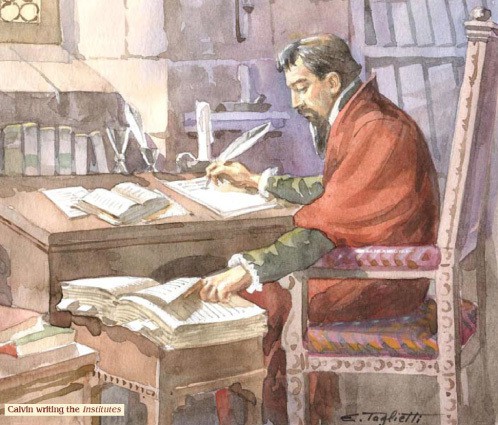
Calvin

In just about sixty pages, this book gives a brief overview of Calvin’s life, from the cultural and religious setting into which he was born, through his education and training, his years of writing and ministry, and his death. The author discusses not just Calvin’s life but also his impact, including his influence on the religious liberties codified in the American Constitution. It concludes with some suggestions for children who may wish to learn more about Calvin and with a series of interesting facts about the day in which Calvin lived. There are original watercolor illustrations or relevant photographs on just about every page.
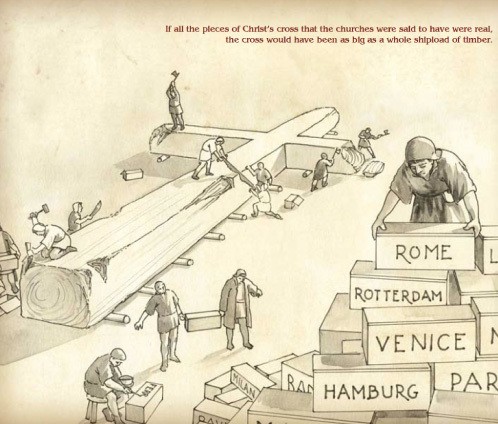
Calvin

This is a very good little biography of Calvin and one that does a very good job of speaking to its targeted age group. It easily held the attention of my six year-old and nine year-old children as I read it all in one sitting (though my two year-old fell asleep before I had completed the first page). It led to some interesting questions and answers afterward, as we discussed persecution, martyrdom and a life lived for God’s glory. The children seemed to enjoy the book a lot. I would recommend this book to any parent who is interested in introducing his children to the life and times of a great Christian of days past. I am hoping that this is just the first in a series of similar books.

Buy it at Monergism Books

Ligonier Conference - Sinclair Ferguson

After a rather tasty lunch we gathered again, this time to hear Sinclair Ferguson speak about “The Doctrines of Grace.” He began by reading Ephesians 1 and said that no man has had a greater impact on his thinking than John Calvin.

When we speak of the doctrines of grace, we tend to think about five particular distinctive and controverted doctrines that we find within the realm of Reformed theology. Calvin’s theology and the theology of Scripture has much more to say about the grace of God in salvation than just these five points.

He followed this structure:

  1. To say something by way of background about the teaching about grace on which Calvin was reared.
  2. The doctrines of grace on which Calvin expounded.
  3. The nature of grace which John Calvin sought to extol.

The Grace on which Calvin Was Reared

Some people mistakenly believe that until the time of the Reformation, grace was a foreign concept in Christianity. The Reformers understood, though, that the medieval theologians had misspelled, misunderstood grace. As they spelled out the doctrines of God’s grace, they saw that grace had been adulterated and was no grace at all. It would not bring the delight of joy and assurance of salvation to the soul.

The Roman Catholic Church was dead set against the doctrine of grace because they felt it would give people license to live however they wanted to live. Of course this is a problem the Apostle Paul faced as well. This is why The RCC has always regarded the doctrine of justification (according to Protestantism) as a legal fiction. They cannot see justification as something so simple as a declaration.

The Reformers came to see that it was possible to know that you were justified. The church taught that unless you had some special revelation from God, you could never know that you had done enough to be saved. All you would be left with is endless years in purgatory with maybe a little reduction based on the overflow of merit from the saints. The consequence of all of this was the absence of joy, the impossibility of assurance. The assurance of salvation was considered the greatest of Protestant heresies.

Calvin saw that the righteousness given to us is the very righteousness of Christ, counted to the believer. It is the righteousness of the final judgment, brought forward into the present. Sin, when punished, cannot be punished again. We can stand before the judgment seat of God, fully righteous and all by God’s grace.

The Doctrines of Grace on which Calvin Expounded

When Calvin speaks of the doctrines of grace (in many ways and in many places) his great desire is to point us to salvation in God by Jesus Christ. Here Ferguson spent a few moments covering each of the five points, showing how Calvin may have explained them. As you may know, the five points as we understand them today, though they are based on Calvin’s teaching, are a reaction to later theological developments which sought to deny this theology. So Ferguson reached just a little further back to explain these terms using what might have been Calvin’s words.

The best line from this section of Ferguson’s address were these: “Two words: Institutes! Read!”

The Nature of Grace which John Calvin Sought to Extol

With time running out, he had only a few moments to dedicate to this topic.

Calvin says there is no such thing as grace, only Jesus Christ. There is not something outside of Jesus Christ that the Holy Spirit dispenses to you like a lump sum. There is only Jesus Christ which is why one of the most significant and startling things Calvin says is that all that Christ has done for us is of no value to us unless we get, by faith, Jesus Christ himself. And in just a moment you can see how the whole medieval system with priests and sacraments and sacrifices and saints and Mary was immediately exploded and destroyed. What the Spirit is doing and bringing you into is the same as the Lord Jesus himself. There is nothing between—no pope, no bishops, no sacraments, no priests—only the Holy Spirit bringing you to Jesus who is all your righteousness and all the righteousness you will ever need.

From Calvin we learn this: it is all there for you in Christ, so drink from no other fountain than Christ. We are all, even in our evangelical hearts, liable to sink back into errors that make us think there is something in us that qualifies us, something that Jesus Christ could give me without giving himself and me giving myself to him. This is Calvin: it is all of God, it is all in Christ, it all comes through the Holy Spirit.

This is a very, very good introduction to Reformed theology as taught by the greatest of the Reformers. I am often asked what I would recommend to those who are just trying to learn about Calvinism (or who are trying to learn the truth behind Calvinism). This is a great place to begin.



