Good morning. I hope you enjoy reading this collection of longer-form content and think pieces. They cover fertility, egg freezing, IVF, AI, and the Indy race that’s making its way through D.C. this weekend. Scroll down a bit, and you’ll also find some reader recommendations that come from people just like you!
Sales & Deals
Today’s Kindle deals include a good collection of newer books along with some older ones that complement them well.
Recommended Reading
Matters of fertility were in the news this week, not least because of Alexandria Ocasio-Cortez publicly going through the process of preparing to freeze her eggs for potential later use.
Emma Waters (author of Lead Like Jael) shared a lengthy article on egg freezing. She discussed the practice, ethics, and theology of it.
Egg freezing has exploded in recent years, with more and more women (often spurred on by large company benefits, delayed marriage timelines, or aggressive marketing campaigns) freezing their eggs than ever before. It’s one thing to consider this in the abstract, but this week I dive into the science, success rates, industry, and poor body literacy with one additional angle in mind: the theology behind it all.
There’s also a video if you prefer watching/listening over reading. This all reminds me of when my daughter was in her public high school and one of the teachers explained to the students that women’s fertility peaks in their twenties and then declines significantly. His advice was that if they wanted to have children, they shouldn’t wait too long. Many of the students were angry to be told that. Yet for all of the technological advancements of recent years, nobody has been able to change our intrinsic biology.
Read: Should Christian Women Freeze Their Eggs?
(Note: she also wrote Equipping the Church for the IVF Era for First Things.)
Also on the subject of fertility, Brian Najapfour wrote an article for Reformation21 that provides a biblical case for in vitro fertilization, provided it adheres to strict ethical boundaries. Since I have read quite a few pieces lately that take the position that IVF is always or almost always either wrong or unwise, I appreciate his measured thoughts on the matter.
As a pastor, I’m occasionally approached with heartfelt questions about In Vitro Fertilization (IVF). These inquiries have led me to study the subject more carefully and to wrestle deeply with its moral and theological implications.
What follows is a series of affirmations, organized into twelve sections. Together, they seek to provide a biblical, pastoral, and ethical framework for considering IVF within clearly defined boundaries.
This concluding thought summarizes his position: “IVF, though morally hazardous in many of its common contemporary practices, may be considered permissible only under exceptionally strict conditions. Conditions that uphold the full dignity of embryonic life, preserve the exclusivity of marriage, reject all forms of destruction or commodification, and maintain submission to God’s providence.”
Read: A Biblical Case for in Vitro Fertilization (IVF) With Strict Ethical Boundaries.
I’m no fan of car racing, but I am a fan of well-made interactive content, and that’s exactly what the New York Times put together to show the route for this weekend’s Indy race through Washington, D.C.

See Where Indy Cars Will Race Through the Nation’s Capital. ( Gift Link)
If you’d like to do some substantial theological reading this weekend, you may want to take a look at the new issue of The Gospel Coalition’s theological journal Themelios. It features no fewer than 231 pages of editorials, articles, and book reviews. You can read it on the web, download it in PDF format, or access it through Logos. Here’s a glimpse at the table of contents:
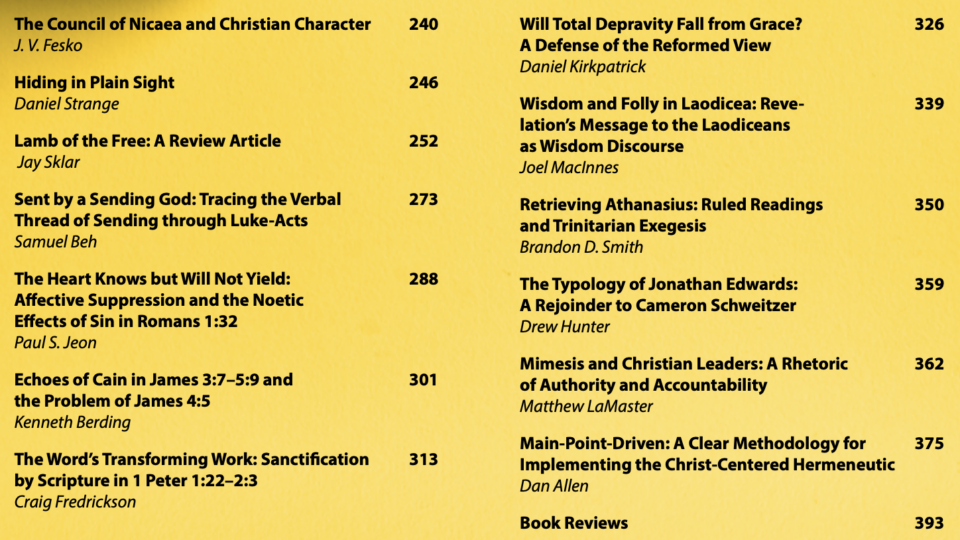
Read: Themelios 51.2.
It is rare for a week to go by without AI being in the headlines. Of course, I was partly responsible for that this week since I wrote an article on the subject that was fairly widely read: TGC, AI, and the Democratization of Competence. As I expressed in that article, I’m genuinely glad that people are discussing this issue and taking strong stances on it, even if those stances are substantially different from one another. This is a healthy process that will help us arrive at better procedures and stronger ethics related to the use or deliberate disuse of AI.
The Wall Street Journal also wrote about AI this week and focused on the publishing industry.
Last year, 70 authors including Margaret Atwood and Jonathan Franzen signed an open letter to publishers voicing concerns about generative AI and asking them to make “a pledge that they will never release books that were created by machines.” Yet the Big Five—Simon & Schuster, Penguin Random House, HarperCollins, Hachette Book Group and Macmillan—have largely been reluctant to make sweeping pronouncements about a technology that is both potentially lucrative and increasingly ubiquitous. (Many of them are also involved in lawsuits against tech companies for training their models on copyrighted books.)
Read: AI Has Plunged the Book Publishing Industry Into Utter Chaos. ( Gift Link)
Chris Hutchison read my article and interacted with it in a helpful way. He picked up on a part of my article that discussed AI as an editor and/or research assistant: “Does it matter if this function is carried out by a someone or a something? Is it acceptable for individuals to use AI to narrow the competence gap that institutions enjoy by virtue of their size, or is this giving an app a function that is essentially human?” Here’s what he said:
If we understand that A.I. is essentially a computer-organized collaboration of people, the distinction between “someone” and “something” shrinks somewhat. When an author uses A.I. to edit an article they wrote, the computer program is estimating how someone would perform that editing based on it’s exposure to the work of many someones.
There’s still a real difference, but it’s not a difference between a human and a machine. It’s a choice between a human and a software-negotiated collaboration of humans. This understanding doesn’t necessarily answer our ethical and practical questions concerning A.I., but it does sharpen them somewhat.
Read: What A.I. Is, and How I Use It.
Since the great majority of us will be gathering to worship tomorrow, I will leave you with an article from Rob Brockman that outlines five ways to prepare yourself.
People ought to come to corporate worship services to get. They ought to come starved for God. They ought to come saying, ‘As the deer pants for the water brooks, so my soul pants for You, O God’ (Psalm 42:1). God is profoundly honored when people know that they will die of hunger and thirst unless they have God.
I think there is an epidemic in the church of starving Christians who are in church every week—even Bible-preaching churches—and yet are not being matured, edified, and encouraged.
When we come to corporate worship, we ought to come with the intention of receiving from our heavenly Father. We are coming to fellowship with him and his people, and to enjoy the many blessings that he intends for us.
Read: How to Gather Well: 5 Ways to Prepare for Corporate Worship.
Reader Recommendations
As you know, I like to give readers of this site the opportunity to make their own recommendations. Here is what readers like you recommended this week.
Cody recommends Mez McConnell’s The Creaking on the Stairs. “Having experienced some measure of trauma in my own childhood, it has been an incredibly refreshing and difficult read. I believe those who have or perhaps are still suffering will find a true friend in Mez—one who can sympathize with them and also direct them to the God of all comfort.”
Kristine recommends volunteering to coach a youth sports team. “Youth leagues are always looking for coaches and it is a good way to connect with young families and build the foundation for starting gospel conversations. … And you have the opportunity to talk with kids and parents, find out what matters to them, represent Christ well in your interactions and have spiritual and gospel conversations.”
Elaine recommends In the Hands of a Fiercely Tender God by Colleen Chao.
Pamela has enjoyed Psalms of Trust by H.B. Charles Jr., a new book that was just released a couple of weeks ago, as well as all eight of The Unselected Journals of Emma M Lion by Beth Brower (which quite a few people have recommended now).
Cheryl has been enjoying Glenna Marshall’s series of essays on Psalm 119 on Substack. “For each section (Aleph, Beth, Gimel, etc), she shares a personal reflection that connects to that passage.” Cheryl also recommends her book Known & Loved, which is based on Psalm 139. “Her writing draws the reader deeper into the truth of God’s beautiful, steadfast word.”
Ben was recently convicted of his lack of patience in many spheres of life. He says he’s “been thoroughly encouraged and challenged by Thomas Goodwin’s Patience and its Perfect Work: Enduring Sudden and Sore Trials with Joy. Hard to beat the Puritans when you need some tough spiritual love!”
Diana recommends two daily devotionals by Tim Keller: God’s Wisdom for Navigating Life and The Songs of Jesus. She finds the format and topics extremely helpful and says, “I look forward to reading both every night.” She also recommends his biography written by Collin Hansen: Timothy Keller: His Spiritual and Intellectual Formation.
I apologize to all those whose recommendations I could not publish. I’ll look forward to sharing more next week. Stay tuned on Monday for the form you can fill out to submit one.
Flashback
Let God Prove Himself. It has long been my observation that it often takes some time for Christians to begin to give to the church (and/or to other ministries) and to do so in a way that is genuinely generous. And I think this actually makes a good deal of sense…

If you are idle in Christ’s work, you are active in the devil’s work.
—C.H. Spurgeon