I want you to think back to the early 2000s. These were the years when we were transitioning from Web 1.0 to Web 2.0, which is to say from the initial version of the internet to the form we know today. If Web 1.0 was about users consuming content, Web 2.0 was about users creating it. It was Web 2.0 that gave us the apps and devices that made us creators and participants rather than mere consumers.
Blogs became the first mainstream form of social media, and they ushered in a seismic change when it came to content creation. They did this by providing the means to avoid the gatekeepers who had long stood between those who wanted to have a voice and those who could give them one. Prior to blogs, anyone who wanted to share an article or write a book had to appeal to the editors at newspapers, magazines, or publishing houses. But blogs allowed anyone to have a voice, and in that way they substantially democratized content creation.
There was no going back. Readers found they enjoyed blogs, and it did not take long for blogs to become as deeply woven into people’s lives as periodicals had been. Many traditional publishers discouraged blogging, considering it the realm of amateurs, yet readers appreciated the very factors that distinguished them from the traditional channels—the writers who had no ties to big ministries or corporations, the lack of gatekeepers, and the speed at which that form of media allowed writers to respond to current events.
Some traditional publishers may have been loath to give up the power that had been theirs, but there was nothing they could do to stop the growth of blogs and all the other forms of social media that soon followed—Facebook, Twitter, YouTube, and so on. Many newspapers and periodicals collapsed altogether. Book publishers adapted by beginning to use social media as a kind of proving ground for potential writers, then offering successful ones book contracts. The traditional and Web 2.0 publishers eventually learned to exist in harmony.
I don’t think it is an exaggeration to suggest that the next world-changing technology is upon us in the form of artificial intelligence, and once again, there will be a time of negotiation and adaptation. AI has many uses but, like the internet and social media, many of the most important will be related to communication.
TGC, CT, and Other Approaches to AI
The Gospel Coalition recently gained a lot of attention when it released strict guidelines for the use of AI. The policy it unveiled for its writers prohibits them from using AI for anything more substantial than bare research and checking for typos. Why is the policy so strict? Writing on behalf of the organization, Brett McCracken offers three reasons: AI writing is not actual writing and doesn’t merit being labeled as such; the labor of writing is an essential component of the task, and short-circuiting it through the use of AI cheats the writer and reader alike; writing is best as a community endeavor rather than an entirely isolated one, and using AI removes the community component. While TGC is not opposed to AI in general, it is opposed to AI in almost all aspects of writing. Ultimately, TGC provides theological, moral, and practical arguments and, on that basis, wants to be able to assure its readers that everything they find there has been researched, written, and edited by human beings. Christianity Today has adopted a similar position.
AI has many uses but, like the internet and social media, one of the most important will be related to communication.
Other Christians are taking a different approach. For example, Aaron Renn uses AI extensively to develop ideas, research them, and pressure test them. “I do not use AI to write the words in my pieces here or for other sites. … I use it to provide editorial feedback on my drafts. I use it to anticipate objections or subject my arguments to critique. I use it for fact checking, as well as spell and grammar checking.” Pastor John Samson uses it in similar ways, ensuring he maintains full transparency before the elders of his church. “I use AI tools as I would use a fast research assistant, editor, or highly capable secretary.”
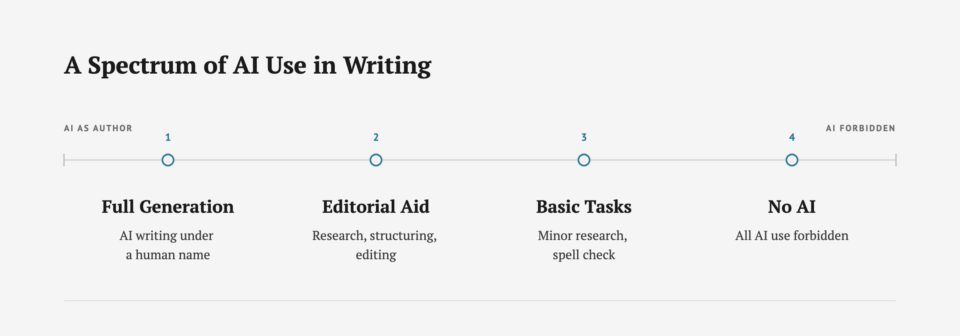
As I see it, there are now four broad positions when it comes to the use of AI in writing. The first position is to use it fully, up to the point of having AI write complete or near-complete articles that will be published under the name of a human being. A human prompts it, and AI does the rest. The second position, which is Renn’s and Samson’s, is to use it to carry out the kind of functions that could otherwise be legitimately assigned to an editor or research assistant—researching, outlining, checking grammar, correcting typos, helping with structure and flow, and so on. The third position is essentially TGC’s—to use it sparingly and only to accomplish what other well-established tools can already do, such as spell checking and basic research. The fourth position is to forbid its use altogether, even in its most basic functions.1
One interesting wrinkle is the recent news that Anthropic (maker of Claude AI) has begun to digitally watermark content it has generated. This will make it more difficult for writers to pass off as their own what has been fully or significantly generated by AI. It will probably soon be possible to have pretty good evidence that a writer has relied on AI, and it seems to me that this will push more writers away from the first of the four options I laid out earlier and force them to go no further than the second. This means more writers will rely on AI as a helper than a ghostwriter, which is undoubtedly a healthy development.2
The Institution/Individual Divide
The reason I began by reminding us of the transition from Web 1.0 to Web 2.0 is that in some ways the current debate over AI reminds me of that earlier time. Technology has provided new abilities, and there once again seems to be a kind of institutional/individual divide in the way bigger organizations and smaller ones are responding to it. If social media began the democratization of influence, AI could mark the democratization of competence. As blogs gave everyone a platform, AI may give everyone an editor.
No writer is so good that he can do his best work without an editor. The best writing flows from an author and editor working closely together. Almost every book and magazine column you have ever read has been thoroughly edited. The ideas, outline, and flow have been shaped by an editor, and the words have been improved by a second and even third editor. Sometimes the facts have first been mined and verified by a research assistant. Yet the book or article is still published under the name of the author, and rightly so. This is a proven and accepted process.
As blogs gave everyone a platform, AI may give everyone an editor.
Today, individuals and small organizations are identifying AI as a tool that can elevate their writing by providing them with what formerly only institutions could afford—the services of a high-functioning research assistant and editor. The bigger institutions don’t need AI to serve these functions because they have access to funding, and therefore to professionals, who can carry them out. Such institutions are responding by betting that branding their content as fully human will prove to be a strategic differentiator. But crucially, with either approach, there is someone or something that stands between the author and the finished work.
And that brings us to the heart of the issue: Does it matter if this function is carried out by a someone or a something? Is it acceptable for individuals to use AI to narrow the competence gap that institutions enjoy by virtue of their size, or is this giving an app a function that is essentially human? Might individuals and small institutions that use AI diminish their humanity even as they elevate their writing?
The Reader Will Decide
Ultimately, it is readers who will decide how much AI they are willing to tolerate, if any. It may be that some remain purists and only read text that has been guaranteed to be fully and entirely untouched by AI in every stage of its creation. Such people may have a lot of confidence in institutions like TGC and CT that guarantee a fully human process. It may be that some readers don’t care whether AI has generated text in its entirety, in which case the stances of those institutions will be irrelevant. It seems likely to me that most readers will land somewhere in the middle—they will accept AI in the role of research assistant and editor, but resist it in the role of author, for ultimately they will still want to know they are reading the words of a human being, not an algorithm. In other words, we could see readers follow a similar pattern to the one we saw in Web 2.0, where they gladly embraced both individuals and institutions, harmonizing the two rather than setting them at odds.
My View
As for me, I think I line up a bit closer to Renn and Samson than TGC and CT, though I am still processing, evaluating, and experimenting. I appreciate both institutions and both writers and am thankful they have formed and shared their policies. They have given me a lot to think about.
For the time being, I find myself unpersuaded by the extent of the moral, theological, and practical arguments made by TGC, though I am willing to be corrected. I strongly resist AI as a ghostwriter, and if I was committed to not using even the least AI text verbatim before, which I was, I am even more so now that such text is watermarked. However, I am not immediately opposed to the idea of writers using it as a thinking partner or pressure tester. I find TGC’s solution of asking a well-read friend or an English-teacher church member impractical—simple to suggest perhaps, but hard to do, and perhaps especially for those who write a lot or in contexts with poor literacy. I would resist AI’s help in iterating ideas if that involved thoughtlessly copying and pasting every suggestion, but if the writer is thoughtfully processing and responding to them, this strikes me as a writer fulfilling his task rather than abdicating it.
Here is something that comes to mind: if institutions lay off their editorial teams and replace them with ChatGPT, they would be replacing a human editor with an AI editor. But for non-institutional writers, AI is not replacing a human editor; it is replacing the lack of an editor. In that way, it is helping that writer or small institution to level up, so that measured and strategic use of AI may foster excellence rather than erode it.
In short, I’m convinced that it matters that the words we read come from someone rather than something, but I’m not convinced it matters nearly so much when we consider who or what edits or improves those words. Clearly, I am still working this out, and I am doing so with a desire to respect my readers and ensure I am not being inadvertently deceptive. I am attempting to think carefully about the McLuhan-esque questions of what AI may add to and take away from our experience of being human and how its widespread or personal acceptance will necessarily change us. Wherever I land, I want my readers to have confidence that they are hearing from me and not from a Large Language Model. I want to honor the Lord and honor them as well.
It seems inevitable that in the final analysis, about half of us will be seen to have permitted what we should have forbidden and the other half will be seen to have forbidden what we should have permitted.
Conclusion: Embrace the Process
We are in a process of learning and negotiating, just as we have had to do for every new communications technology since the dawn of time. This is a good and healthy process, and one we should embrace. It seems inevitable that in the final analysis, about half of us will be seen to have permitted what we should have forbidden and the other half will be seen to have forbidden what we should have permitted. Until we all figure it out, let’s commit to believing the best about one another and to assume that we all have the same goal—to allow our words to be a gift to others in the hope and expectation that we can be a blessing to them as we serve the Lord together.
- This graphic was generated by AI. I think we all agree that’s a legitimate use of AI, don’t we? ↩︎
- AI can only watermark text it has generated in whole or in part. If a writer uses text verbatim that AI has generated or edited, his text may be watermarked. However, if that author merely takes suggestions from AI and writes them in his own words, his text will not be watermarked. ↩︎