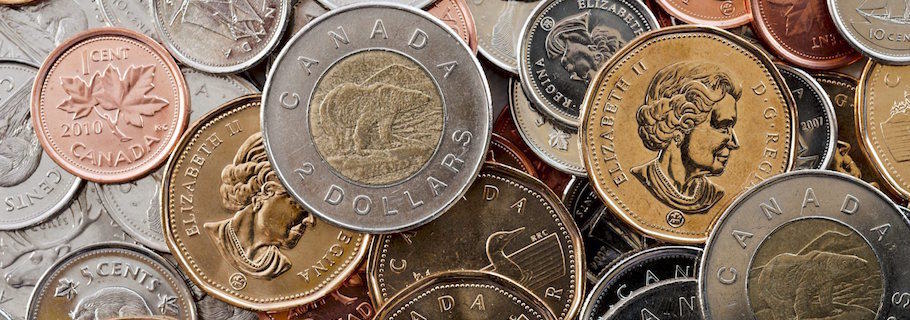
I maintain an occasional series of articles called “It’s a Fact, Eh?” which offers little glimpses at some of the joys, complexities, and eccentricities of being Canadian and living here in the Great White North. Today I want to talk about the Canadian dollar and its relationship to its American counterpart. Really, I want to talk about the Canadian obsession with the U.S. Dollar.
When you listen to a Canadian news report, you will almost always hear how the Canadian dollar (the Loonie) is doing in comparison to the American dollar. “Today the Loonie gained two basis points and closed at 75.92 (US).” Canadian media reports this information on a daily basis because Canada is so heavily dependent on our relationship with the United States in matters of trade. A lot of what we buy, what we eat, what we watch, what we read is shipped up from America. We buy these products in Canadian dollars, of course, and that Canadian dollar gains and loses value in comparison to the greenback. Sometimes the Canadian dollar gains in strength so that the two currencies are roughly equal, but sometimes there is a twenty or thirty-percent disparity between them. Currently one Canadian dollar will purchase just seventy-five cents American.
Why does this matter? It matters a lot when it comes to those products that come to Canada from the U.S.. When the Canadian dollar is strong, as it has been quite recently, we tend to pay the same amount as Americans for these products. So, for example, the cheapest apps at the Apple App Store are typically $0.99, just like in America. But then sometimes the Canadian dollar loses value just like it has done recently. When this happens there is a sudden adjustment and one day we wake up to find the apps now begin at $1.29. The app that cost $9.99 yesterday costs $13.99 today. The computer that was $999 is now $1299 or $1399. Book prices fluctuate the same way (in both print and electronic formats) as do movies (so that renting movies online now costs $5.99 instead of $4.99). Even groceries are affected—we are paying twenty percent more for produce this year than we were last year since the bulk of it is shipped up from California.
This all makes sense. Those American manufacturers can’t lose twenty-five or thirty-percent in the currency exchange. But here’s where it gets difficult for Canadians: When our dollar weakens, certain products and services experience a dramatic rise in cost, but our salaries do not. So even though we now pay twenty percent more for produce, for online services, and for certain other items, some of which are luxuries and some necessities, we do not have a commensurate rise in income to offset it.
So now you know why when you come to Canada you will always hear about the American dollar on the Canadian news. It’s a fact…





