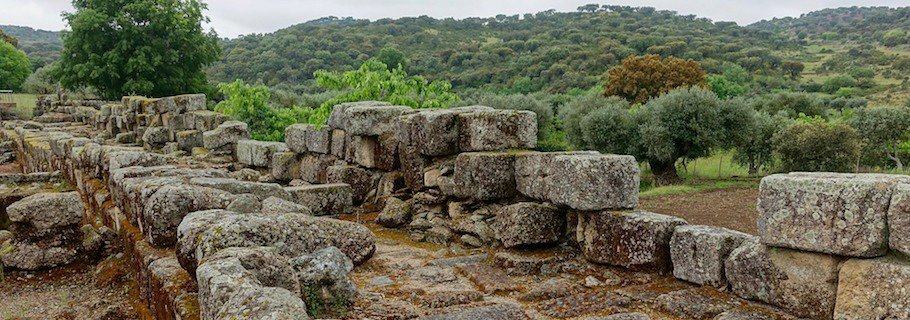
God had promised his people a land. He had promised to lead them out of captivity and into a place of their own. And now he had delivered them from their bondage in Egypt, he had led them across the Red Sea, he had remained with them for forty years of wandering, he had taken them safely across the Jordan River. Now just one great barrier remained—the people who already inhabited that land. The first city they encountered was the city of Jericho, a strong and fortified city surrounded by great walls. How could these wilderness wanderers hope to prevail against so great a city? God had a plan.
For six days the Israelites marched around Jericho. First came an honor guard to lead the way. Behind them walked seven priests, each carrying and blowing on a ram’s horn. Then came the Ark of the Covenant, the presence of God on earth. Following the ark was the rear guard and the army of Israel. They all marched in silence with no sound but the horns. For six days this strange procession marched a single time around the city before retiring to their camp. Then, on the seventh day, they marched around the city seven times, and just as they completed the final circuit, they lifted up their voices and shouted with a great shout. And in an instant the walls of the city fell flat.
This was God’s deliverance. A city with walls was a fearsome foe, and capturing it required a costly and devastating battle. But a city without walls was helpless and hopeless. And sure enough, “the wall fell down flat, so that the people went up into the city, every man straight before him, and they captured the city. Then they devoted all in the city to destruction, both men and women, young and old, oxen, sheep, and donkeys, with the edge of the sword” (Joshua 6:20-21). The battle was decided the moment the walls fell flat.
I wonder if Solomon was thinking of Jericho when he wrote, “A man without self-control is like a city broken into and left without walls” (Proverbs 25:28). There’s no city more pitiful than a city without walls. There’s no worse place to build a home, no worse place to raise a family, no worse place to found a business than in a city without walls. Such a place is always vulnerable to marauders, always prone to falling into the wrong hands. It practically invites invaders. It’s easy pickings.
There’s no city more pitiful than a city without walls, and no man more pitiful than a man without self-control.
Barely a day goes by when I do not speak to someone or inquire after someone or pray for someone who is struggling with the sin of pornography. Men get in touch all the time to confess the sin and to ask for help. And what I want them to know is that they are cities without walls. Through their lack of self-control, they have done the work of a conqueror in their own lives. They have voluntarily flattened their defenses and left themselves vulnerable to attack. They are in the very act of committing spiritual suicide, of showing every enemy they are ripe for the taking. They, like Jericho, are defeated before the battle even begins. There’s no city more pitiful than a city without walls, and no man more pitiful than a man without self-control.
Their salvation is in the Lord who offers wisdom and, with it, self-control. “God gave us a spirit not of fear,” says Paul, “but of power and love and self-control” (2 Timothy 1:7). Self-control is the walls around their city, the protection around their souls. “Whoever is slow to anger is better than the mighty, and he who rules his spirit than he who takes a city” (Proverbs 16:32).