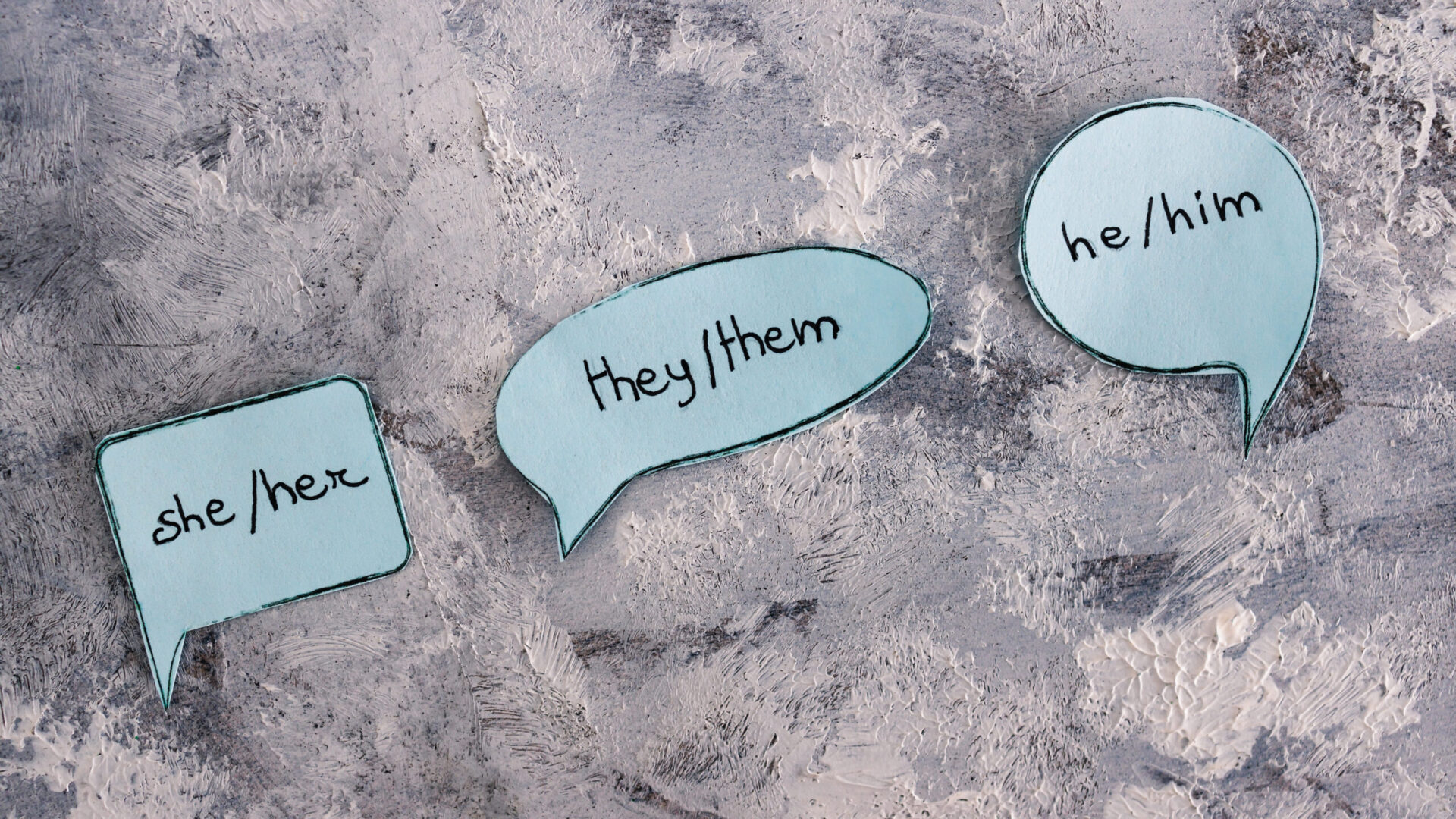
It’s a question each of us will have to face if we haven’t already—should I use another person’s preferred pronouns? For some the question will come up in a context that is innocuous, and the decision may involve no negative repercussions. But for some the question will come up in a context in which they stand to lose something as substantial as respect, a job, or even a relationship with a child. The authors of the book The Gender Revolution speak to the subject of so-called “pronoun hospitality” along with the pressure to tell others your own preferred pronouns and provide their guidance.
The use of preferred pronouns and ‘neopronouns’ (such as ‘ze’ and ‘zir’) is highly contentious, even among like-minded Christians who agree about other aspects of this issue. Some see it as a matter of courtesy to accede to the use of a person’s preferred pronouns and to state your own. This is based on a belief that even if you disagree with the ideology driving the use of alternate pronouns, a willingness to use them can be a way of preserving a relationship and avoiding unnecessary offence. Christian psychologist Mark Yarhouse says, “It is an act of respect, even if we disagree, to let the person determine what they want to be called. If we can’t grant them that, it’s going to be next to impossible to establish any sort of relationship with them.
Preston Sprinkle calls this approach “pronoun hospitality”, and believes that “using the pronouns a person identifies with should be a matter of common courtesy, not a legal demand”.
Others would take the opposite view, seeing the use of pronouns as evidence that you agree with, and are a willing participant in, transgender ideology’s underlying assumptions about gender. By signalling this acceptance, you become complicit in the ideology’s regressive belief system, thereby helping to legitimize and promote it. While other concessions could be made to avoid offence and to preserve relationships, speaking something that is untrue by calling a woman ‘he’ or ‘him’, or a man ‘she’ or ‘her’, is a bridge too far for many. As Andrew Doyle, author of the book The New Puritans, points out: “When you ask someone to declare pronouns, you are doing one of two things. You are either saying that you are having trouble identifying this person’s sex, or you are saying that you believe in the notion of gender identity and expect others to do the same.”
We do not recommend the use of preferred pronouns—either in personal discourse, or when speaking to others about someone who has requested new pronouns. In our view, it is not compassionate because it reinforces a falsehood. We recommend that when communicating with someone who has changed their identity, you avoid using pronouns and instead use their name all the time. (We do not object to using a person’s preferred name—[something they cover later on in the book].) So, instead of saying ‘he’ or ‘she’,‘zhi’ or ‘zher’, we recommend constantly saying ‘John’ or ‘Jane’. This may make communication more difficult and awkward—but, in a sense, that’s the point. Adopting a transgender identity doesn’t make anything better; it only makes things worse.
In offering this advice, we are disagreeing with Mark Yarhouse and Preston Sprinkle, who are both faithful Christians and thoughtful contributors to the larger conversation. … [They then recommend reading those authors’ rationales to ensure they have been fairly presented.]
But what about situations in which you are asked to provide your pronouns?
Choosing to share your pronouns is one thing. Being required to state your pronouns is far from an innocuous act. It is an implicit endorsement of transgender ideology and its erasure of the significance of biological sex. Biologist Colin Wright is correct: “Coercing people into publicly stating their pronouns in the name of ‘inclusion’ is a Trojan horse that empowers gender ideology and expands its reach”.
He also suggests that the forced use of the word ‘cisgender’ (a person who is not transgender) fits into this same category and has the same effect.
The Sex Matters website has a range of useful advice on dealing with this issue. In particular, they offer this helpful summary of what to do when asked to share your pronouns:
The simplest thing to do is to politely decline. Refrain from putting pronouns in your biography or your email signature and don’t announce them at meetings. If invited to, say “No thank you” and if asked why, say something bland like “It is not a practice I follow”.