
As mentioned in an earlier post, I read through Lou Priolo’s book Pleasing People last week. This was a book that just showed up in my mailbox. It is not one I would have chosen and even after I pulled it out of the box and set it in my “to read” bookcase I didn’t think I’d actually care to read it. I’ve got a billion other books to choose from and this one didn’t seem to offer much based on a quick perusal of the front and back cover. But eventually I began to feel guilty that I had read several mainstream books and thought that Pleasing People would be good for me to read something that might just challenge me on a personal level. So I grabbed my pencil and my highlighter (yes, at long last I’ve stooped to highlighting my books) and got to work. At first I thought my suspicions may have been correct that this book would offer me little. But as I read further and began to read about what it means to please people, and even more, what the symptoms are of a heart that desires to please people above God, I began to see glimpses of myself. And really, it has only been after I finished the book, in times of prayerful reflection, that I’ve begun to see myself even clearer. It was a valuable read and one I’m glad I made time for. It has shown me that there are areas where I seek to please people above God; areas where I seek approval and acceptance rather than seeking the Lord.
There was a little chart in the book that I found very helpful. I spent some time in Photoshop today and rigged up my own version of it and thought I’d share it with you. It comes from a chapter dealing with the question of whether we, as sinful human beings, can please God. There is a section heading entitled “The One you please will judge you not on outward appearance, but on that which is in your heart.” So, unlike people, who see only dimly, God sees with complete clarity. He sees not only the outward appearances but the attitudes, thoughts and motives that drive those outward expressions. One reason that living to please people is a dead end is simply that humans see that which is most superficial rather than that which is deepest. Actions which are based on pure motives can be misinterpreted as being spiteful and words that are said from an angry and sinful heart can be interpreted as loving, caring, godly words. But God is not so easily fooled.
We all know that others cannot see our thoughts and motives, but the Bible tells us that we can’t even see into the deepest recesses of our own hearts. As Priolo says, “the further into our hearts we look, … the more difficult it comes for us to evaluate things accurately. In other words, because they are more readily apparent to our view, our words and actions are much easier to detect than our attitudes, thoughts, and motives.”
And then he provides the following diagram. As the arrows extend downwards into the heart, they become darker and thus represent the greater difficulty in seeing with clarity.
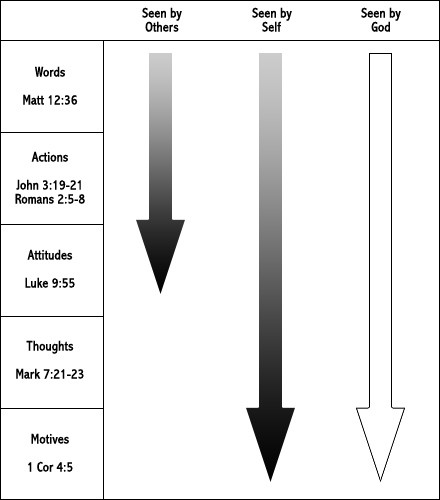
I’ll grant that this is a simple diagram but it nicely put into a picture what before I’ve seen only in words. It shows just what the Bible says: when I look at others, I can evaluate only on the basis of words and actions and perhaps get a glimpse of the attitude. But I cannot see their thoughts or motives. When I look at myself I can evaluate words, actions and attitudes. But the thoughts begin to appear dim and the motives even more so. As well as I know my own heart, I can still not properly evaluate or judge my motives. But then there is God. God sees everything with utter clarity, judging not just words and actions, but attitudes, thoughts and motives alike. Nothing is hidden; nothing is even darkened. “God is the only one who can see and rightly evaluate all our external and internal behavior. And He assesses these things in our lives even better than we can. His ability to judge these areas is at once more severe and more merciful than our own sin-tainted capacity to discern ourselves.”
So it is God, and only God, who can truly judge whether we are truly doing what is right and good. It is only God who can see deep enough into our hearts to tell whether we are doing what we do our of pure hearts or hearts that are set on pleasing others. Thus we must seek to please Him–the One who can evaluate our hearts rightly and truly; the One who is never fooled.





