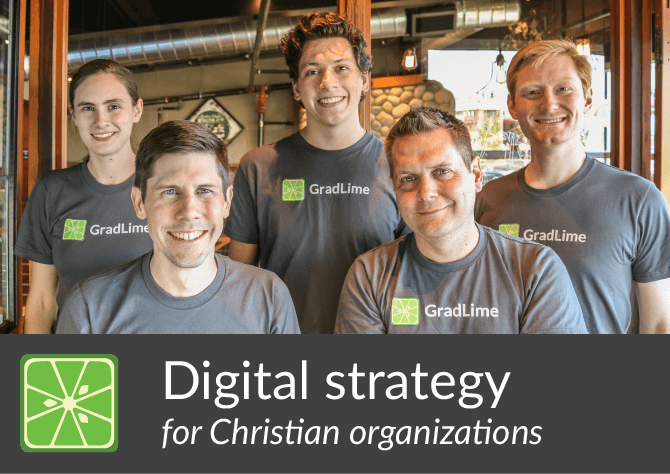

This sponsored post was prepared by GradLime.
If you’re a pastor or nonprofit leader, you already know that you need to find a way to reach more people online. “Reaching people” can take many forms:
- Increasing church attendance
- Growing monthly giving
- Serving the community
- Expanding your donor base
… whatever the need is, you know that there’s got to be a way to meet it, and that it’s going to involve some degree of digital strategy. (Which is how I make a living.)
But we run into a problem. Too often, our online ministry efforts end up looking like this:
- We decide what we want people to do (give money, volunteer in the nursery, etc.)
- We use our online channels (like our website, email, and social media) to push people to do that.
- And … crickets.
Why?
Maybe we have online ministry backwards. By making our online communication all about what we want people to do instead of about how we can serve them, we’re gating our service. We train people to believe that in order to be served, they need to do what we ask.
But what if we first took our service to them?
Pastors: What if college students in your city found your student ministry blog so helpful that they made a point to visit every Sunday before exams?
NGO leaders: What if your “marketing” emails were so helpful that any time you sent a message to your list, your followers would reply to thank you? (This happens all the time for one of my clients.)
It’s possible, and here’s how …
It’s time for “content ministry.”
I’d like to share an approach that has been helping organizations do this for a while. It’s called “content ministry.”
Content ministry = churches and nonprofits making online content that meets the same needs their “offline” ministries meet.
Content ministry serves first, and asks later. That can take a variety of forms:
- You run a teen moms ministry? Write a list of tips for getting a baby to fall asleep.
- You made an app for KidMin pastors? Make a list of places they can find Sunday school lessons online.
- You offer pastors a Church giving app? Publish aids on the topics of tithing and end-of-year giving.
Does it work?
After doing this for a while, my clients are actually finding that if you initiate relationships with generosity, the people you want to reach become more and more receptive to hearing from you.
Case in point: when Disciplr (a tech arm for a nonprofit) sends a mass email, someone somewhere replies with a note thanking them for all the ebooks and blog posts they’ve shared.
What if churches and Christian NGOs everywhere embraced content ministry?
How to start doing content ministry today:
- Pick a ministry that you’d like to see grow.
- Ask, “Whom can this help most, and how?”
- Now ask, “What problems or challenges is this person facing?” See if you can write down 10 ideas.
- Pick just one of those problems, and write a solution for it. You can ask for help from your communications or marketing team, if writing’s not your forte.
- At the end of that piece you’re writing, recommend your ministry (or product) as a way for people to get even more help. You can finish with something as simple as, “If you found this post helpful, you might enjoy [MINISTRY NAME].”
- Publish it on your website. Then share a link to it via email and social media.
- Done. You’ve just started doing content ministry. Now keep it up!
And here’s the sales pitch …
… there is none.
Sure, the GradLime team would love to help you with a content ministry strategy (you can reach us here). But we’re pretty pricey. I’d rather share something that any leader reading this can put into action this week!
Jeffrey Kranz is CEO and co-founder of GradLime, a content strategy agency for Christian organizations. He and his wife Laura live in the Pacific Northwest, where they push the human limits of coffee intake and sunlight deprivation.