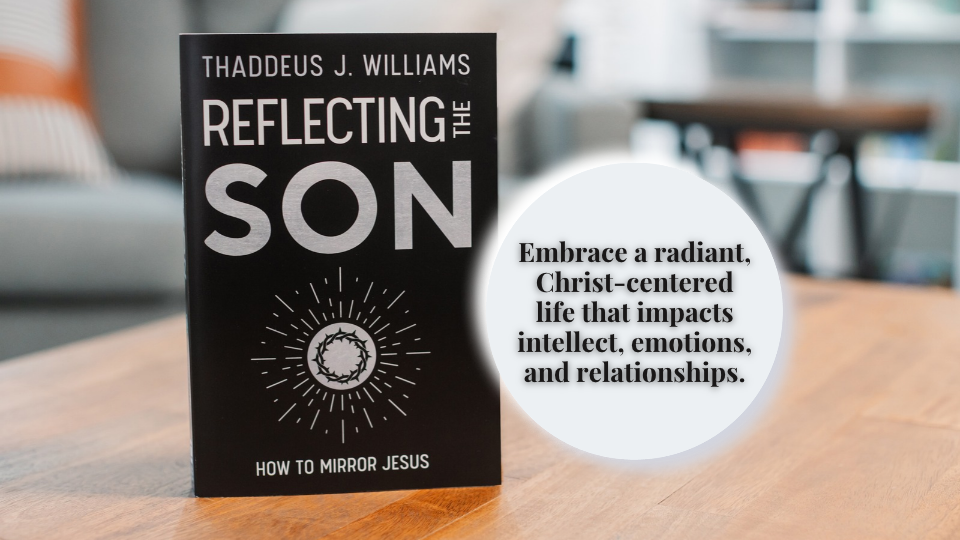
This week, the blog is sponsored by Zondervan Reflective and written by Thaddeus Williams, who is assistant professor of Systematic Theology for Talbot School of Theology.
We begin on the steps of the temple in Jerusalem. It is the Tuesday before Jesus’s execution and a lawyer asks him to define the greatest of the 613 commandments. Jesus answers, “You shall love the Lord your God with all your heart and with all your soul and with all your mind” (Matt. 22:37). Jesus cares enough about our minds to include them in his first and greatest commandment.
But what does it mean to love God with all of our minds? Jesus not only talked the greatest commandment, he walked it better than anyone. How, then, did the greatest keeper of history’s greatest commandment love God with his mind?
Moments before answering the lawyer’s question, Jesus demonstrates what a mind that fully loves the Father looks like in action. The Sadducees, a group of politically savvy Jewish thinkers, confront Jesus on the crowded temple steps to test his intellect. These veterans of debate pool their collective genius to construct a clever logical trap for Jesus. They begin with a sad story (Matt. 22:23–27). A woman loses her husband. The dead husband’s brother steps in to marry and support her. He dies too, and she marries yet another brother- in- law. The sad story repeats down to the seventh and last brother. Finally, the widow dies.
Jesus not only talked the greatest commandment, he walked it better than anyone.
With this grim tale of seven weddings and eight funerals, the Sadducees pull back the steel teeth of their logical trap. Then they lay the bait and carefully set the trigger with a simple question: “In the resurrection, therefore, of the seven, whose wife will she be? For they all had her” (Matt. 22:28). To appreciate how skillfully the Sadducees had constructed this intellectual trap, notice its logical structure. It takes shape as what philosophers call a “destructive dilemma.” As Josephus tells us, “The doctrine of the Sadducees is this: That souls die with the bodies.” Their destructive dilemma against Jesus’s belief in the afterlife runs like this:
- If (x) the dead will one day rise, then the woman will either (A) be married to all seven when she resurrects, or (B) she will remain married to only one of the seven when she resurrects.
- A is false because a woman married to all seven brothers would violate marriage as a monogamous institution, and B is false because it would be totally arbitrary for the woman to remain married to only one of her seven husbands.
- Since A and B are both false, x—Jesus’s belief that the dead will rise—is also false.
The Sadducees knew that if Jesus answered with either A or B, then his credibility as a rabbi would be left bleeding and twitching for all to see. There seemed to be no way out. What does a mind that fully loves the Father do in such an intellectual fix? Does Jesus say, “Hey! What’s that over there?” and run to hide in a nearby cave? Does he condescendingly pat them on the head and say, “Quit asking silly questions, close your eyes, and take a leap of faith with me?” Does he threaten to smite them with fire from the sky for questioning him?
None of the above. Jesus does not retreat, cop out, or bully. He answers, “For in the resurrection they neither marry nor are given in marriage, but are like angels in heaven” (Matt. 22:30). Jesus instantly dismantles the Sadducees’ trap. He exposes their hidden and false assumption of their argument that resurrected people will be married. Jesus articulates what philosophers call the tertium quid, meaning the “third thing,” not the false A or the false B but the true C.
Do you see the brilliance of a mind that keeps the greatest commandment? Jesus used the same style of logical trap that had been set for him—a destructive dilemma. The scholars fell silent (Matt. 22:34). The crowd that the scholars had hoped would be astonished by a blundering Jesus is astonished by something else—his sheer brilliance (Matt. 22:33).