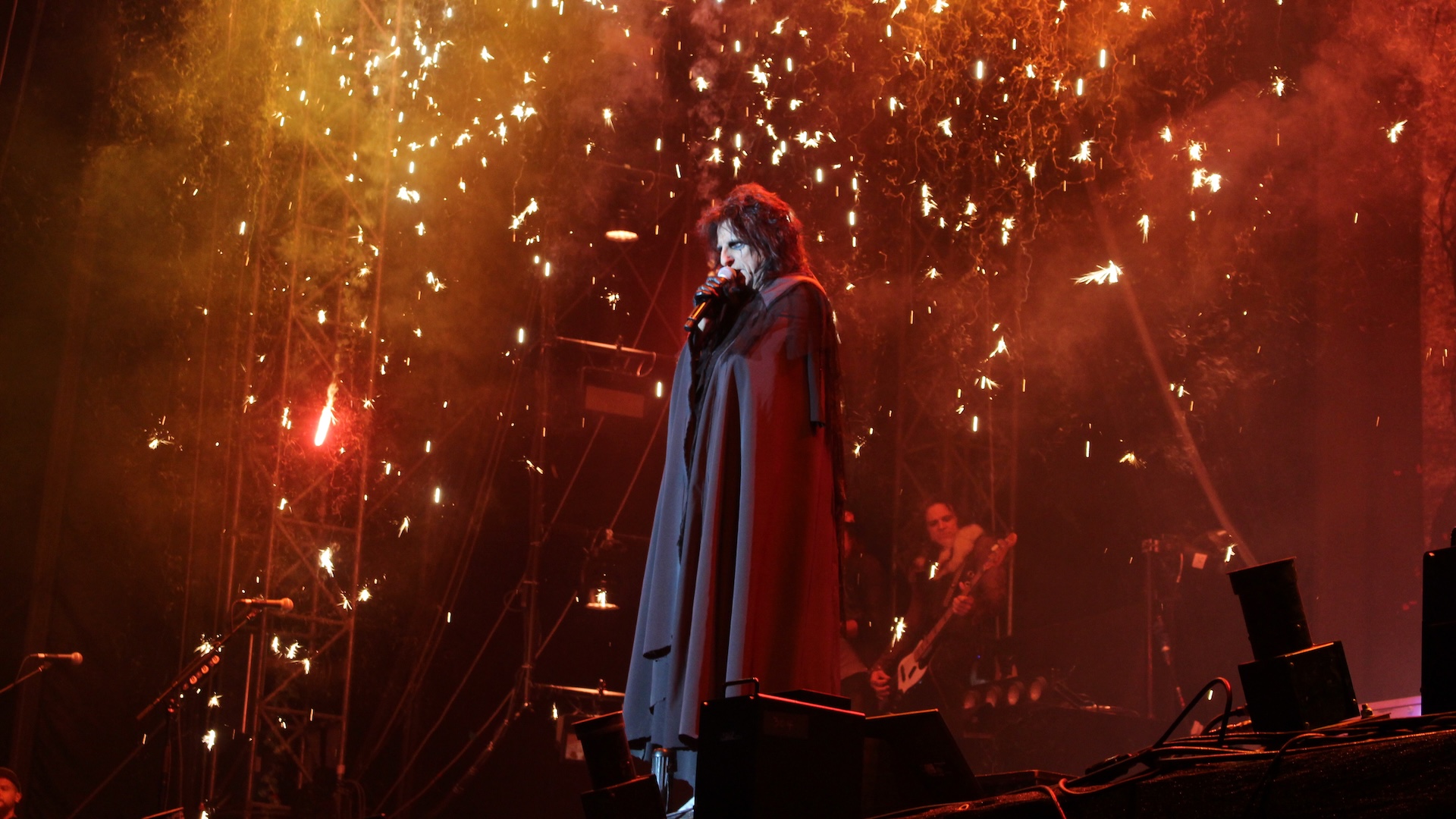
It’s probably not fair to read a book on my own terms rather than the author’s, but I suppose that’s what I might have done with Alice Cooper’s new memoir, Devil on My Shoulder. I am not very familiar with his music, I have little interest in knowing how he rose to fame in the world of rock ’n’ roll, and I don’t really care to know the stories behind his songs. So why would I read it?
I read it because I have been interested to hear repeatedly over the years that Alice Cooper is a Christian. I have heard of his relationships with Christian leaders like R.C. Sproul, Alistair Begg, and Greg Laurie. I have always wanted to know whether the rumors are true that he is, indeed, a believer, and even more, to have this tension resolved: Is it possible for a man to be both Alice Cooper and a Christian? So when I saw news of his book, I decided to give it a read, especially when I saw that faith would be one of its themes, as described in this marketing copy:
I want to talk about God. Don’t worry, I’m not gonna bang you on the head with a Bible, I just want to describe how it is that I found Him dwelling in me. Alice, that inveterate liar, was a voice in my ear for so long, whispering lies and sweet nothings, pretending to be my better conscience and my inspiration, pretending to be me, that I think it’s only right to present both sides of the story: the angel on one shoulder, the devil on the other.
Alice Cooper was born in Detroit in 1948 as Vincent Furnier. Both his father and grandfather were leaders in The Church of Jesus Christ, a restorationist offshoot of the Latter Day Saint movement that is often referred to as “Bickertonite.” Here’s Cooper’s own explanation of the church:
In 1844, after the founder of the Church of Latter-Day Saints, Joseph Smith Jr., was murdered by a lynch mob, there was bitter argument over who should succeed him. Brigham Young took his followers, later called the Mormon Pioneers, to Utah, while some of those who stayed behind split off from the Church of Latter-Day Saints and founded the Church of Jesus Christ (Bickertonite). So, we share the same roots but (confusingly to laypeople), although we accept the Book of Mormon as scripture, we are not Mormons!
He discovered rock ’n’ roll music when he was a teenager, formed a band, and began to make his mark on the music scene, first in Phoenix, and then in Los Angeles and Detroit. Eventually he and his bandmates began to perform under the name of Alice Cooper, and when the band dissolved, he became solely associated with the name, even going so far as to legally adopt it as his own. Cooper led one of the first shock rock bands and, like so many others, was soon notorious for all manner of overindulgence and immorality. He spent many years philandering, drinking to excess, and addicted to drugs. While his career soared upward, his life began to spiral downward, and he utterly abandoned the faith of his youth.
So who is Alice Cooper in relation to Vincent Furnier? In my understanding, Alice is a character Vince developed, through whom he could explore and express the depraved and macabre. Vince has too much fear and respect for the demonic to make Alice an occult figure, but he’s certainly a dark and ghastly one who is obsessed with death, suffering, sex, gore, and the intersections between them. Vince has always insisted that Alice is an alter ego he plays and even becomes when he puts on his makeup, but one who is very different from himself. Even his name change was not because he had become Alice, but simply because he was so closely associated that no one called him Vince anyway.
Cooper eventually married Sheryl Goddard, who was one of the dancers in his stage shows. Though their marriage was at first enjoyable, his addictions began to dominate, and it was only when Sheryl determined to leave him that he appealed for help. Through contacts at Moody Bible Institute, they were referred to Christian psychologist Kevin Leman, who provided intense counseling that saved their marriage. They decided to make church a part of their life, and settled into Camelback Bible Church, long pastored by Tim Savage (who, interestingly, was a founding council member of The Gospel Coalition).1 They have considered this their home church ever since.
It is at this point that I would expect the rest of his biography to express how he knew that as a Christian he could no longer play Alice, so retired him and started a new character, or formed a new band, or found a whole new occupation. But that’s not his story. Instead, he kept on performing as Alice Cooper and found that in many ways his greatest successes were still to come. He continued to develop Alice as a character, and made him every bit as depraved and macabre as he had ever been. He continued to sing songs whose themes are the kind that are surely covered by Ephesians 5:12: “it is shameful even to speak of the things that they do in secret.” Yet now he did it as someone who professed to be a Christian.
And this is where I was left scratching my head. I have read of how Cooper attended a Ligonier Ministries conference and, after bumping into R.C. Sproul at a golf course, enjoyed a round of golf with him. R.C. later downplayed the meeting, and said only that in their brief interaction he had found Cooper committed to his Christian faith. I remember Alistair Begg interviewing him during an evening service2 and Greg Laurie interviewing him on his show not just once, but twice. All sorts of Christian periodicals have written about him and described him as a believer. People I know and trust have affirmed that.
So what do we do with Alice Cooper’s faith? Well, until he applies for membership at my church and I become responsible to determine whether or not I can recommend to others him as a brother in Christ, there is a sense in which it doesn’t much matter. It’s not for me to determine. But here are a few observations drawn from Devil on My Shoulder.
First, he is often described as having grown up in a pastor’s or evangelist’s home and having been raised as a Christian. But his family was Bickertonite, and while that sect is not formally Mormon, they consider themselves the true heirs to the teachings of Joseph Smith. They accept the Book of Mormon, hold to a non-orthodox doctrine of the Trinity, and add the necessity of works to faith. This means he was actually not raised in a Christian home. He also never disambiguates his Bickertonite upbringing from his current beliefs and, in fact, uses “we” and the present tense when he describes what Bickertonites believe. He expresses anger at those who might suggest his father was actually unsaved and tells of friends who died in utter debauchery, yet shares his conviction that they are in heaven or something like it.
Second, while Cooper describes becoming a churchgoer and recounts many great transformations to his life, his biography does not recount an experience of conversion, or trusting in Christ. While his life has certainly changed, and while he ascribes this change to God’s presence in his life, he does not tell of trusting in Christ alone. He may, indeed, do so, but his memoir does not make it clear.
Third, he does not express remorse for the sins of his youth, other than the ways they may have impacted others. Neither does he repent of the ways he may have led others into sin, including through the explicit nature of his shows, not to mention some parts of this book. Even his girlfriend having an abortion passes by without much moral significance attached to it. Never is there any indication that he, like David, could say, “Against you, you only, have I sinned and done what is evil in your sight” (Psalm 51:4). He has plenty of regrets, but he also seems to still delight in much of the debauchery of his youth and describes it seemingly without shame. At one point he says that while a certain vile sexual practice is not of interest to him, he is fine with others indulging in it. At another point he mentions how his daughter used to play a dominatrix in his shows, as if this is a good and noble thing that a father can be proud of. Even today, he is surrounded by sexualized characters on stage while he sings of unspeakable deeds.
Perhaps most concerning, he continues to play Alice. To be clear, Alice is not a character he needs to play, but a character he chooses to play and to present to the world. He has changed Alice since becoming a churchgoer, but he is still as abhorrent and repulsive as can be. “He still feasts at a smorgasbord of grave robbing, [something else too evil to even mention], boozing, and gambling, force-feeding candy canes to diabetics, chopping up babies, slitting throats, tearing out hearts, blowing schools to pieces, doubting parents’ authority, and generally enraging decent citizens everywhere like a blood-bubonic psychopath, but he’ll never swear at you. That wouldn’t be gentlemanly! Alice has his own morality, and I have mine. We’re separated for the sake of both our health.”
I think there is a sense in which we all want to have an Alice—a person through whom we can act out our depraved interests and fantasies, and do so without attaching moral weight to it. And then we want to have a Vince, if you will—a person who is moral, upright, and worthy of respect, and who represents who we believe we really are. But God’s calling on our lives is meant to impact us to such a degree that we have no right to partition ourselves in such a way. There is really no such thing as an alter ego, but only a self who is sometimes torn between wanting to sin and wanting to honor God. There is only a self who is called to flee from the very appearance of sin, and certainly not to frolic in it, delight in it, and rejoice in it. We may all want to have an Alice, but we realize we cannot and must not, for Alice would actually be us.
When writing about a certain kind of religious person, of whom I suspect I am one, Cooper says this: “Nothing and nobody is holy enough for these people! But that shouldn’t be what Christians are about. Real Christians don’t judge. Real Christians don’t hate. Jesus says, ‘If you’re going to represent me, be very careful. If you’re going to be a teacher, be very careful. Because you’re representing me, you will be judged more.’ That’s why I never make fun of religion, because I’m going to have to answer to it when all this is all over. Unfortunately, there’s always going be over-the-top fundamentalists. Haters gonna hate. I’m just not one of them.”
I’m no hater and would love to know that Cooper is a believer, but if a man is going to profess to be a Christian and be one with a public platform, he should not be surprised, dismayed, or offended when others take an interest in the nature of his faith. He chooses to be an influence over others, and a spiritual influence at that! Neither is it fair to head off all criticism by painting those who are concerned as mere judgmental fundamentalists. In fact, a true believer should welcome the watchful eyes of brothers and sisters in the Lord who love him and want only the best for him.
So, let’s return to the question that sparked this article: Is Alice Cooper a Christian? I don’t know, and it’s not for me to determine. But as I finished reading Devil on My Shoulder, here’s what I found myself pondering: In the day of judgment, the Lord will ask Vincent Furnier to give an account of his life. The great theme and accomplishment of his life, the one he created, the one he has fostered, the one he is known for, the one who has enriched him, and the one he is proud of is Alice Cooper. I am not Vincent Furnier, but I know that I would fear to approach the Lord, present him Alice, and say, “This is what I did with all that you entrusted to me.”
- This explains why Savage’s book on marriage featured this endorsement: “No Ordinary Marriage explains how a marriage is intended to glorify God. Dr. Tim Savage writes not in a spirit of condemnation, but rather of encouragement as he paints a picture of what marriage is really meant to be. In reading this book, Sheryl―my wife of nearly 36 years―and I found ourselves challenged and inspired to rely on God as the core of our marriage. We pray that the Lord will inspire Tim to write his next book―How To Survive Hormonal Teenagers!” ↩︎
- Unfortunately, the recording is no longer available. ↩︎