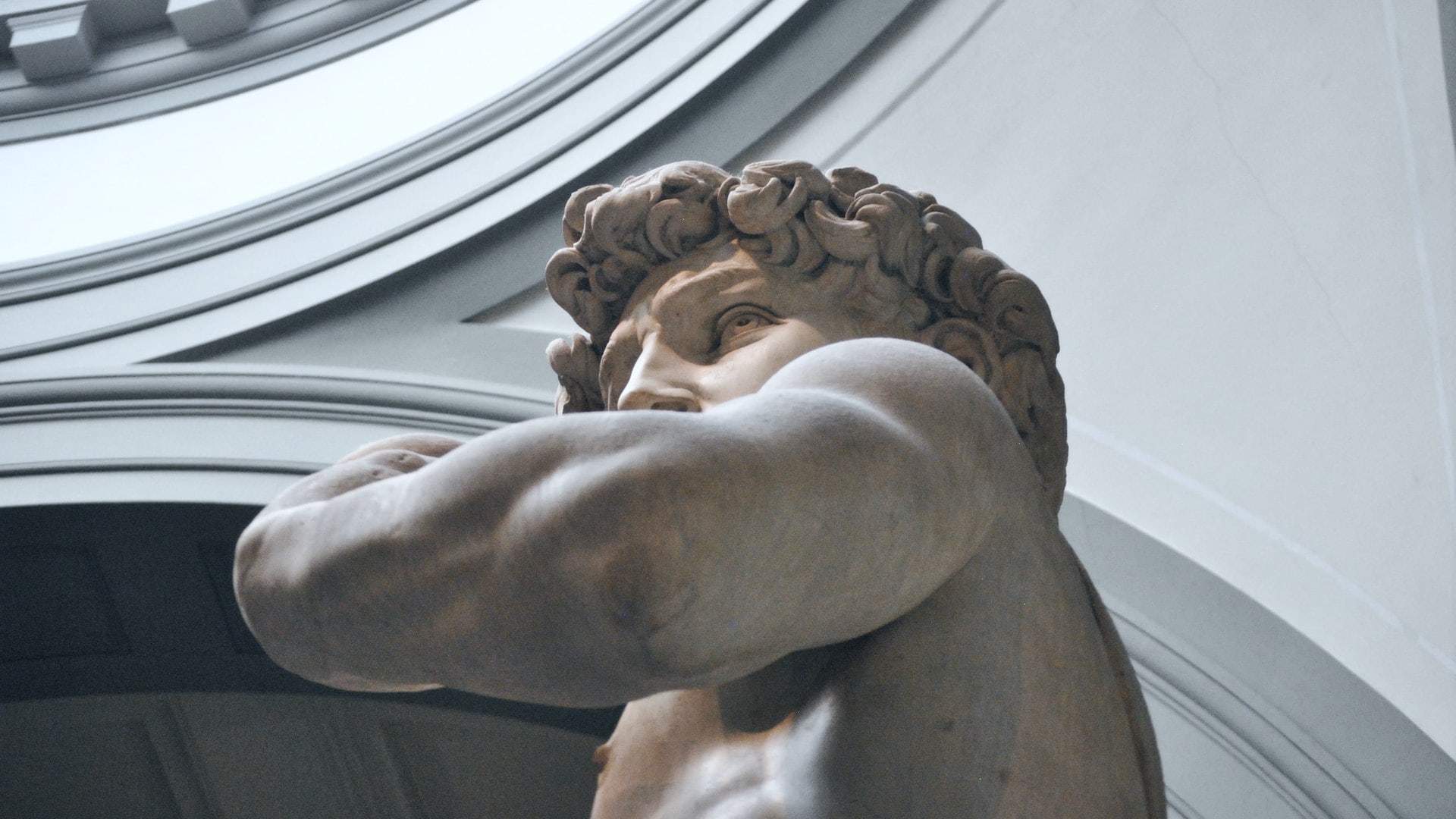
It is said of Michelangelo that when he was carving his best-known masterpiece he began with a block of marble and simply removed whatever was not David. This is the task of any sculptor—to begin with raw material and to work with it until nothing is left but the subject itself. Under the hand of a skilled artist, each rough blow of mallet on pitching tool, each gentle tap of hammer on chisel, each precise stroke of rasp and riffler, each careful sweep of paper and polish steadily transforms an unformed block of marble to a stunning work of art.
When we come to Christ in repentance and faith, we surrender ourselves to the purpose of God and submit ourselves to the hand of God. We are the block of marble and he the artist, we the medium and he the one who must remove from it whatever is not Christ. From the moment of our salvation he begins to conform us to the image of his Son, to pare away whatever is earthly until there is nothing left but that which is heavenly.
His work, though always purposeful, does not always feel gentle. If a block of marble had a voice it might cry out at the actions of the artist, it might object to having piece after piece chipped away. But surely it would be comforted by the sculptor’s reminders of what it is becoming and his assurances of what it will soon be. And as God carries out his work on us, as he removes what is sinful and idolatrous, what distracts and diverts, what keeps our feet planted on earth and hearts fixed on what is present, we, too, sometimes cry out in pain. But as rust must be scoured from a blade to make it glisten, as grime must be polished from glass to make it transparent, as pieces must be carved from a block of marble to make it a work of art, so God must sanctify us to make us like Christ. And if it was only through suffering that Christ himself was made perfect as our Savior, it should be no surprise that it is only through suffering that we are made perfect as his imitators.
Of course all illustrations grow weak at some point and this one is no exception, for it may cause us to think there is something unblemished within, some glimmer of goodness, some spark of divinity, that God looks for and finds and perfects. But this is not the case, for God assures us there is no one righteous, no one who understands, no one who seeks after God, no one who does good. There is not even one. But through God’s work of salvation, he transforms us from coal to marble, from what is worthless to what is precious, what from is darkened with our depravity to what glistens with his goodness. Then through his work of salvation he steadily sculpts that new material to resemble the image of Christ. He removes the old to display the new.
Diamonds need to be polished to display their brightness, spices need to be crushed to release their fragrance, trees need to be shaken to relinquish their fruit.
Diamonds need to be polished to display their brightness, spices need to be crushed to release their fragrance, trees need to be shaken to relinquish their fruit. And as marble needs to be carved to bring forth the image within, we oftentimes need to endure sorrows to bring forth the character of Christ. But we have the assurance that our Artist is kind and good, that he only ever acts lovingly and purposefully, that he only ever does what is for our good and his glory. And as he goes about his work, he always holds before us Christ as our model, God’s Son as our prototype, so that when we feel the blow of the hammer, when we feel the pierce of the chisel, we can keep our eyes fixed on the beauty of what we are becoming. For it is God’s will to do his work in us and upon us until we have been perfectly conformed to the perfect image of our perfect Savior.
(Inspired by the writings of J.R. Miller)





