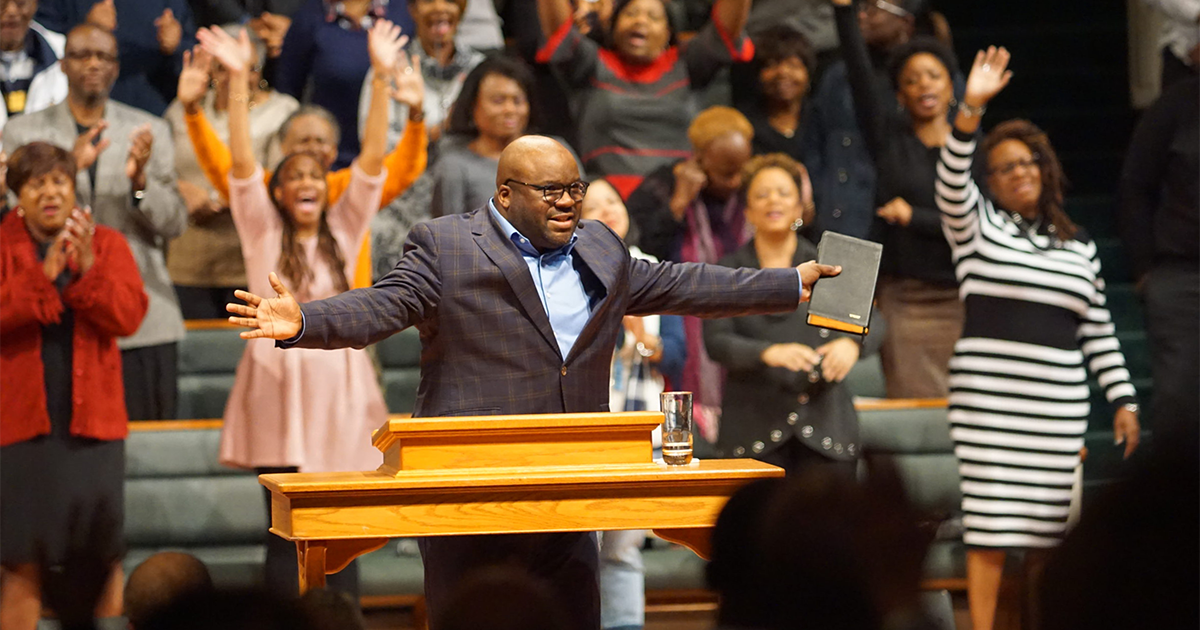
Though we are 2,000 years past the founding of the New Testament church, we are seemingly still confused about how we ought to worship God. There are many competing philosophies of worship, many disagreements about everything from its purpose to its God-ordained elements and methods. We know we must worship, but we so often don’t know how.
It is for this reason that we continue to see so many new books on the subject and for this reason that we need to. This includes, most recently, H.B. Charles Jr.’s On Worship: A Short Guide to Understanding, Participating in, and Leading Corporate Worship. He confesses that, though he has previously written on preaching and pastoring, he found it surprisingly difficult to write on worship. “I believe I have a biblical philosophy of these [other] ministry subjects. After more than thirty years of experience in pastoring a church and preaching each week, I feel comfortable writing about those subjects. Who, truly, is competent to write about worship? And if writers feel confident that worship is a subject they have thoroughly mastered, should we be reading what they think?”
Though he does not claim to have thoroughly mastered the subject of worship, he has made a long and careful study of the matter and over many years of leading a church has attempted to refine his convictions along Reformed, Protestant lines. The result is On Worship which “is not a theological treatise, biblical study, or comprehensive handbook on worship.” Neither is it meant to be. It is instead “more like a compass than a road map” that “seeks to point you in the right direction.”
The book is comprised of thirty chapters that fall into three parts. The chapters are deliberately short and are not always entirely thematically sequential—perhaps a bit more like essays or blog posts that could be read in any order rather than having to be read one after the other.
The first section is dedicated to understanding worship not just as a brief time on Sunday mornings but as a whole-life pursuit that is meant to be the priority of every Christian. Worship that honors God depends upon worshipping in the ways he instructs us to, acknowledging his supremacy, depending upon his Word, and being filled with his Spirit. It requires us to be bound to the local church, to faithfully steward our entire lives, and to live with joy and generosity.
The second section is for those who participate in worship (which is to say, for every Christian). All Christians are to be committed to participating in public, corporate worship and all Christians are to carefully prepare themselves for such worship. The gathered church is to read the Word and pray together, to sing and to “amen,” to exercise their gifts and so build up and encourage one another and in that way to carry out the work of the ministry.
The third section is for those who are involved in leading worship. Here Charles writes about specific elements of a service like a call to worship and leading singing. He discusses the importance of racial diversity in the church and the ways churches can honor and integrate young people. He points out that in a society in which biblical knowledge is waning, we must explain everything and take for granted nothing.
In the end, the three sections and thirty chapters lead to a well-rounded and biblically-faithful understanding of why and how God calls us to worship him. It leaves room for different Christians to worship in ways consistent with their traditions and culture, yet also calls us to ensure that, no matter what, our worship is “shaped and governed by the Word of God. Sacred Scripture should be foundational to all that happens in our public and corporate worship assemblies. Beyond the foundation, however, God’s Word should explicitly structure our worship lives—privately and publicly.”
As is the case with all of Charles’ books, On Worship is filled with instructive quotes and punchy one-liners. It leans upon other useful worship resources and amplifies the voices of other helpful authors. His hope, he says, is to lift the reader’s gaze “beyond mundane, secondary, and worldly thoughts to the ultimate goals of true worship.” And that is a hope he realizes well. This is a book that will benefit every Christian, for whether or not we have been called to take a leadership role in worship, it most certainly falls to each one of us to understand it and participate in it.





