Good morning and welcome to Weekend A La Carte. Be sure to scroll down to read this week’s Reader Recommendations, since you will find some good and interesting ones there. And check in again tomorrow for Works & Wonders.
Sales & Deals
Today’s Kindle deals include some superb books like Kevin DeYoung’s Daily Doctrine and Mark Vroegop’s Waiting Isn’t a Waste.
I have updated the Commentaries on Sale page. It includes deals in both print and Kindle editions, and you’ll find some great discounts there.
Recommended Reading
Brett McCracken watches a lot of movies, and that gives him the authority to create this list of 40 great films for parents to watch with their kids.
In today’s glutted, morally compromised streaming-media environment, Christian families are right to worry about the countless options billed as “kid-friendly” but actually form kids in spiritually unhealthy ways. As a dad of four young kids, I know the struggle well.
It’s impossible to keep up with the content conveyor belt of new film and TV options being marketed to kids. Christian parents need trusted curators who can reliably point us to entertainment that isn’t just “safe” for our kids to watch but is actively promoting laudable themes and (sometimes accidentally) modeling Christian virtue.
This list is my attempt to help my fellow Christian parents in this struggle. The movies below are all G- or PG-rated and generally “safe for the whole family,” though parents should still consult online content guides to discern the appropriateness for their particular family.
Read: 40 Great Films for Christian Parents to Watch With Their Kids.
You’ve no doubt heard something about Bessel van der Kolk’s The Body Keeps the Score, a book that has been on the bestseller charts for more than 10 years. That book has done more than anything else to normalize a particular understanding of the relationship of the body to the mind and of the body’s response to trauma. Matthew Loftus, author of Resisting Therapy Culture explains why van der Kolk’s explanation is unsatisfying and no longer credible.
As important as arguments over how to interpret scientific research are, the larger problem with pop theories of trauma has to do with misapplications of that research and outright misinformation. You may have seen ads, videos, or blog posts proclaiming that procrastination is a trauma response, a statement with no basis in scientific research but still accepted easily because it’s far easier to let go of one’s guilt over procrastination if it’s linked to trauma. The Canadian physician Gabor Maté argues that most mental illness is somehow linked to trauma—another baseless assertion that is nonetheless very popular.
Expanding the definition of trauma can be powerful because it gives people a story that explains how they got to where they are—regardless of whether or not that story is true. We can’t always draw a hard-and-fast line to say “this is psychological trauma” while “that is just a very stressful experience” because stress and trauma are more of a continuum than two distinct categories. However, what we see now is an attempt to maximize the number of things considered as trauma, even using the language of “microtrauma.”
Read: Does the Body Really Keep the Score?
Since we have come to the weekend, perhaps you’d do well to be challenged by Zak Mellgren who wants you to know that it’s not “your” weekend.
“How was your weekend?”
I’ve used this phrases countless times myself. It is an ingrained, deeply rooted piece of my vocabulary. A conversation starter. A way to communicate interest in another person’s life. And let’s be clear up front, that is a wonderful thing. It is good to ask another image bearer about their daily life. “How was your weekend” opens the door to countless possible avenues of conversation. We will often get surface level small-talk from this question, but even these little details are worth our time. And we might get more than small-talk. We may learn of a doctor’s visit that bore bad news, or lay-offs at work, or difficulties in the home – all things we can enter deeper into to communicate greater love and value to that person. So the heart behind this phrase, when asked out of genuine care, is a good thing.
But consider what it implies and reinforces…
Read: There’s No Such Thing as “Your” Weekend.
Jordan Steffaniak says that while AI can be helpful for research and writing, we need to resist using it to do our thinking for us. I quite agree! This is going to be a huge battle in the years to come.
Skirmishes abound. Do we use it? For what and how often? Will it diminish our humanity? Will it enhance it? All excellent questions worthy of debate, reflection, and consideration.
In this short essay I take up a portion of this query and sketch a brief cautionary word for the future of AI as it relates to research and writing, along with a brief suggestion on how we might responsibly use it, if we dare.
Read: To Efficiency and Beyond: A Warning for AI, Research, Writing, and the Rest of the World.
The Wall Street Journal shares the results of a nationwide study that tried to figure out the impact of phones on students and their schools. You will probably not be shocked by the results.
Have smart phones made children dumber? So suggests a new study from Harvard University’s Center for Education Policy Research, which finds that student learning improved at schools with strict cell-phone bans.
Standardized test scores in the U.S. and many advanced countries have declined since the mid-2010s. Between 2013 and 2024, U.S. eighth graders lost the equivalent of one grade in math and reading on the National Assessment of Educational Progress on average, even as average public K-12 per pupil spending increased by nearly two-thirds.
One suspected culprit is distractions from cell phones. It’s hard to pay attention to a teacher when you’re scrolling social media. But how to disentangle the effect of cell phones from such factors as relaxed academic standards and reduced school discipline?
Read: What Happens When Schools Ban Phones.
Finally, a warning to parents and others: Grand Theft Auto VI, which is nothing less than a cultural phenomenon, is shockingly sexualized and gory.
To give you an idea of the cultural impact of this game, comparisons are being made to the release of a blockbuster movie like Harry Potter, or a new Star Wars. If it were a film, its $1.8 billion in pre-sales would tie it with The Odyssey’s total take this year, and place it behind only the $2.5 billion grossing Spider-Man: Brand New Day for total 2026 revenue.
One key difference is that people spend a couple hours with a movie, but it reportedly takes a minimum of 42 hours to well beyond 100 hours to finish the game. That’s days’ worth of immersion in a sadistic, pornographic world.
And just how sadistic and pornographic is it? To again compare it to a movie, Internet Movie Database users – these aren’t Christians, just your average mostly secular sort – rate it the worst in every single category…
I’ll leave you to decide whether you want or need to read the details.
Top Content
Here are the links readers clicked the most this week:
- Churches Shouldn’t Just Ban Hillsong, Bethel, and Elevation
- Can You Keep Falling into the Same Sin and Still Be a Christian?
- The Best Way to Serve Your Local Church
- Christians Shouldn’t Invoke “the Longhouse”
- How to Experience Gospel Transformation
And here are the articles on my site they read the most:
Reader Recommendations
I like to solicit recommendations for things readers are reading, listening to, watching, eating, or otherwise experiencing. Here’s what you sent along:
Joshua recommends the website Jesusfreakhideout.com. “The reviews page is gold. It is where I found all my recent favourite music.” (TC: I rely on it as well.)
Bill has been enjoying Matt Boswell’s Create in Me a Clean Heart: Experiencing God’s Abundant Mercy in Psalm 51. (TC: Highly recommended!)
Sue says The Singing Bible “has to be the best use of AI I’ve encountered. It’s the whole of Scripture set to music. It offers the choice of a male or female voice and quite a variety of musical styles from which to choose. I’d never have guessed it’s AI. I think many of us find that Scripture set to music is the best way to make it ‘stick’ in a way that allows us to access it decades later. Even sequential reading takes on a different flavor when set to music.”
Suzanne has “really been enjoying” the Daily Spurgeon Devotionals app by Tap Tap Studio. “It’s a quick devotional, and you navigate it just like Instagram. I will often use this instead of scrolling on social media, and it has been such a blessing.”
Bill and his wife have a hard time finding TV content they can watch. He says the new PBS series Maigret “is excellent family viewing. No foul language. No sexual content. The hero is happily married. The show is a French Sherlock Holmes. I think you’ll like it.”
Elizabeth recommends Tilly Dillehay’s My Dear Hemlock. “Written in the style of The Screwtape Letters, specifically for women.”
Jennifer recommends Andrew Randall’s Following Jesus: The Essentials of Christian Discipleship. “I have bought this book as a gift for a fairly new believer which it is aimed at but I really valued reading this myself as a reminder of what my life should be like as a disciple. It’s also enjoyable and easy to read, serious but not heavy going.”
Joseph recommends Faith Chang’s Peace Over Perfection: Enjoying a Good God When You Feel You’re Never Good Enough. “It’s on my top 10 list of all-time favorite books, and she argues that believers trapped in exhausting cycles of spiritual perfectionism and self-scrutiny can find lasting peace not by trying harder to measure up, but by resting in the patient, merciful, and sovereign character of a good God who already knows and loves them through Christ.”
Kristine just finished reading Jen Wilkin’s new book, Dust to Dust. “I read it, not once, but twice, finding the content to be applicable, biblical, and written with such heart and clarity. The book addresses the lies our culture presents about aging, as well as the biblical reality of how we should regard this natural process in addition to how we should regard those who are elderly. As she states so well, the aged are ‘people to love; not problems to solve.’ I can’t recommend this excellent book highly enough!” (TC: I concur; it’s a very good book.)
Flashback
Helpful Things You Can Say to Grieving Parents. I recently consulted with a few other parents who have experienced the loss of a child and want to offer a few things you can say to grieving parents that may prove an encouragement to them—a flicker of light in their time of deep darkness.
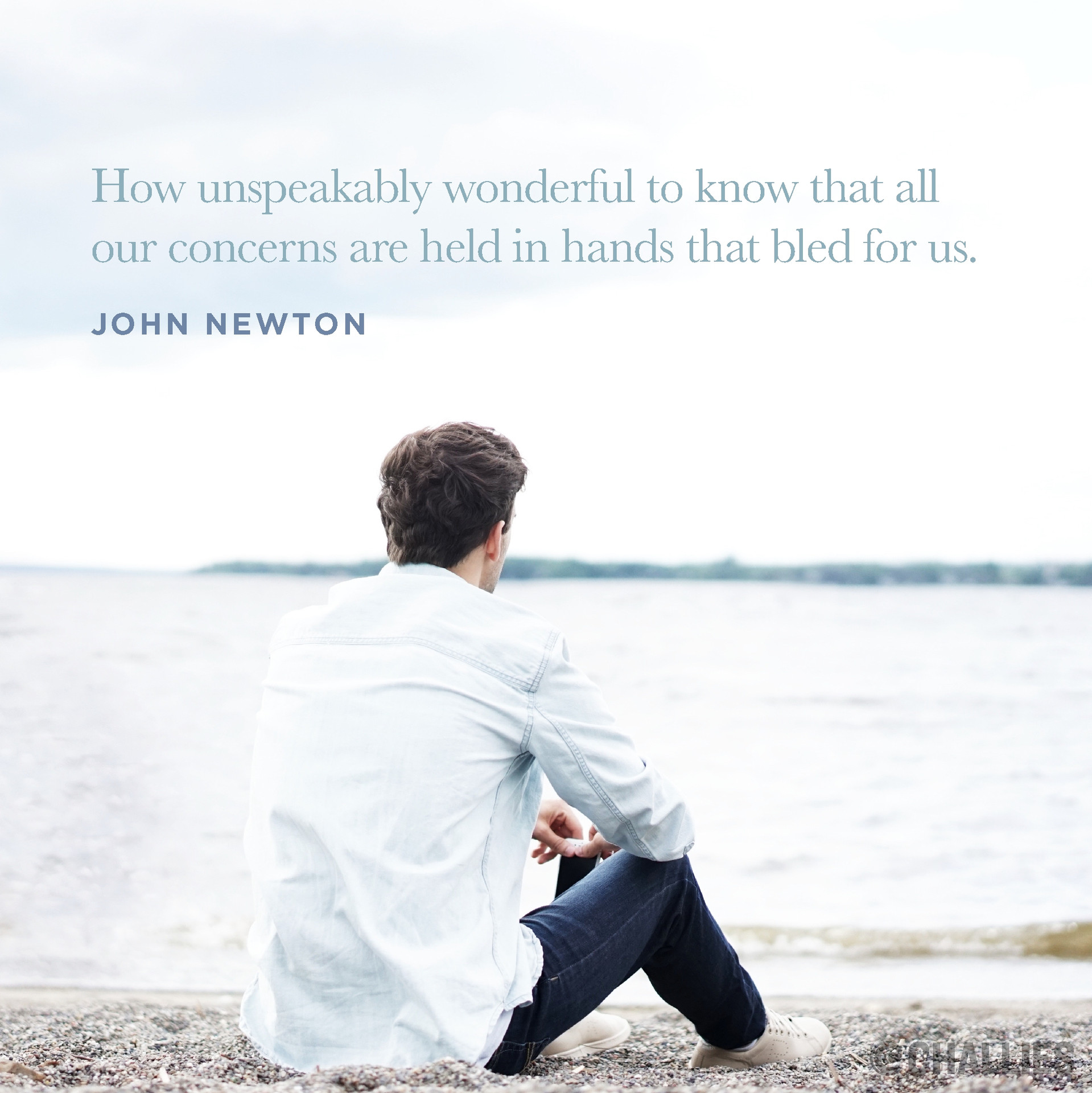
How unspeakably wonderful to know that all our concerns are held in hands that bled for us.
—John Newton