Good morning from Brandon, Manitoba, where I am leading a marriage seminar. I trust you are enjoying your weekend as much as I am, and hope today’s links and reader recommendations will make your day just a bit brighter.
Sales & Deals
Today’s Kindle deals include a couple of good books that you’ll find well worth a look.
Recommended Reading
There are some today who disparage people like Adoniram Judson for bringing the gospel to foreign lands, as if he was nothing more than a Western colonizer. Yet, as this article from CT points out, you’ll often find people in those nations who continue to honor and appreciate those missionaries.
Whenever diaspora Burmese Christians gathered in Boston, they would drive up to the 18th-century white colonial-style house on 145 Main Street in Malden, Massachusetts, where Baptist missionary Adoniram Judson was born and lived for the first four and a half years of his life. They’d snap a quick picture in the yard and then get back in their cars and drive off.
The house, known as the Old Parsonage, was built in 1725 (after a previous parsonage burned down) and is considered the oldest structure in Malden. It housed the pastors and families of First Church in Malden, before the Congregationalist parish sold the house in 1845 to abolitionist George H. Wilson, who used it as a stop on the Underground Railroad. The American Baptist Foreign Mission Society later purchased the building to put up missionaries on furlough.
Read: A Baptist Brought Jesus to Burma. His Spiritual Descendants Bought His Birthplace.
Freya India has done lots of interesting writing about young women in this modern world. She has an article in First Things that explains why women often do, but ought not, tolerate men’s use of porn.
Young women today have unrealistically high standards. When I speak to conservative young men about dating, this is something I often hear.
There is some truth to this. Online, women often share rules and checklists for future partners. In one viral post, viewed over 28 million times, a woman says that her ideal man is over six feet, earns more than $130,000 a year, has an IQ above 120, and is preferably Ivy League–educated and from old money. Other women won’t tolerate anything less than “princess treatment,” from having Ubers sent to pick them up for first dates to getting their pedicures paid for. Many describe getting “the ick,” a sudden feeling of disgust, after men do anything from tying their shoes to sneezing. No man ever seems good enough.
What that doesn’t mean, though, is that young women shouldn’t have any standards. Some are very important, particularly when it comes to a man’s character. One standard that is valid is not wanting your partner to watch pornography.
Read: Women Should Not Tolerate Porn. (Note: You may need an account or one of your allotment of free articles to read it.)
Stephen Jones has a really interesting article that shows how large corporations have changed their views on culture and religion over the past few years. He also makes the fascinating point that Eastern and Indigenous religions are often not seen as religions at all, but as something more pure and universal.
Much has already been written about the fact that every large company is constantly vying for the pole position on cultural issues. It’s true that every packaged goods company, sports apparel manufacturer or construction firm must have a stated position on the latest political issue du jour. And the strategy is well established by now, companies simply seek to reflect the latest version of the culture back to the culture, lest they be relegated to the position of out of touch. And in fairness to them, it can happen very quickly. Any corporation is at risk of missing a couple of trends and finding themselves targeted by a coordinated campaign to have their brand name blacklisted for failing to adhere to the ever-shifting societal moral purity standards. So companies invest time and resources in shaping a moral persona they wish to project to the world.
Read: The Rise of Corporate Spirituality.
I always enjoy it when a very close reading of a Scripture passage turns up the kind of detail that we tend to overlook. Rebekah found one of those while reading about Jesus and the woman who had been caught in adultery.
Sometimes the thing that catches my eye in the Bible isn’t the famous quote, or the memorable story, or the inspirational promise, or the comforting reminder—although I do appreciate all of those things. Sometimes it’s the odd little phrase that makes me wonder why it’s even there.
I’ll leave it to Rebekah to explain what she found and why it matters.
Read: Jesus and the Woman Caught in Adultery: The Unexpected, Don’t-Miss Detail.
Wyatt Graham goes deep into what Baptists believe, both in an objective sense and in comparison to other Protestant traditions.
When asking the question about what Baptists believe, we might say they believe just about everything other Protestants do. But doing so would be to bypass what makes Baptist thought distinctive. So let me try to define what Baptists believe in common with Protestants, and then point out our distinctives which we can summarize as the doctrines of (1) a believer’s church, (2) believer’s baptism, and, because of the prior two points, (3) a congregation of visible saints in association with one another.
Read: What Baptists Believe.
Trevin Wax has never considered rejecting his Christian faith yet, like most of us, does have the occasional bout of doubt. In this article he explains what continues to draw him back in those moments.
I have a handful of friends in the world of theology and apologetics who have experienced serious and sustained doubts about the existence of God or the truth of the gospel. Some grew up in church, later became skeptical of their childhood faith, and embraced the label “agnostic” or atheist for a time, but were then drawn back to a more robust and intellectually satisfying Christian profession.
I have other apologist-friends who didn’t grow up Christian at all. They started out on the fence about God and only began to wrestle with the big questions of life once they hit their high school or college years.
One benefit these colleagues have in conversation with skeptics is their personal experience. They can address others’ doubts from a place of having lived with those doubts themselves. They’ve been there.
Read: What Draws Me Back: 3 Arguments for the Faith on the Days I Doubt.
Top Content
Here are the links readers clicked the most this week:
- A Worship Leader’s Take on the Caleb Flynn Case
- How a Boeing 737 MAX Survived a Nosedive Traveling at the Speed of Sound
- The Marriage Miracle That Takes Time
- Never to Be Cast Out
- Caleb Flynn and the Deadly Sin of Greed
And here are the articles on my site they read the most:
Reader Recommendations
I like to solicit recommendations for things readers are reading, listening to, watching, eating, or otherwise experiencing. Here’s what you sent along:
Bill is enjoying Dane Ortlund’s new book Finally Home: The Christian Hope of Heaven.
Cathy recommends Dale Ralph Davis’s 2 Kings: The Power and the Fury. “His OT expositions are highly readable and soul stirring. I highly recommend any book by Rev. Davis.” (TC: You can’t go wrong with anything by Davis!)
Jason read Malcolm Guite’s Galahad and the Grail last week and calls it a wonderful book. “The rhythm and rhyme of the ballad’s verses was a refreshing departure from the norm in modern storytelling. The poetic description of the grief and relief of repentance was pure beauty.” (TC: I’m reading and enjoying it as well!)
Mike recommends William Perkins’s A Reformed Catholic, written in 1597 and now modernized. “He does something that no one else in his time did… in this book he speaks of the difference between Reformed Christianity and the Roman Catholic Church by beginning where we agree and working to where we disagree and why.”
Emily recommends inviting people to Bible study. “I host our church’s Ladies Bible Study in our home and have long felt a desire to see my church and my community intersect. This semester I invited three acquaintances in my community to join us, and all three of them have! They were just waiting to be asked.”
Isabel recommends Ordinary People with Extraordinary Lives, “a podcast that features testimonies of salvation stories. You can find it on YouTube or where you listen to your podcast.”
Stephen recommends Maddie Larson’s “It Could Be Worse” (And Other Things I Probably Say Too Much), “a short, encouraging book about the challenges one Christian woman has experienced through adoption, foster care, and chronic health issues, and how her faith has sustained her through them.”
Izzy “baked two loaves of cinnamon babka for the first time about a week ago, and I would highly recommend it over cinnamon rolls! The bread is so much richer and more flavourful, and it pairs nicely with a cup of English Breakfast tea (or coffee) during these cool autumn months.”
Bill recommends Stockholm Syndrome Christianity by John G. West. “I think this is an important book for Christians to read. West contends that the church, in many ways, is identifying with the culture that is holding it captive. He has three sections: Symptoms, Causes, and Cures.”
Tiffany enjoys listening to the A Jane Austen Year podcast “while looking at the accompanying book. The book has more than the podcast covers, but seeing the items the podcast describes has been a delight. It is relaxing and informative!”
Sean says, “If you like solid, consistent, and faithful expository preaching that goes verse-by-verse through entire books of the Bible, I recommend the sermons of Faith Family Church. The preaching pastor, Kyle Shearin, is currently working through the book of Matthew.”
James “was mesmerized by this video from Tom Scott showing how the English Royal Jam makers grow and harvest strawberries!”
Liz recommends Nature Friend, a magazine for families. “It is put out by a Christian family, holds to creationist views and is excellently done. Some of the articles, photos and drawings are submitted by the readers. It’s enjoyed by adults and kids alike!”
Bernard, with Reformation Day approaching, recommends “Post Tenebras Lux,” a look at the various ways light is used as a metaphor in Scripture.
Tim is enjoying music by Sow and Tether, “a church band in northwest Mississippi. Very solid, scriptural, engaging, largely hymn-based or similarly-constructed lyrics. Try ‘What I Deserve,’ ‘Great God Above Beheld Below,’ or their ‘Redeemer Hymnal’ album.”
Andrew has “been listening through the discography of Sam Bowman—very thoughtful with his lyrics and very creative with his music. If you have a spare three hours to listen through, he builds narrative through his album, telling the story of redemption and sanctification.”
Tami recommends the work of the Open Air Mission, for which her husband preaches on the streets of Derby, Nottingham, and Loughborough two to three times a week. It is “one of the most historical street preaching ministries to exist. It was founded in 1853 by a Christian Barrister called John MacGregor in London and it has, over its nearly 200 year history, been supported by none other than Spurgeon (who spoke at their Annual Supporters Day in the 1890s), Lord Shaftesbury, George Muller, amongst many others!”
Flashback
On the Day When God Fails in Just One of His Promises. The God who vanquished Midian with the sound of breaking jars, the God who turned the Assyrians against one another, the God who turned a day of terror into a day of feasting has not become weak, has not become distant, has not become uninterested in the plight of his people.


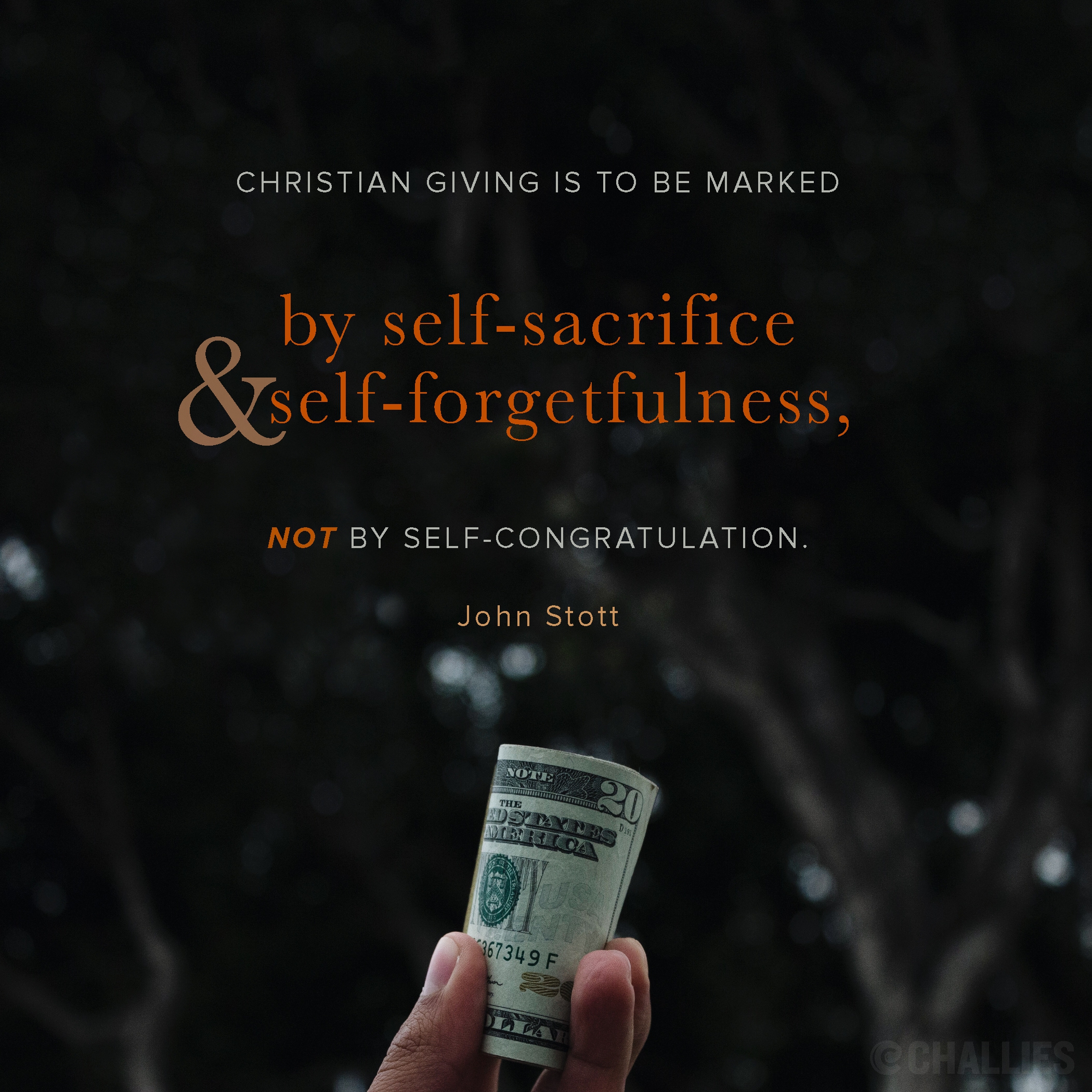
Christian giving is to be marked by self-sacrifice and self-forgetfulness, not by self-congratulation.
—John Stott